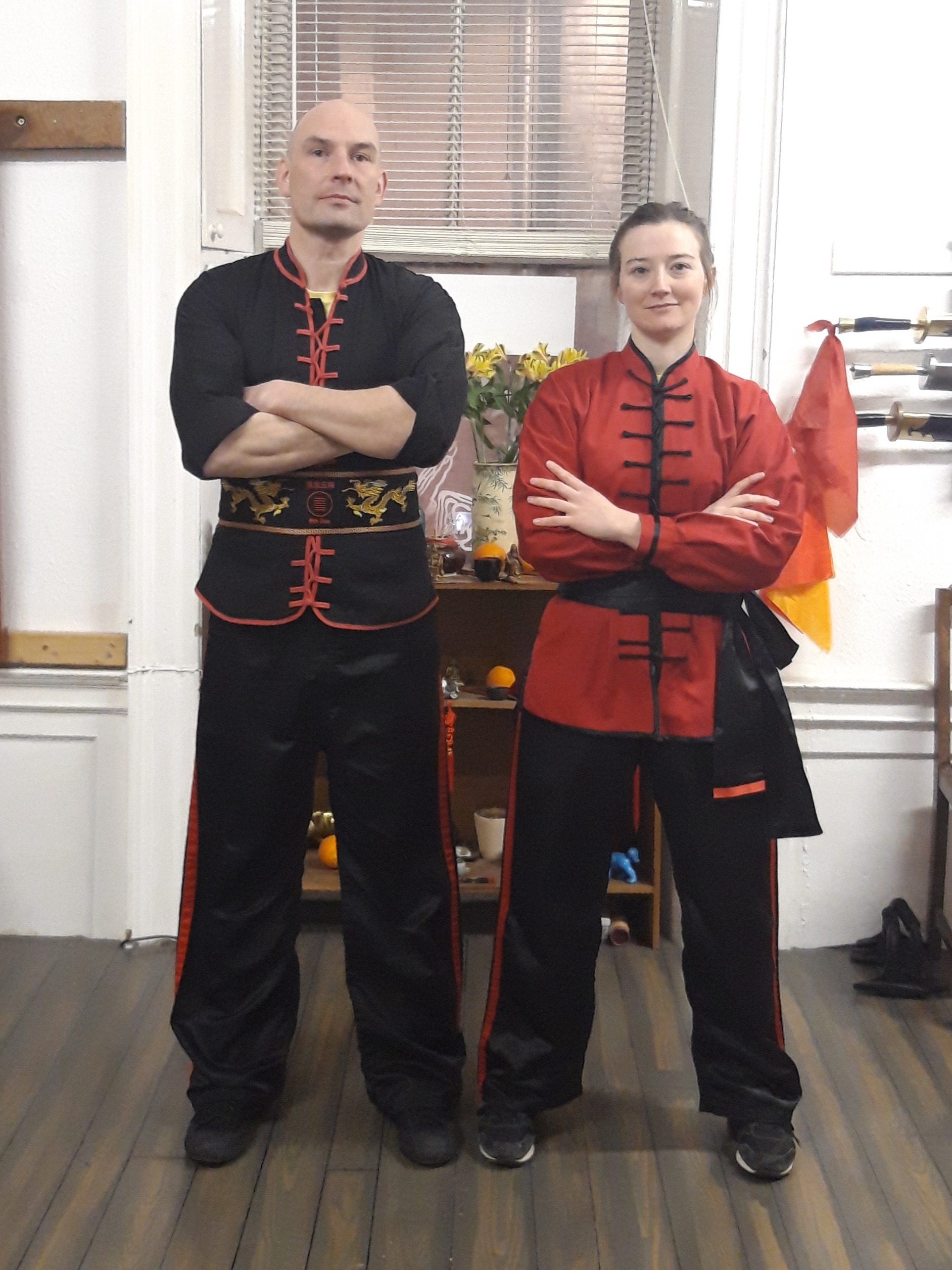
In our Student Spotlight series, our students have the opportunity to tell you about their training in their own words. Emma Archer has been training since 2015, participating in demonstrations and lion dance displays. Due to working life, Emma’s progress has been more gradual than some other students, however she enjoys committing her leisure time to training and gaining a deep appreciation for the style. Emma is currently learning the famous Fu Hok Seung Ying Kuen (Tiger & Crane Double Fist) form for her Yee Cup Junior level (1st test of 2nd level). Here Emma tells you about her experience of training at Yee’s Hung Ga Kung Fu Academy in Inverness.
Sifu Hepple and Emma Archer
What made you want to train in martial arts? Originally, I was inspired by my father who practiced Lau Gar Kung Fu in his teens. He taught me some stances and techniques. These share similarities with Hung Ga. Of course, films starring famous practitioners were also an influence.
How did you hear about the school? There was no Kung Fu school in my hometown, so growing-up I practiced Shotokan Karate off and on for several years. While I did enjoy the training and think it is a great style, something about Kung Fu always appealed to me more. In my 3rd year of University, I desperately needed an alternative focus to my dissertation, and decided that it was time to look into Kung Fu again. Miraculously, there was a school across from my flat (Yee’s Hung Ga Aberdeen at the time); guess it was just meant to be! When I moved to Inverness for work, I knew of the school here and began training under the instruction of Sifu Simon Hepple.
What was your first class like? Just as nerve wracking as my first class in Aberdeen. However, I had met Sifu Simon and some of the Inverness students before at tests and events, and they were very welcoming. Did it live up to your expectations? Exceeded them.
How did you feel after your first class? Pumped with motivation to train again and after a few more classes, felt right at home.
What do you think of your training so far? Is there anything you’d change? Enjoy every minute of it. If I could train all day every day, I would.
What are your hopes for your future in martial arts? Apart from maintaining my own fitness and well-being, eventually I would like to help others on their Hung Ga journey.
Anything else that you wish to add? I have trained at a few branches, and each has a positive and friendly atmosphere. While it is not common for a student to change schools, branch instructors have been very accommodating of my working situation. I feel accepted and enjoy training with everyone. Sifu as well as my Hung Ga brothers and sisters are always encouraging and help to improve my skills. It is also nice when we join other schools for seminars and events. Not to mention our predecessors are very skillful, knowledgeable and approachable. Always an honour to learn from them. Kung Fu truly improves your fitness and self-confidence, which has helped me in other areas of life. Come try Hung Ga and join our awesome family.
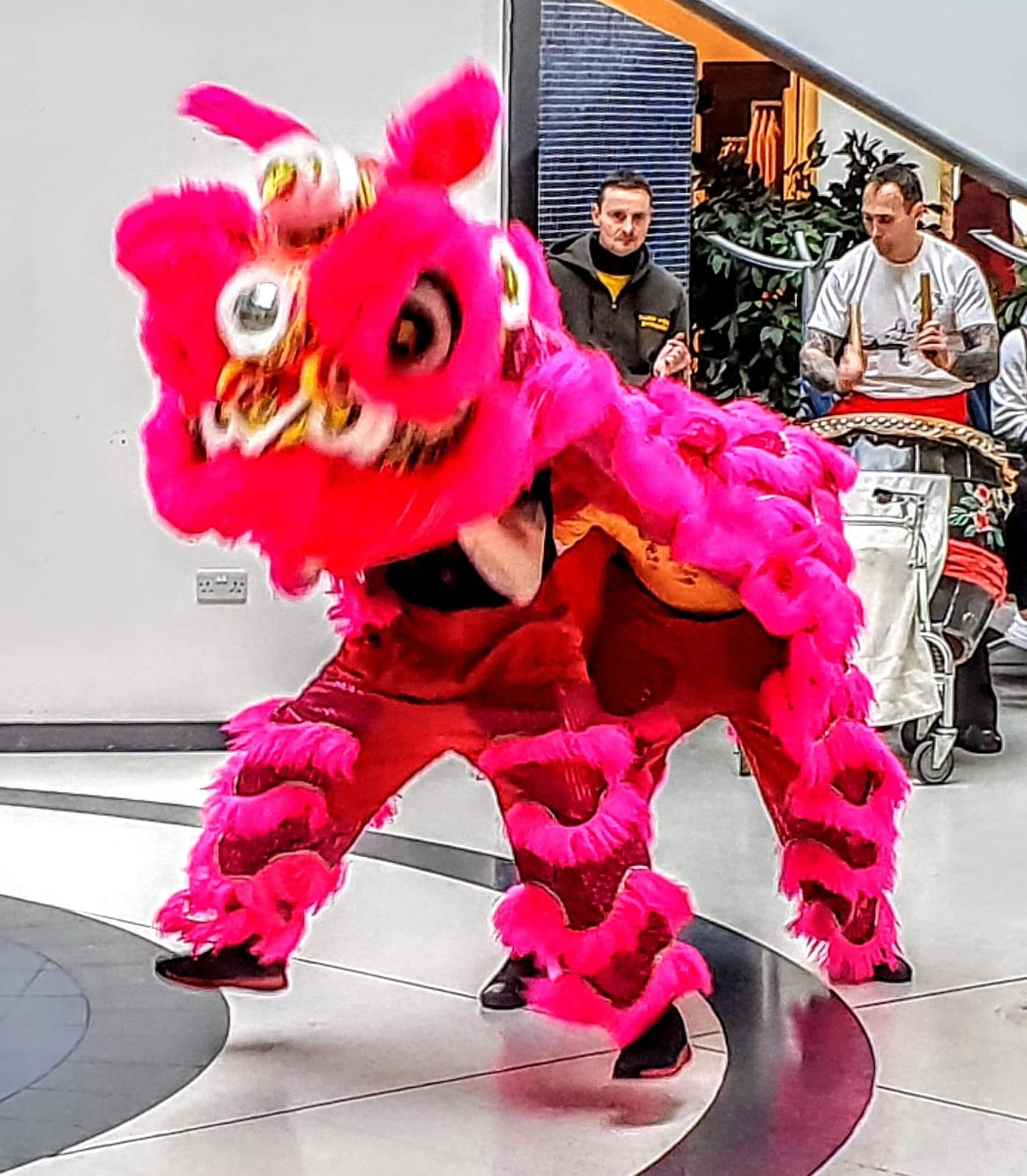
Our Spring Festival/birthday celebrations for Inverness has now been and gone. The dust has, just about, settled and our students have returned to their regular practice routine. We had a real blast with our lion and dragon dance parade and, if you came to see us, we hope that you did too. We performed displays at various locations across the city centre including Jimmy Chung’s Restaurant, The Eastgate Centre, The Victorian Market, Blacks Outdoor Retailers and outside our very own premises on Inverness High Street. We are honoured to have taken part in the blessing of so many stores around Inverness. It was quite a large undertaking but, with the help of our other schools across the North East from Ellon and Peterhead, we were able to complete around 50 blessings. This is sure to clear the city of evil spirits, at least until next year when ‘Nian’ is set to return for the ‘Year of the Ox’. These blessings are traditional “Choi Chang,” blessings. You can read more about them in our article about Chinese Lion Dance. The Spring Festival lasts for about two weeks so there will still be many more celebrations besides our own. You can check out photos and videos of our parade, blessings and performances on our Facebook and Instagram pages. Please feel free to tag us in your own posts, so we can see them all, with the tags #yhginverness #yeeshungga or #invernesscny20 You can also see many other performances and demonstrations from our Lion & Dragon Dance Team throughout the year. You can even book us for your own celebration, wedding or event.
We also have a Facebook Event Page for our 2021 celebrations. Feel free to like and share this to help us spread the word for next year.
Here are a few photos from our Year of the Rat Celebrations on Saturday the 25th of January 2020. 恭喜发财 (Gung Hei Fa Choy)
Chinese New Year Celebrations for the Year of the Rat 2020
Chinese lion dance is a tradition which is at least 1000 years old. It is a fun, colourful way to bring a party atmosphere to any happy occasion. Weddings, festivals, parties, blessings, shop openings and, of course, Chinese New Year. Lion dance is huge in Asia and in many other parts of the world. As with most Chinese traditions, there are many myths, legends, symbology and folklore attached to these practices. We’ll take a look at the significance of the different lions and explore some of the hidden meanings behind them.
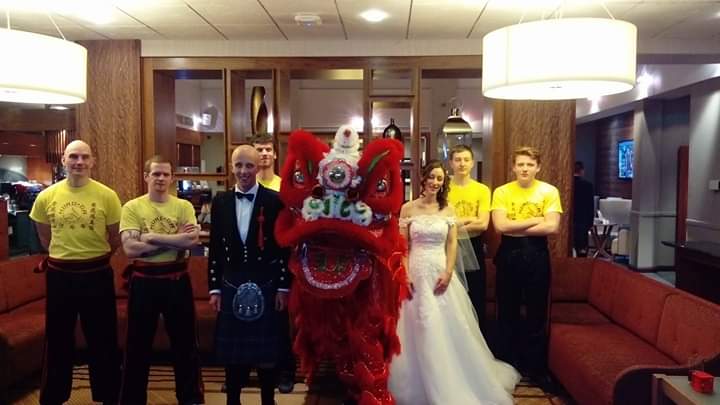
Yee’s North Scotland Lion Dance Team blessing a young couple’s wedding.
Chinese lion dances can be split into two main groups or styles, Northern and Southern. The Northern style is sometimes called Beijing style. It can be very acrobatic. They usually appear in pairs and have long, ruffled, shaggy orange and yellow hair. Dependant on whether the lion is male or female, it will have a red or green bow on the head. Male lions have a red bow and the female has a green one.
Northern lion dance tv spot. Note the coloured bows on the head.
The movements of Northern lions resemble those of a Pekingese or Fu Dog. Stunts and acrobatics such as lifts, jumps, walking on rattan poles, or balancing on giant balls are common. They sometimes appear as a family, with two large “adult” lions and a pair of small “young lions.”
A statue of a ‘fu dog’ guarding a temple, similar to a Northern lion.
Southern lion dance is usually performed as a ceremony or blessing. The ceremonies are performed to bring luck and good fortune. The Southern lions are decorated in many different colours and they have a very uniquely shaped head. There is a mirror on the forehead and a horn above it in the center. The performers animate the lion by flashing the large eyes and flapping the ears. The mouth also opens and closes.
A colourful green lion. Note the mirror on the top.
Southern lion dance is also known as Cantonese style. There are two main groups within the Cantonese style. Fat San (Buddha Mountain) and Hok San (Crane Mountain). There are other groups too, such as Fat-Hok (a fusion of Fat San and Hok San), and the Green Lion (Qingl Shil – popular with the Fukien/Hokkien and Taiwanese).
A selection of southern style lion heads at Yee’s Hung Ga, Inverness
Fat San is common amongst many Kung Fu schools. The movements are very powerful and require considerable strength. The lion represents each individual school and demonstrates a lot of the stances and footwork involved. It also shows how strong the students are. When performing, the most senior students are therefore chosen to represent their school with the lion. It is a great honour for students to be given this privilege.
A famous lion dance scene with a complicated choi chang using Fat San Lions from the film Dreadnaught.
The Hok San style combines a Southern lion head with Northern lion movements. Hok San focuses on life-like, realistic movements, and acrobatic stunts. The tail is shorter on this type of lion. Many lion dance troupes that perform pole (jong) jumping, use this type of lion. You will often see Hok San lion dances using three different coloured lions. A black, a yellow and white lion. The black lion is the youngest of the three. The movements of this lion are performed fast, like a young child with lots of energy. The yellow lion is the middle child, it’s movements are energetic and lively. The white lion is the oldest. You may see many other colours too. A red lion is common at weddings because the colour is considered to be lucky. The red lion also symbolises courage and strength. The green lion, however, represents friendship.
The three coloured Hok San lions. Black, Yellow & White. Performing in front of the Yee’s Hung Ga, Inverness Kung Fu school.
There are also three lions which represent three brothers in arms from the classic, “Romance of the Three Kingdoms.” The characters are Liu Bei, Guan Gong and Zhang Fei. Together they swore a blood oath to restore the Han dynasty. You can read more about Guan Gong and this classical Chinese novel in our article, “Who’s the guy with the big sword thingy!”
Statues of the three sworn brothers who founded Shu Han in the Three Kingdoms Period of China
The Liu Bei lion is the eldest of the three brothers. Yellow is the main colour of his face with a white beard and fur. The imperial yellow colour is significant because it shows that he became the first emperor of the Shu-Han Kingdom. The white beard and fur shows that he was very wise. He has a multicolored tail with a white underside, representing the five elements. He also has three coins on his collar, to show that he is the eldest. The Liu Bei lion is used by kung fu schools or organisations to show that they are well established. He is also known as Rui Shi or ‘Auspicious Lion’.
A Liu Bei lion. Note the yellow colour, white beard & fur and multicoloured tail.
The Guan Gong lion has red as the main colour of his face and a long black beard. His tail is red and black coloured with a white underside and white trim. He has two coins in his collar and is referred to as the second brother. He is also known as Xing Shi meaning ‘Awakened Lion’.
Guan Gong lion with red face, long black beard and red and black tail.
The Zhang Feilion has a black coloured face with a short black beard. His tail is black and white, also with a white underside and white trim. He has bells attached to his body too. He has a single coin on his collar, showing that he is the youngest brother. This Lion is known as Dou Shi or ‘Fighting Lion’. This is because Zhang Fei had a short temper and liked fighting. Kung fu schools that are just starting out or those wanting to make a challenge might use Zhang Fei.
A Zhang Fei lion with a black & white tail, black face and black beard
Choi chang
Choi chang is a Chinese New Year tradition. Shopkeepers, restaurants and business owners attach a red envelope filled with money to a lettuce and hang it above the doorway of their premises. Kung fu schools visit the premises with their lions and perform the choi chang. The lions approach the lettuce inquisitively, with cat-like movements. They will jump up and eat the lettuce, keeping the money, and spitting out the chewed up lettuce leaves around the doorway. This brings good luck to the store during the forthcoming year. “Choi chang,” literally means picking the greens. It is seen as especially auspicious for the lettuce leaves to land on you. Sweeping the lettuce leaves up however, rather than picking them up, is seen as sweeping away the good luck and therefore unlucky.
‘picking the green’
Sometimes the lettuce is hung quite high, 15 to 20 feet. The prize in the envelopes of these lettuces can be quite considerable. Only the most skilled martial artists are able to obtain these lettuces, whilst dancing with a heavy lion head and in front of a watchful crowd. The higher the lettuce, the bigger the challenge and the greater the reward, in the red envelopes and from the crowd. Kung fu schools gain notoriety through this practice and therefore more students too.
Our lion performing the choi chang in Jimmy Chungs restaurant during a Chinese New Year celebration.
Many kung fu schools would take part in the choi chang. Occasionally more than one school might approach the same lettuce. If this is the case, the lions must fight a duel to decide a winner. The battle that takes place is not a street fighting brawl but one that uses the lion’s movements to impress the crowd. The greater the style and finesse from the performers, the greater the audience’s praise. The lions with the highest praise and cheers wins the right to complete the choi chang. The reputation of the schools are at stake during these duels so the performers must act with the highest respect and decorum.
Some famous faces in this clip demonstrate some lion dance etiquette & a battle between rival schools. From the film Martial Club
There are other types of challenges that a lion dance troupe may be confronted with instead of lettuces. Pineapples, bananas, oranges, pots, benches etc have all been used as barriers for the lion to overcome.
A lion dance performances using many obstacles for the lions to overcome. From the film The Young Master
Our own new year celebrations in Inverness will begin on Saturday the 25th of January 2020. We start out at Jimmy Chungs restaurant at 1pm, then on to the Eastgate Centre for about 2pm. We then proceed to the Victorian Market for 4.30pm and finally back to Jimmy Chungs for about 5.30pm for a final dance and some food. We would love for you to come and enjoy our celebration so that we may continue to honour this wonderful festive experience year after year. As always, we value your feedback so don’t forget to tag us in your photos #yhginverness#invernesscny20. You can also email us and let us know what you thought.
Chinese New Year is celebrated by more than 20% of the world’s population. It’s the most important holiday across China and most of Asia. There are lots of festivities from people, businesses and organisations all over the world. Yee’s Hung Ga are no exception, we have organised a free Chinese New Year Celebration for Inverness, performing lion dance displays, parades and demonstrations. You can find a link to our Facebook Event Page here:
If you would like to get involved, promote your business or would like us to perform a lion dance, please email us directly. You can keep up to date with all our displays and demonstrations on our specially created Facebook page:
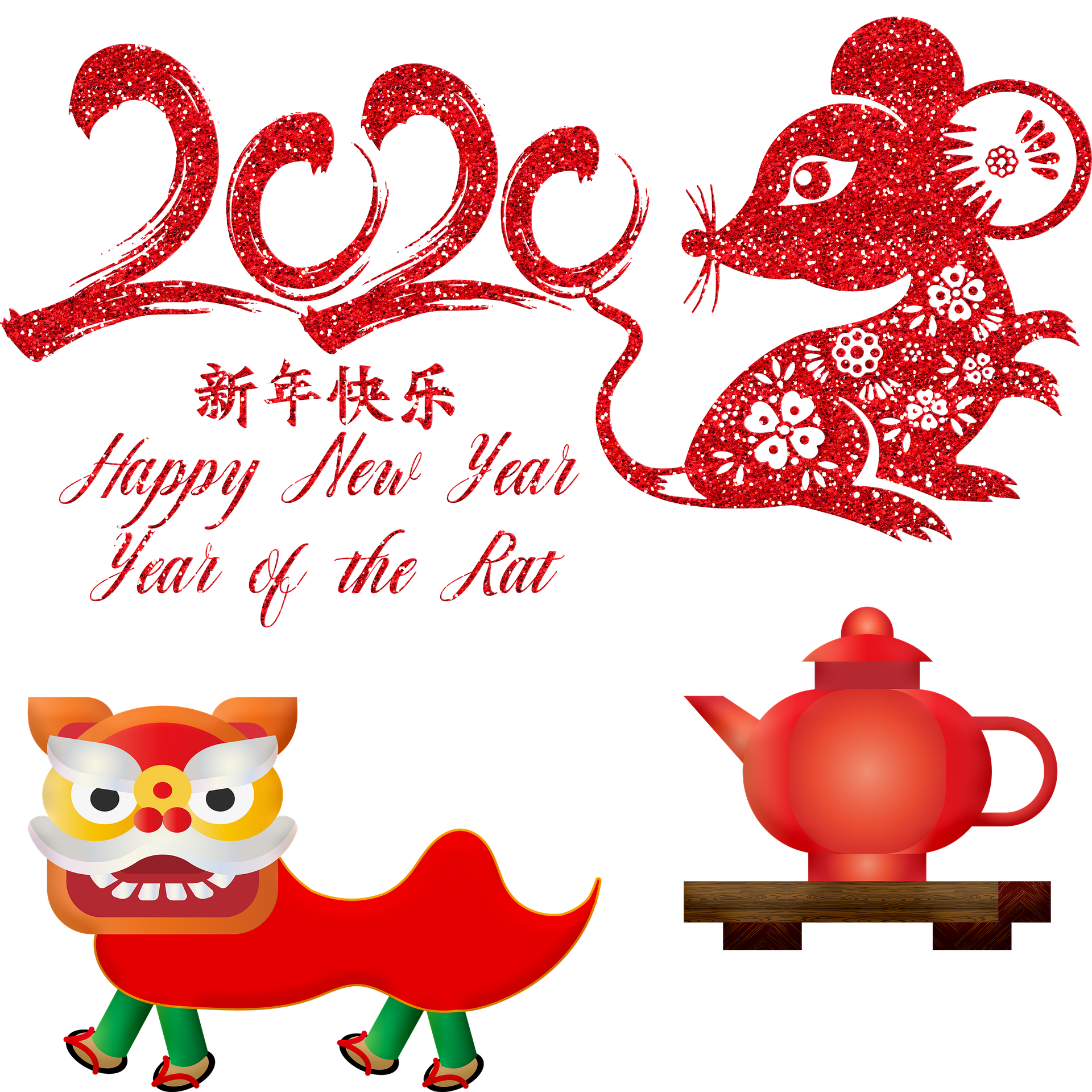
The Chinese New Year of 2020 falls on January 25th (Saturday), and the festival will continue to February 8th, about 2 weeks in total. 2020 will be the Year of the Rat according to the Chinese zodiac. The Rat is the first of all the zodiac animals and represents the beginning of a new cycle. In Chinese culture, rats are seen as a sign of wealth and surplus. Because of their reproduction rate, married couples used to pray to them to bless them with children. People born in the Rat years are likable, charismatic and energetic.
The Year of the Rat
In China, you’ll hear Chinese New Year being called chunjie (春节), or the Spring Festival. It can still be very wintry, but the holiday marks the end of the cold, short days and the beginning of the days getting longer. People welcome spring and all that comes with it: planting and harvests, new beginnings and fresh starts.
Yee’s Hung Ga in New York
At Yee’s Hung Ga, we celebrate with lion and dragon dance parades. Yee’s displays in New York Chinatown are world renowned. Here, in Scotland, our displays gain ever increasing popularity and media coverage. We travel all over the North, performing at galas, highland games, weddings, festivals, special occasions and events throughout the year.
Yee’s Lions performing at Belladrum music Festival
Lion dance displays play an important role in Chinese mythology. They represent joy and happiness and symbolise power, wisdom, and superiority. The lion dance is one of the most important traditions of the Spring Festival. They are performed with the accompaniment of percussion instruments such as drums, cymbals, and gongs, synchronised to the lion dance movements and actions. People traditionally used to perform lion dances to bring luck and to get rid of evil spirits. It is performed nowadays to symbolise prosperity and good luck, for instance at a shop opening, celebration or wedding. It is also a great way to create a festive atmosphere, bringing happy times and good memories.
Yee’s Traditional Lion Dance Blessing at a young couple’s wedding.
There are many legends surrounding the customs and practices of the Spring Festival. According to one such legend, a monster called Nian (年) would appear every New Year’s Eve and terrorise the local people. Everyone would hide away in their homes from the creature. The legend tells of one boy who was brave enough to fight off Nian using firecrackers. The next day, people celebrated their survival by setting off even more firecrackers. That practice has become, forevermore, a crucial part of the Spring Festival.
Nian
In modern times we use firecrackers to make a lot of noise for celebrating and to welcome in the new year. It is customary to stay up on Chinese New Year’s Eve and set off firecrackers at midnight. In the morning, firecrackers are used again to welcome the new year and bring good luck. The most amount of fireworks are set off at this time, more than any other time of the year, anywhere in the world. Due to safety reasons and concerns for air pollution, many Chinese cities have banned fireworks. Over 500 cities also have restrictions in place too. Beijing banned fireworks for 13 years. The ban was lifted in 2006 due to public pressure. If you’re in China during this time, you’ll probably be able to hear and see the explosions for at least 3 nights (and it can go on for weeks).
Defeating Nian with firecrackers
Kung fu schools have kept the traditional lion dance alive over the years. Chinese new year is a big deal for most kung fu schools all over the world over. It is a chance to demonstrate the skills of the students and promote the school, raising awareness and interest. It is a great honour for students to be involved in these celebrations. It demonstrates a high level of commitment to the school and also that their skills are worthy of such displays. It is a great way to showcase the strong stances of the students from the school. Lion dance can be quite hard work. It requires considerable strength to carry and animate the lion heads for any length of time. At Yee’s Hung Ga, these traditions have been passed on to our students so that they may carry it on for future generations to enjoy.
Yee’s Hung Ga Inverness will be 8!
The Spring Festival also coincides, roughly, with our birthday at Yee’s, Inverness. This will be the 8th year that YHGInverness has been open on Inverness High Street. In Chinese culture, the number 8 is regarded as the luckiest number. It’s pronunced ‘Ba’ in Chinese, similar to the word ‘Fa’, which means to be prosperous. It signifies prosperity, success and high social status. We hope that this means it will be a good year for us at Yee’s. 2020 is also the year of the rat. The rat is also particularly auspicious for businesses starting new ventures.
Lions & Dragons
We celebrate our birthday and the Spring Festival together by organising the free Inverness Chinese New Year Celebrations throughout the city centre, performing lion and dragon dance displays. The lions and dragons are often confused with each other. Both dance traditions date back well over a thousand years. Although neither creature existed in ancient China, both are celebrated as mythical, powerful, and auspicious, especially during Chinese New Year and other important events. The main difference between the two is the number of performers. A lion only has two, a head and a tail performer. A dragon is very long and can have 10 performers operating it. Some of the larger dragon parades can have many many more performers. It also looks like a dragon flying in the air. It is raised up on poles and the performers move the dragon around in spirals, usually above the heads of the audience. The lion performers move around on the ground, using stances based around their style of kung fu.
Robert Burns
It should also be noted that the 25th of January is Rabbie Burns Night. Robert Burns was a famous Scottish poet who was born on this day in 1759. Burns Night, also known as a Burns Supper, is celebrated the world over. Rabbie Burns’s poems are very popular in China and have been ever since they were first published for a magazine in the 1920s.
“Gung Haggis Fat Choy”
“Gung Haggis Fat Choy” is also a thing! It is an event which began in Vancouver, Canada but has since gained popularity in other countries too. The phrase, “Gung Haggis Fat Choy,” is a fusion of Scottish and Chinese words. Haggis, being our national dish and ‘Gung Hei Fat Choy’ is a traditional Cantonese greeting used during Chinese New Year. The event, which began in 1998, is a celebration of both Burns Night and Chinese New Year which includes bagpipes and lion dances. We are certain that there will be plenty of both this year in the Highlands capital. We would love for you to come and enjoy our celebration so that we may continue to celebrate this wonderful festive experience year after year. As always, we value your feedback so don’t forget to tag us in your photos #yhginverness#invernesscny20. You can also email us and let us know what you thought.
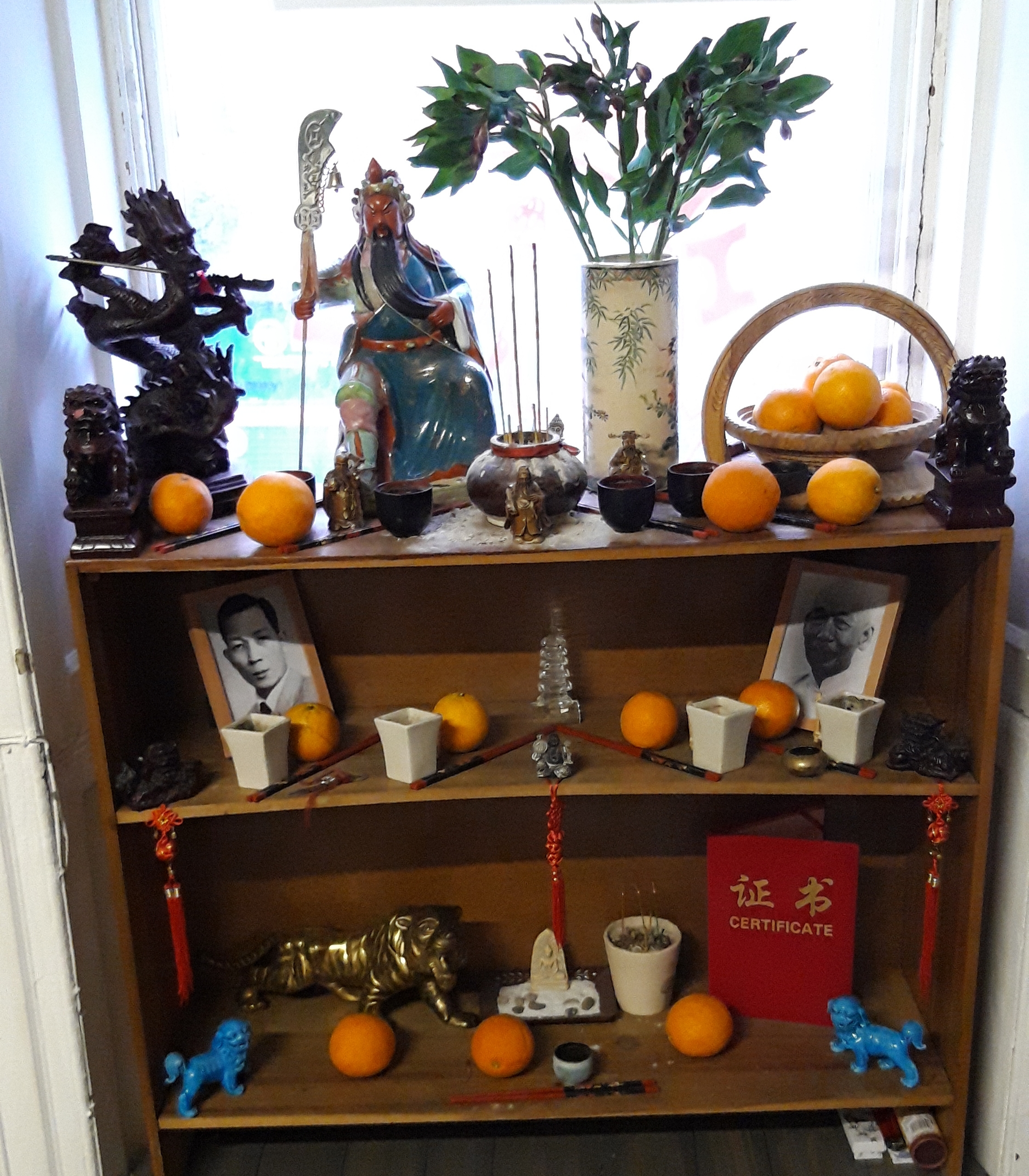
The Sun-Toi is the ancestral altar in the Mo-Kwoon (Kung Fu School). Kung fu martial artists bow to the Sun-Toi when we enter and leave the training space using the traditional ‘sun and moon fist.’ We light incense and place it in censers on the Sun-Toi. On special occasions we pour wine in the cups and put vegetables and/or meat on the Sun-Toi. It can be a small table or it could be the whole side of a wall. They can be ornately carved wooden masterpieces or a simple shelf-style structure.
The Sun-Toi (ancestral altar) at Yee’s Hung Ga, Inverness
Why do we bother? What is the point? Is it religious or specific to Chinese culture or just some bizarre, esoteric kung fu ritual? In this article we’ll answer these questions and address the necessity and value of the Sun-Toi in modern Chinese martial arts schools.
The Sun-Toi serves as a place that we can connect with the previous masters of the Hung Ga lineage. It is somewhere that we can show respect to our ancestors and keep their memory alive. We are thankful for the opportunity to practice an art form which they laid the foundation to. As practitioners, students, teachers and masters, we all hope that we will do our forefathers proud as we steer the art through modern times. We all share the common aim of making Hung Ga Kuen as relevant today, and in the future, as it was in the time of the people who passed it on to us.
The unmistakable figure of General Gwan on the Sun-Toi in Inverness
The Sun-Toi is placed in a prominent position within the Mo-Kwoon, so it is visible as soon as one enters the training space. They are uniquely personal to each individual school. Even in branches of the same school, such as Yee’s, you may find many differences from school to school. Despite there being so many differences, almost every Sun-Toi has a few common items that you may find upon it, regardless of kung fu style. General Gwan (Gwan Di, Gwan Yu) is a frequent figure which you will not only see in traditional Mo-Kwoons but also in police stations, restaurants, casinos, shops and even some family homes. His figure symbolises loyalty, trust, honesty and respect. He was known for his martial arts excellence and loyalty to his sworn brother. His figure is usually placed at the top of the Sun-Toi, to show the greatest respect. The Gwan Dao (The Spring Autumn Great Knife) is a traditional weapon named after General Gwan. Whilst performing with the weapon, there are many gestures which represent General Gwan. For example you may see the practitioner galloping as if he is riding his horse or perhaps composing his long beard in preparation for battle. It is also common to see miniature weapons, such as the Gwan Dao, on a traditional Sun-Toi. You may also see other figurines such as ‘Shishi’ or ‘foo-dogs,’ which guard the physical structure of the kwoon as well as the people who are part of it.
The censer at the foot of General Gwan on top of the Sun-Toi in Inverness
Almost every Sun-Toi will also have at least one incense holder. You may see censers for every level of the Sun-Toi or in front of pictures of the ancestors. Normally the biggest censer is placed in front of the central General Gwan figure. Many of the Hung Ga ancestors are excellent roll models, especially in today’s fast paced lifestyle of excess. They lead heroic, righteous, noble lives. Wong Fei Hung is almost certainly one of the most familiar. Their example has set a very high standard for modern martial artists to follow. Smoke from the incense is meant to cleanse the air of toxins that cannot be seen. It symbolises the connection between the ancestral spirits and our lives in the modern day. By lighting the incense we invite the essence of their positive character to motivate us in the proceedings of the present day. The smoke carries the thoughts, prayers and aspirations of the practitioner to the ancestors, or whomever they may be thinking of. As such, lighting incense can be an art form in itself. Martial artists treat the incense very respectfully and carefully, as if it were the ancestors themselves. The number of incense sticks can vary depending upon the proceedings but a common number is three, or a multiple of three, such as nine. The incense is carefully lit and fanned gently with the hand, rather than blowing or waving the sticks in the air. Two hands are always used to handle the incense and to place it in the censer. It is held above the height of the head as the practitioner bows, as if to elevate it above oneself. All these things are perceived as demonstrating awareness of the present moment, respect for tradition and appreciation of the ancestors endeavours.
Oranges, chopsticks and cups of water in front of photos of our ancestors
Fruit, such as oranges, are often placed on the Sun-Toi along with cups filled with water and also chopsticks. These are seen as symbolic gestures or offerings to pay reverence to the ancestors. The fruit represents the results of the hard work of the school. When you work hard, you gain the fruit of your labour. This is the basic principle of kung fu, to train hard and become good at what you practice, through the practice itself. Symbolically, water represents the cleansing of any wrongs. Many cultures apply the same meaning to water, to wash away sin. Water also benefits the whole world, we could not survive without it. The heart should be like the water, clear and clean. The traditional martial artist aims to be the same in their thoughts and actions. Similar to water, you may also see candles or oil lights. The light drives away the darkness and any pesky evil spirits. It represents the good in everyone. The righteous path that all traditional martial artists attempt to traverse.
Flowers signify the hard work needed to achieve a goal.
During special occasions, such as Chinese New Year; flowers, vegetables, dishes of rice, fish, chicken etc can also be placed on the Sun-Toi as a way to mark the occasion and celebrate the achievements of the Mo-Kwoon. Similar to fruit, flowers on the altar represent the hard work that accomplishes a goal or task. When you work hard your flowers will bloom. They symbolise the hard work itself, rather than the results, which the fruit represents. Wine can also replace water in the cups to signify the happy, cheerful mood of the proceedings. You may also see two chairs on either side of a traditional Sun-Toi. The right hand chair is reserved for the Si-Gung or visiting Sifus of the school. The left hand chair is for the Sifu, or Dai Si-Hing/Jai should the Sifu be away.
The Sun-Toi is not meant to be for religious purposes. As mentioned, they vary quite considerably from school to school. You may find that some schools have religious figures on their Sun-Toi if they have religious roots. For example a Shaolin school may have a figure of the Buddha because Shaolin kung fu originated in a Buddhist temple. There are many components to the Sun-Toi which can still be seen as worthwhile, without being seen as worshipping another faith. The fundamental purpose of the Sun-Toi is to pay respect to the origins and founders of the complete martial art system that we enjoy practicing daily in modern times.
If you enjoyed this post, please give it a like and share on your social media. If you wish to be notified of future articles, like our forthcoming Autumn qigong article, as well as other notices, discounts and events, pop your email address in the box below and we’ll give you a shout when new posts are added. You can also follow our journey on social media. Like and share on Instagram, twitter & Facebook
Processing…
Success! You're on the list.
Whoops! There was an error and we couldn't process your subscription. Please reload the page and try again.
All kung fu schools are very much family oriented. They are set up like a family and try to instil family values to their members. Family names are used to show respect to instructors and other students. At Yee’s Hung Ga we have many branches so it can be difficult to keep track of who is who and what the proper name should be. The following are the family names and meanings that you will commonly hear at a Yee’s Hung Ga school.
English
Cantonese
Male
Female
Door Man or Founder
Jeurng Mun Yahn
Jeurng Mun Yahn
Lineage Holder
Si-Jo
Si-Jo
Great Grandmaster
Si-Tai Gung
Si-Tai-Poa
Grandmaster
Si-Gung
Si-Poa
Senior Kung Fu Uncle
Si-Bahk
Senior Kung Fu Aunt
Si-Guma
Junior Kung Fu Uncle
Si-Sook
Junior Kung Fu Aunt
Si-Guje
Teacher/Instructor
Si-Fu
Si-Fu
Teacher’s Husband/Wife
Si-Jeong
Si-Mo
Most Senior Brother/Sister
Di-Si-Hing
Di-Si-Jeh
Senior Brother/Sister
Si-Hing
Si-Jeh
Junior Brother/Sister
Si-Dai
Si-Mui
Student
Toh-Dai
Toh-Dai
If you are a student at Yee’s Hung Ga in Inverness, anyone who has been training longer than you at the school, depending on their gender, you would call Si-Hing or Si-Jeh. Anyone who begins at the school after you would be your Si-Dai or Si-Mui, depending on their gender. They would call you Si-Hing or Si-Jeh. Sifu Hepple would be your Sifu and his wife would be called Si-Mo. Sifu Bruce Clark would be your Si-Gung. Sifu Pedro Cepero Yee and Grandmaster Yee Chee Wai would be known as Si-Tai Gung.
If visiting another local Yee’s school, the students of that school would be your cousins. You would address them just as if they were training brothers or sisters at Inverness, Si-Hing, Si-Jeh if more senior and Si-Dai or Si-Mui if junior. The Sifu of that school would be your uncle. You would call them Si-Bahk or Si-Guma if they were Sifu Hepple’s Si-Hing or Si-Jeh. If they were Sifu Hepple’s Si-Dai or Si-Mui, you would call them Si-Sook or Si-Guje.
Confused?!
This might seem rather complex and difficult to learn but it is important to maintain the traditions of the kung fu school so that we can pass on our heritage for future generations. The important ones to remember are your Sifu and Si-Mo/Si-Jeong. Showing further respect to their teacher, Si-Gung/Si-Poa, and their teacher, Si-Tai Gung/Si-Tai Poa is also expected. Everything else can be worked out and nobody else is likely to take great offence if you call them the wrong name. If you are unsure, it is always best to ask, just like anything else that you may be uncertain of.
It is also worth noting that a senior uncle/aunt/brother or sister are senior only by the length of time practicing and not necessarily of a higher rank. Your Si-Hing is, and always will be, your Si-Hing. Just as an older brother can never be demoted to a younger brother, no matter how much you may wish for it to happen.
Other important terms that you may hear is the Kwoon or Kung Fu School itself. We shall look at the etiquette within and around the Kwoon in a future post. Suffice to say though, that it is important to remain respectful and uphold composure whilst in and around the Kwoon. Inside the Kwoon is the Sun-Toi or ancestral altar. We will also discuss this in a future post too. To show respect to the ancestors, who have passed down our art from generation to generation, we bow to the Sun-Toi. We use the traditional ‘sun and moon fist’ to bow to the ancestors, whilst entering and leaving the main training area. You may also hear your Sifu or instructor counting punches or kicks etc in Cantonese. The following table will help you to learn numbers 1 to 10:
English
Cantonese
One
Yat
Two
Yee
Three
Saam
Four
Sai
Five
Ng
Six
Luk
Seven
Chat
Eight
Baat
Nine
Gau
Ten
Sahp
Perhaps you have heard a term that you are unsure of that is not listed here. Please feel free to let us know and we can discuss. If you enjoy our posts and wish to be notified of further posts, notices, discounts and events, pop your email address in the box below and we’ll give you a shout when new posts are added. You can also like and share on Instagram & Facebook
Processing…
Success! You're on the list.
Whoops! There was an error and we couldn't process your subscription. Please reload the page and try again.
The Shaolin Monastery, or Shaolin Temple, is a Buddhist temple in Dengfeng County, Henan Province, China. The name ‘Shaolin’ refers to the location of the temple. It is situated in the forests of Shaoshi mountain, one of the seven peaks of the Song mountains. It literally means “Temple of Shao[shi Mountain] Forest”.
Ariel views of the Shaolin Temple.
The Shaolin Temple is known, not only as the birthplace of Chan, or “Zen,” Buddhism, in China, but also where kung fu martial arts originated. The temple is steeped in myths and legends. (More about these in future posts) Shaolin became a renowned centre for extremely powerful martial arts. As the teachings of Shaolin grew, other Shaolin monasteries appeared across China. From a Southern monastery came the lineage of the Abbot Gee Sim Sim See. He is recognised as the first person to bring Shaolin martial arts out of the temple and to the people of Southern China.
Gee Sim taught five founding fathers of “Southern Shaolin.” The five families of martial arts from the Gee Sim lineage became Hung Ga, Choy Ga, Mok Ga, Lau Ga and Li Ga. The “Ga,” or sometimes “Gar,” means family, in this case the Hung family. The founding father of the Hung family was Hung Hei Guen and therefore it is named after him.
Donnie Yen plays Hung Hei Guen in the 1994 TV series, “The Kung Fu Master”
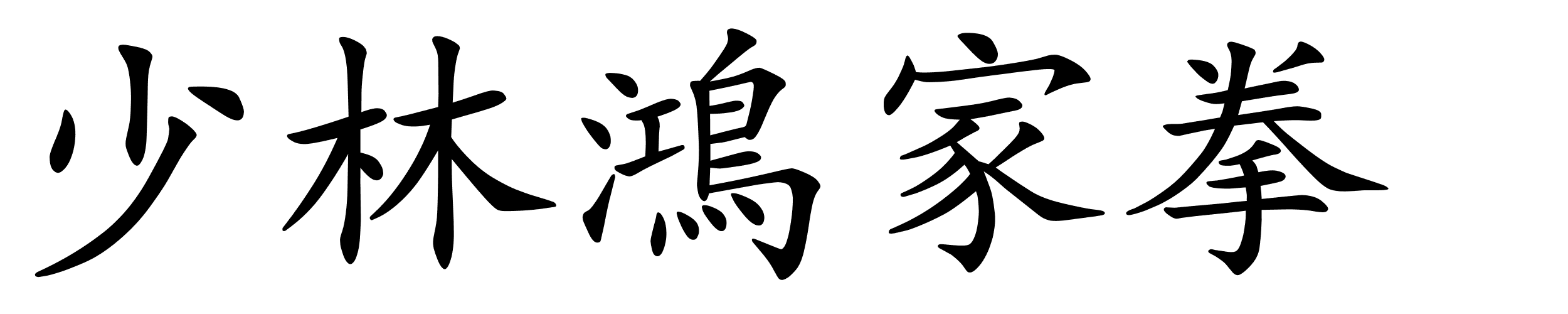
“Kuen” means fist, but in this case “fist” refers to the art or system of fighting, not just the hand shape. Therefore “Shaolin Hung Ga Kuen,” means, “The fighting art of the Hung family from the temple in the forest of Shaoshi Mountain.”
In general terms, the Hung Ga art is renowned for very strong, rooted stances and extremely powerful arm movements. Training concentrates heavily on stance work, body and arm conditioning, qigong, and practicing the forms or set routines. Yee’s Hung Ga run classes for you to specifically train each of these key areas. The forms are a way of practicing fighting techniques as well as a tool for developing a strong mind and body. One of the most famous forms in the world is the Tiger Crane Double Fist (Fu Hok Seung Ying Kuen). This form is at the core of the entire Hung Ga art.
A montage of Hung Ga Kuen, as portrayed in the movies.
If you have a question that you would like to ask us, why not send us an email or get in touch via our social media? Just search for YHGInverness.
If you like our blog posts, you can also sign up for notifications of further posts, notices, discounts and events, pop your email address in the box below and we’ll give you a shout when new posts are added. You can also like and share on Instagram, twitter & Facebook
Processing…
Success! You're on the list.
Whoops! There was an error and we couldn't process your subscription. Please reload the page and try again.