Posted on 2 Comments

Lion Dance

Chinese lion dance is a tradition which is at least 1000 years old. It is a fun, colourful way to bring a party atmosphere to any happy occasion. Weddings, festivals, parties, blessings, shop openings and, of course, Chinese New Year. Lion dance is huge in Asia and in many other parts of the world. As with most Chinese traditions, there are many myths, legends, symbology and folklore attached to these practices. We’ll take a look at the significance of the different lions and explore some of the hidden meanings behind them.

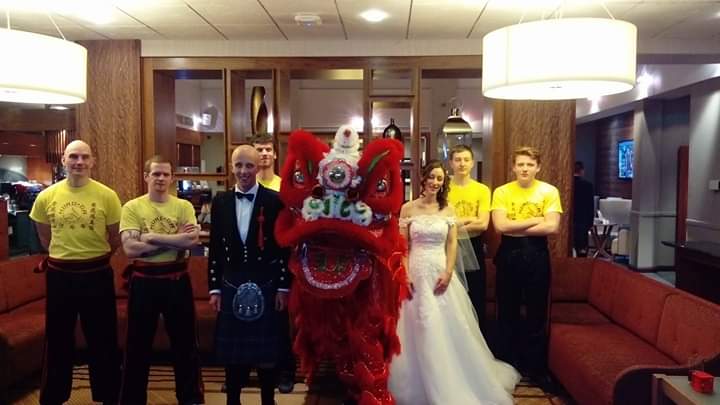
Yee’s North Scotland Lion Dance Team blessing a young couple’s wedding.

Chinese lion dances can be split into two main groups or styles, Northern and Southern. The Northern style is sometimes called Beijing style. It can be very acrobatic. They usually appear in pairs and have long, ruffled, shaggy orange and yellow hair. Dependant on whether the lion is male or female, it will have a red or green bow on the head. Male lions have a red bow and the female has a green one.

Northern lion dance tv spot. Note the coloured bows on the head.

The movements of Northern lions resemble those of a Pekingese or Fu Dog. Stunts and acrobatics such as lifts, jumps, walking on rattan poles, or balancing on giant balls are common. They sometimes appear as a family, with two large “adult” lions and a pair of small “young lions.”

A statue of a ‘fu dog’ guarding a temple, similar to a Northern lion.

Southern lion dance is usually performed as a ceremony or blessing. The ceremonies are performed to bring luck and good fortune. The Southern lions are decorated in many different colours and they have a very uniquely shaped head. There is a mirror on the forehead and a horn above it in the center. The performers animate the lion by flashing the large eyes and flapping the ears. The mouth also opens and closes.

A colourful green lion. Note the mirror on the top.

Southern lion dance is also known as Cantonese style. There are two main groups within the Cantonese style. Fat San (Buddha Mountain) and Hok San (Crane Mountain). There are other groups too, such as Fat-Hok (a fusion of Fat San and Hok San), and the Green Lion (Qingl Shil – popular with the Fukien/Hokkien and Taiwanese).

A selection of southern style lion heads at Yee’s Hung Ga, Inverness

Fat San is common amongst many Kung Fu schools. The movements are very powerful and require considerable strength. The lion represents each individual school and demonstrates a lot of the stances and footwork involved. It also shows how strong the students are. When performing, the most senior students are therefore chosen to represent their school with the lion. It is a great honour for students to be given this privilege.

A famous lion dance scene with a complicated choi chang using Fat San Lions from the film Dreadnaught.

The Hok San style combines a Southern lion head with Northern lion movements. Hok San focuses on life-like, realistic movements, and acrobatic stunts. The tail is shorter on this type of lion. Many lion dance troupes that perform pole (jong) jumping, use this type of lion. You will often see Hok San lion dances using three different coloured lions. A black, a yellow and white lion. The black lion is the youngest of the three. The movements of this lion are performed fast, like a young child with lots of energy. The yellow lion is the middle child, it’s movements are energetic and lively. The white lion is the oldest. You may see many other colours too. A red lion is common at weddings because the colour is considered to be lucky. The red lion also symbolises courage and strength. The green lion, however, represents friendship.

The three coloured Hok San lions. Black, Yellow & White. Performing in front of the Yee’s Hung Ga, Inverness Kung Fu school.

There are also three lions which represent three brothers in arms from the classic, “Romance of the Three Kingdoms.” The characters are Liu Bei, Guan Gong and Zhang Fei. Together they swore a blood oath to restore the Han dynasty. You can read more about Guan Gong and this classical Chinese novel in our article, “Who’s the guy with the big sword thingy!”

Statues of the three sworn brothers who founded Shu Han in the Three Kingdoms Period of China

The Liu Bei lion is the eldest of the three brothers. Yellow is the main colour of his face with a white beard and fur. The imperial yellow colour is significant because it shows that he became the first emperor of the Shu-Han Kingdom. The white beard and fur shows that he was very wise. He has a multicolored tail with a white underside, representing the five elements. He also has three coins on his collar, to show that he is the eldest. The Liu Bei lion is used by kung fu schools or organisations to show that they are well established. He is also known as Rui Shi or ‘Auspicious Lion’.

A Liu Bei lion. Note the yellow colour, white beard & fur and multicoloured tail.

The Guan Gong lion has red as the main colour of his face and a long black beard. His tail is red and black coloured with a white underside and white trim. He has two coins in his collar and is referred to as the second brother. He is also known as Xing Shi meaning ‘Awakened Lion’.

Guan Gong lion with red face, long black beard and red and black tail.

The Zhang Fei lion has a black coloured face with a short black beard. His tail is black and white, also with a white underside and white trim. He has bells attached to his body too. He has a single coin on his collar, showing that he is the youngest brother. This Lion is known as Dou Shi or ‘Fighting Lion’. This is because Zhang Fei had a short temper and liked fighting. Kung fu schools that are just starting out or those wanting to make a challenge might use Zhang Fei.

A Zhang Fei lion with a black & white tail, black face and black beard

Choi chang

Choi chang is a Chinese New Year tradition. Shopkeepers, restaurants and business owners attach a red envelope filled with money to a lettuce and hang it above the doorway of their premises. Kung fu schools visit the premises with their lions and perform the choi chang. The lions approach the lettuce inquisitively, with cat-like movements. They will jump up and eat the lettuce, keeping the money, and spitting out the chewed up lettuce leaves around the doorway. This brings good luck to the store during the forthcoming year. “Choi chang,” literally means picking the greens. It is seen as especially auspicious for the lettuce leaves to land on you. Sweeping the lettuce leaves up however, rather than picking them up, is seen as sweeping away the good luck and therefore unlucky.

‘picking the green’

Sometimes the lettuce is hung quite high, 15 to 20 feet. The prize in the envelopes of these lettuces can be quite considerable. Only the most skilled martial artists are able to obtain these lettuces, whilst dancing with a heavy lion head and in front of a watchful crowd. The higher the lettuce, the bigger the challenge and the greater the reward, in the red envelopes and from the crowd. Kung fu schools gain notoriety through this practice and therefore more students too.

Our lion performing the choi chang in Jimmy Chungs restaurant during a Chinese New Year celebration.

Many kung fu schools would take part in the choi chang. Occasionally more than one school might approach the same lettuce. If this is the case, the lions must fight a duel to decide a winner. The battle that takes place is not a street fighting brawl but one that uses the lion’s movements to impress the crowd. The greater the style and finesse from the performers, the greater the audience’s praise. The lions with the highest praise and cheers wins the right to complete the choi chang. The reputation of the schools are at stake during these duels so the performers must act with the highest respect and decorum.

Some famous faces in this clip demonstrate some lion dance etiquette & a battle between rival schools. From the film Martial Club

There are other types of challenges that a lion dance troupe may be confronted with instead of lettuces. Pineapples, bananas, oranges, pots, benches etc have all been used as barriers for the lion to overcome.

A lion dance performances using many obstacles for the lions to overcome. From the film The Young Master

Our own new year celebrations in Inverness will begin on Saturday the 25th of January 2020. We start out at Jimmy Chungs restaurant at 1pm, then on to the Eastgate Centre for about 2pm. We then proceed to the Victorian Market for 4.30pm and finally back to Jimmy Chungs for about 5.30pm for a final dance and some food. We would love for you to come and enjoy our celebration so that we may continue to honour this wonderful festive experience year after year. As always, we value your feedback so don’t forget to tag us in your photos #yhginverness #invernesscny20. You can also email us and let us know what you thought.

Posted on 1 Comment

The Horse Stance

The Horse stance, feared by some, celebrated by others! What is it, what’s the point? Let’s take a look…

Jackie Chan in Drunken Master

The horse stance (Ma Bu in Chinese), also known as the Four Point Great Stance (Sai Ping Dai Ma). It is not unique to Hung Ga, by any means, however it is of particular importance to practitioners of the Hung style. It is a basic stance for training the foundation. The foundation is the fundamental elements that support the three pillars. The fundamental elements being the strong body, including the bones, muscles ligaments, fascia and tendons. Ma Bu lowers the centre of gravity which helps the practitioner have a stable base. Practicing Ma Bu improves the structure of the body and the body’s alignment. Holding the stance can increase the stamina and determination of the practitioner, far beyond what they ever thought possible. With the correct posture, one can then focus on the breath. Having a regulated slow, deep breathing cycle has many calming benefits. It has been proven to reduce the heart rate and relax the body. With the relaxed, yet stable structure, one can then improve further with the circulation of fluids and the transportation of oxygen to the vital organs and the efficient removal of toxins, improving performance. With regular practice, the body can then heighten its performance further with the circulation of vital energy or Qi. Circulating qi around the body can have a huge benefit to physical, emotional and mental wellbeing, as well as increasing longevity, boosting energy levels and creating a barrier against diseases. This encompasses the three pillars we mentioned earlier. They are the body, the mind and the spirit. The physical body is trained by using the mind to focus and hold the static posture for a period of time. When the mind and body are synchronized in this way, over time, the spirit can elevated to higher levels.

Standing in Ma Bu takes time. It is hard. It is not the kind of practice for someone who is looking for quick results. At Yee’s, students train Ma Bu, it is a requirement for their gradings. As students advance through the system to higher levels, they must have a bigger and bigger foundation. They therefore need to train Ma Bu for longer periods of time. This is not just to pass a test but also to build the three pillars and to protect themselves from harm. This can be the downfall for many students who neglect to train Ma Bu. As students progress through he Hung Ga system, they learn more and more forms and techniques. Training Ma Bu often takes a back seat in favour of the other types of training. It can often be overlooked as it is so simple. Because it is simple, that doesn’t mean that it is easy. In fact it can be very difficult to maintain the stance for a long period of time. This is the nature of kung fu however, hard work and perseverance to achieve results. In today’s fast paced world, there are a select few people who wish to take this path. Most people try to take shortcuts or look for easier methods. For many practitioners the Ma Bu is a love/hate relationship. To succeed, you must enjoy the challenge and you must persevere through hardship.

Gordon Liu as Pai Mei in Kill Bill: Vol. 2

Are you ready to step up to the challenge? Think you can master the Ma Bu? Do you want to rise to the levels of previous kung fu masters throughout history? Good. Let your training begin….

• Stand with your feet together. Hands by your sides.

• Lift your arms up in front of you, palms up, and take a nice deep breath.

• Once you have breathed in, make fists and place them at the chamber (the groove above the hip and below the bottom rib) as you breathe out.

• Pivot on your heels and turn your toes out at an angle, creating a V shape. Pivot on the ball of the feet and turn the heels out. Pivot on the heels again to turn the toes outwards and then once more so that the toes are now pointing forward. Your feet should be fairly wide apart. Roughly the length of your lower leg.

Horse stance feet placement.

• Next, bend the knees and ‘sit’. Push your knees out so that they are above the feet. Keep your back straight and head up, with your fists in the chamber, elbows squeezed towards each other. The thighs should be almost parallel with the ground, at a slight angle. You can use a mirror to check your posture.

• Focus on your breathing. Place your tongue on the roof of your mouth and breathe through the nose. Take long, slow, deep breathes. Aim for 4-5 complete breathes in and out per minute.

• Great job. You’re now in the Ma Bu. You are practising an art which every Hung Ga master before you has also practiced, for centuries.

• Comfortable?

• Time how long you can maintain this stance for, without getting up. Every time you practice, try to beat your best time, even if it’s just a few seconds.

Sifu Hepple demonstrating the Ma Bu

How did you get on? How long did you manage before you had to get up? Let us know in the comments below. Send us an email or give us a tinkle on our social media channels.

Facebook

Instagram

Twitter

If you like this article and would like to see more, subscribe to our email list below.

Processing…
Success! You're on the list.
Posted on

Do you have belts?


A common question asked about Yee’s Hung Ga is, “Do you have a grading system or belts, like in other martial arts?”

Coloured martial arts belts

There are many martial arts which have a grading system. As the student passes through the different grades and attains a higher level of skill, they also obtain a different coloured belt to show the practitioner’s rank within the system. Normally a white belt is given to a novice and a black belt is given to a proficient or skilled practitioner. It is said that originally all novices started off with a white belt and over the years of training the white colour turned to a dark grey/black, which is where the coveted black belt stems from. All the colours in between have been added in recent years, varying in degrees of brightness, from white to black (i.e. yellow, orange, red, purple, brown etc) to portray the idea that the student has trained hard enough for the belt to change colour. There are many other martial art systems that don’t have coloured belts but still have gradings. There is also a lot of tradition and etiquette surrounding the different belts of each martial art, for instance how they are tied, which side of the body the knot is tied on, how they are stored and looked after etc. These traditions are usually specific to the individual martial art system.

At Yee’s Hung Ga we have a grading system where student’s skills are tested regularly. The student begins with a black sash and as they pass through the different skill levels, a red stripe is added to the end of the sash to display the student’s rank.There are 3 main levels. Each level has 2 tests, a junior and senior.

1st level (yat cup) sash
1st level (yat cup) sash displays a single stripe to show 1st the rank.
2nd level (Yee Cup) sash
2nd level (yee cup) sash, displays 2 stripes.
3rd level (Saam cup) sash
3rd level (Saam cup) sash displays 3 stripes.

When the student completes all 3 levels, they may then begin their ‘Jo Gow’ (black belt) training. Once the Jo Gow has been attained, a red stripe is attached all around the black sash.

Jo Gow
A Jo Gow (black belt) Sash

Attaining this level is cause for a big celebration. It demonstrates that the student has mastered the basic skills of the Hung Ga system, which is a notoriously difficult level to reach. At the Jo Gow level, a student is considered an Assistant Instructor. To become a full-fledged Instructor (Sifu), 2 years of additional intensive training is required. Training does not end with becoming a Sifu. Sifus must continue their training and testing to progress through the 10 Dan (Levels) if they wish to understand the full depth of the Yee’s Hung Ga art – a feat that requires great dedication, loyalty and passion for the art.

Through these rigid training and testing protocols, Yee’s Hung Ga is able to preserve the highest levels of quality and integrity of the Hung Ga style passed down through its lineage, while simultaneously and uniformly advancing the art itself. Very few martial arts systems go to such lengths to maintain quality instruction.

If you enjoy our posts and wish to be notified of further posts, notices, discounts and events, pop your email address in the box below and we’ll give you a shout when new posts are added. You can also like and share on Instagram, twitter & Facebook

Processing…
Success! You're on the list.
Posted on

Student Spotlight – John Weaver

Sifu Hepple & John Weaver

This is a picture of Sifu Hepple and John Weaver. John has been practicing for 3-4 years now and is currently training towards his Yee Cup Jr (1st test of the 2nd level) Grading. Here John tells, in his own words, of his experience training at Yee’s Hung Ga Academy in Inverness.

What made you want to train in martial arts?

I previously trained in Jujitsu when I was about eight years old. When I reached twenty four, I became very interested in practising meditation, healing arts and focusing (balancing) my mental/physical energies. I read books, became Reiki attuned and watched videos to increase my knowledge on the subject. This led me to learn versions of qi gong, from some new age teachers and other kung fu personalities. I think I was the ripe old age of thirty one before I attempted to do kung fu work out drills; I was completely exhausted and realised I knew nothing of the hard work and discipline that was required to achieve what I wanted. It was then I started looking for a teacher.

How did you hear about this school and why did you want to train there? What were your expectations before you started?

Kung Fu was the obvious choice for me based on my interests. I did a little research on the different styles, and thought about what may suit my body type. I knew already I would prefer something that would be powerful and balanced, but more hand based rather than the flippy-flappy leg kicks. I saw some videos of the Hung style online after finding out that a new had school opened up in Inverness. I contacted Sifu to see if he would accept me as a student, and the rest is history. My expectations were realistic; having tried to keep up with drills on dvds and failed, I was open to whatever lessons Sifu had for me in order to progress.

What was your first class like?

I was slightly nervous and wondered what the other students would be like. At that very first class, I mentioned some of the things I had been doing and Sifu responded “this may be a little different to what you’re used to!” He proceeded to show us Tiger techniques, specifically how to break an opponents arm. After that class, I was aching all over. My legs felt like jelly, and I thought it would be very hard to build up my fitness to an acceptable level to continue. However, I stuck with it and after a further four or five lessons I got used to doing the warm up exercises! It is quite invigorating once you have built up the stamina and I am glad I have continued with my training. My life has changed considerably in the last two years and I now have a young family and a home to maintain. I haven’t had as much time as I would have liked to train recently but as my understanding of Hung Ga grows, so does my desire to push myself further.

What do you think of your training so far? Is there anything that you would change?

So far I have learnt the full Gung Gi Fuk Fu form and am now learning Fu Hok. I have also learnt about the theory of Hung Ga and some of the additional exercises that can be done to unlock potential skills; fighting and some softer skills like balance, conditioning and strengthening. I have attended seminars in Aberdeen with Grandmaster Yee Chee Wai and our Sifu’s teacher, Si Gung Bruce Clark – both are very well respected Martial Artists. It is hard to start with, but if you try and push through it is very much worth your while. Our Kwoon (school) is very friendly, and Sifu obviously loves Hung Ga; showing us how it becomes a solid foundation in life. I would change nothing about the training given but if I could give advice to other beginners it would be to put three times as much effort in to practising at home, as you do in class. Basic drills, form and practising stances – but also looking at the ways in which Qi Gong and breath exercises can improve your general well-being.

What are your hopes for your future in martial arts?

My hopes for the future are to continue training, and to push myself further. My aim at the moment is to improve my stances, transitions between movements and get more sparring practice to apply what I have learned. I enjoy the traditional Lion Dance practice and would like to do more of that for the school in the coming years.

Anything else that you wish to add?

While studying for the Fuk Fu test, I wrote this down. ‘Kung Fu is something that cannot be bought or stolen; you cannot cheat or make it easier as it is what it is. You get out what you put into it via training – body and mind with a strong spirit.’ I am beginning to understand more on the concept of ‘martial virtue’ and can say that with Kung Fu, actions speak louder than words – so come join us.

If you enjoy our posts and wish to be notified of further posts, notices, discounts and events, pop your email address in the box below and we’ll give you a shout when new posts are added. You can also like and share on Instagram & Facebook

Processing…
Success! You're on the list.
Posted on

Motivation: Hints, Tips & Good Practice

Whether you’re just starting out or you’re a seasoned warrior, it can sometimes feel difficult to keep yourself motivated, especially with the cold weather, dark nights, the hectic partying over the festive period taking its toll on the body. It can be a bit of a slog getting yourself back into a routine and keeping that routine going. If one of your New Years Resolutions is to get fit and healthy, like many other people, you might be thinking about attending one of our classes. If you are serious about taking it past the thinking stage and really want to attend, (obviously we would highly recommend that you do and you would be most welcome.) what steps can you take to ensure that your first class isn’t also your last? What if even your best intentions aren’t good enough and you run out of steam before you even get up and running? Well we’re not going to lie to you, there’s no magic wand. You still have to actually make it to class (on time!) and you still have to do the work but here’s our top 10 hints & tips on keeping yourself keeping going.

#1. Patience

It takes time, don’t be put off if you don’t see results straight away. Looks can be deceiving. You may not see results for a while, especially if you are just starting out. It takes time to learn and to build muscle memory. You may hear claims that you can be a master in a short time, “Learn Kung Fu in 3 Months,” “Become a master in only 2 weeks.” There are some things that you can learn and use straight away but to be a master you first need to learn and that can take time, patience and lots of practice.

Just because you’re not seeing results it doesn’t mean that you are not getting any. You are better today than you were yesterday, try to remember that. Your brain will get better at sending messages to your body and your body will get better at receiving and understanding them. You will actually be able to activate a higher percentage of your muscle fibers, commonly referred to as neuromuscular efficiency. Your coordination will improve, reflexes start to become faster, your breathing and focus will increase. It is a slow process because you are bound by your body’s limitations, just be patient. Don’t look in the mirror after two weeks and wonder why you’re not looking like Bruce Lee or why you’re not managing to quite get the results that you are looking for. Be patient and put in the work, the results will come.

#2. Enjoy the journey.

Try not to think of your goals as the soul purpose for training, that’s just a destination. Enjoy the process and get excited about what you are learning. If you enjoy what you are doing you are more likely to keep it up. Get excited. You have to want to do it. If you force yourself, it could have negative results. Instead of looking negatively at things that you are not so good at or find difficult, try and turn your thinking around. Be positive about it and see if you can work at those things, bit by bit, to get better at them. Chip away a little bit every day and they will soon become less of a problem.

#3. Don’t rush!

Arrive early, give yourself time. If you leave things to the last minute it gives your mind one more excuse to back out of it. If you have plenty time and are well prepared then you are less likely to change your mind at the last minute. Make sure you have your kit ready the day before. Write a list of all the things that you need to take with you and make sure you check your list every time you get yourself ready. Plan your trip, where you’re going to park the car, how long will it take you to get there? Allow extra time in case of slow traffic or for events beyond your control. If you think ahead and plan in advance you will put yourself in the right frame of mind and it will give you less excuses to not go through with it.

#4. Are you keeping track?

Keeping records can help you to remember what you have learned. What did you get out of class today? Did you just go through the motions or did you pick something up? Were there any “light-bulb moments?” Keeping a training diary can help you to remember information and focus on learning. It can also help you to look back and see how far you have come in your training. You can also see what went wrong, should you get injured, and learn from any mistakes.

If you can only make it to the occasional class, it is down to you to make the effort to practice between those classes. Your Sifu will give you advice on what and how to practice. If you just practice bits of what you remember, it may be that you are not paying attention to the right things or worse, practicing them the wrong way. You should know it inside out and back to front.

#5. Stick to a plan

Remove the randomness from your training. This is the best way to improve your speed, strength, focus, body weight…. any of your goals in fact. For a beginner it can be tempting to try out all the different classes that are available to you at Yee’s but it is better to pick one or two which you can definitely, regularly make, every week. Stick to them and make them part of your routine. When you feel more confident in what you have learned and you have time available to try out the other classes, then give them a go. Too much, too soon is a recipe for failure.

#6. Do it for yourself.

Do it for yourself, not because of anyone else. Come with friends but don’t stay at home just because they decided that they couldn’t be bothered. Their excuses will turn into your excuses. You must do it because you want to do it for yourself. Similarly, try not to compare yourself to others. Everyone has strengths and weaknesses so whilst you might not be as good as the one you are comparing yourself to, they might not be as good as you at other things. They may also be further ahead in their training or have practiced more or many other reasons. If you practice, you will become better. If you practice a lot, you will become a lot better. Sometimes it takes longer for some people so just relax and enjoy the ride.

#7. Prevention is better than cure.

Be sensible about how you train. An injury can set you back months, perhaps even years. It may stop you training altogether. It is important in the beginning to take things slowly until your body gets used to it. If you push too hard, you can injure yourself. Ensure that your body is warmed up gently and muscles are stretched before you do your main practice. You will have to do this every time and you will have to factor the time it takes into your practice. Similarly, a cool down routine can help to bring your body back to normal. Again gentle stretching can be useful. After your training your muscle fibers will be warmed up and loose. The sudden shock from the cold outside, especially in the North of Scotland, can cause them to constrict. Problems may result from over tension such as muscular cramps and pain, twisting and knotting of the muscle fibers. Be sensible and have an extra layer of clothing to put on before you head out into the cold. Our training hoodies are perfect for this purpose.

#8. If you don’t make time, you’ll never have time.

You need to factor time into your daily routine or weekly schedule. If you don’t have one, make one! Fit it into your lifestyle. It is difficult juggling everything in your life but the bottom line is that if you don’t do it, then you won’t do it. Spare time can seem to be a rarity in modern life and if you really want to do something, you will have to make the effort to make it happen. With kung fu this means making time to practice. In the same way though, if you do nothing but practice then you will not have time for anything or anyone else so you need to find a balance. Make it happen!!

#9. Rise to the challenge!

Treat it like a test. Everything that you find hard is an obstacle to you becoming better and achieving your goals. If you clear the obstacle then you are one step closer. If you don’t quite make it then it’s no big deal, just try again. It may take you many attempts. Many, many, many attempts in fact. This is the challenge that you face. Give up, find an easier way or just keep chipping away until you get it. The nature of kung fu means that you kind of do all 3. You try until you get it, you understand the movement. You then find an economy in the movement, simplify it, make it easy. Then, when you get it, you leave it. It’s there now until you need it. You just need to maintain it. Great skill obtained through hard practice.

#10. Don’t beat yourself up

You’ve all seen the motivational memes on social media, “Failure is not an option!” “Winners never quit!” ” You haven’t failed until you quit trying!”

Jeezzz….. Give yourself a break, we are only human. Circumstances might mean that you have to put things aside for a while. You might have to give yourself some time to focus on other areas of your life. Family, work, friends, commitments. You know what that is? That’s life! (That’s what people say, You’re riding high in April, Shot down in May) It doesn’t mean that you’ve failed. If you falter or can’t remember or didn’t practice or took the day off, it doesn’t matter. Everyone needs a break. In fact it is advisable to take a break every once in a while. “All work and no play makes Jack a very dull boy!” Have you never seen ‘The Shining’ before?!? It only becomes a problem if you let it. You gave it a shot, you turned up for class and you trained really hard. That’s more than a lot of people ever do. A lot of people never get further than giving it a whimsical thought. “Wouldn’t it be amazing to be able to move like that?” “I wish I was as strong or graceful as that?” But you actually made the effort. That is amazing in itself. (a round of applause please!) If you need a breather, that’s not failing, that’s being realistic. Just don’t let it get to you. Get back in the saddle again and own it!! Take your training to the next level and achieve what you set out to do.

See you in class…

If you enjoy our posts and wish to be notified of further posts, notices, discounts and events, pop your email address in the box below and we’ll give you a shout when new posts are added. You can also like and share on Instagram, twitter & Facebook

Processing…
Success! You're on the list.