Posted on 2 Comments

Lion Dance

Chinese lion dance is a tradition which is at least 1000 years old. It is a fun, colourful way to bring a party atmosphere to any happy occasion. Weddings, festivals, parties, blessings, shop openings and, of course, Chinese New Year. Lion dance is huge in Asia and in many other parts of the world. As with most Chinese traditions, there are many myths, legends, symbology and folklore attached to these practices. We’ll take a look at the significance of the different lions and explore some of the hidden meanings behind them.

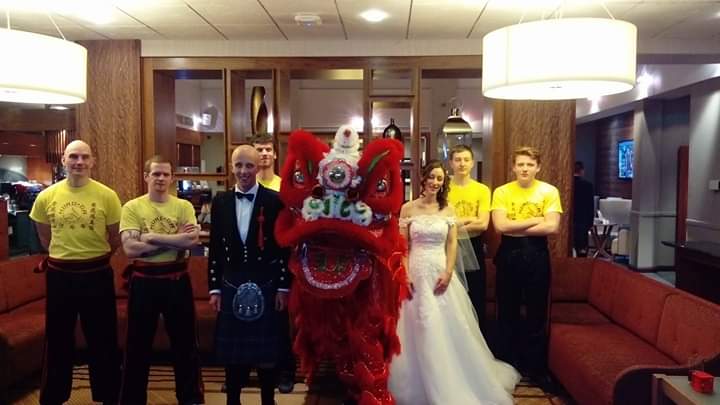
Yee’s North Scotland Lion Dance Team blessing a young couple’s wedding.

Chinese lion dances can be split into two main groups or styles, Northern and Southern. The Northern style is sometimes called Beijing style. It can be very acrobatic. They usually appear in pairs and have long, ruffled, shaggy orange and yellow hair. Dependant on whether the lion is male or female, it will have a red or green bow on the head. Male lions have a red bow and the female has a green one.

Northern lion dance tv spot. Note the coloured bows on the head.

The movements of Northern lions resemble those of a Pekingese or Fu Dog. Stunts and acrobatics such as lifts, jumps, walking on rattan poles, or balancing on giant balls are common. They sometimes appear as a family, with two large “adult” lions and a pair of small “young lions.”

A statue of a ‘fu dog’ guarding a temple, similar to a Northern lion.

Southern lion dance is usually performed as a ceremony or blessing. The ceremonies are performed to bring luck and good fortune. The Southern lions are decorated in many different colours and they have a very uniquely shaped head. There is a mirror on the forehead and a horn above it in the center. The performers animate the lion by flashing the large eyes and flapping the ears. The mouth also opens and closes.

A colourful green lion. Note the mirror on the top.

Southern lion dance is also known as Cantonese style. There are two main groups within the Cantonese style. Fat San (Buddha Mountain) and Hok San (Crane Mountain). There are other groups too, such as Fat-Hok (a fusion of Fat San and Hok San), and the Green Lion (Qingl Shil – popular with the Fukien/Hokkien and Taiwanese).

A selection of southern style lion heads at Yee’s Hung Ga, Inverness

Fat San is common amongst many Kung Fu schools. The movements are very powerful and require considerable strength. The lion represents each individual school and demonstrates a lot of the stances and footwork involved. It also shows how strong the students are. When performing, the most senior students are therefore chosen to represent their school with the lion. It is a great honour for students to be given this privilege.

A famous lion dance scene with a complicated choi chang using Fat San Lions from the film Dreadnaught.

The Hok San style combines a Southern lion head with Northern lion movements. Hok San focuses on life-like, realistic movements, and acrobatic stunts. The tail is shorter on this type of lion. Many lion dance troupes that perform pole (jong) jumping, use this type of lion. You will often see Hok San lion dances using three different coloured lions. A black, a yellow and white lion. The black lion is the youngest of the three. The movements of this lion are performed fast, like a young child with lots of energy. The yellow lion is the middle child, it’s movements are energetic and lively. The white lion is the oldest. You may see many other colours too. A red lion is common at weddings because the colour is considered to be lucky. The red lion also symbolises courage and strength. The green lion, however, represents friendship.

The three coloured Hok San lions. Black, Yellow & White. Performing in front of the Yee’s Hung Ga, Inverness Kung Fu school.

There are also three lions which represent three brothers in arms from the classic, “Romance of the Three Kingdoms.” The characters are Liu Bei, Guan Gong and Zhang Fei. Together they swore a blood oath to restore the Han dynasty. You can read more about Guan Gong and this classical Chinese novel in our article, “Who’s the guy with the big sword thingy!”

Statues of the three sworn brothers who founded Shu Han in the Three Kingdoms Period of China

The Liu Bei lion is the eldest of the three brothers. Yellow is the main colour of his face with a white beard and fur. The imperial yellow colour is significant because it shows that he became the first emperor of the Shu-Han Kingdom. The white beard and fur shows that he was very wise. He has a multicolored tail with a white underside, representing the five elements. He also has three coins on his collar, to show that he is the eldest. The Liu Bei lion is used by kung fu schools or organisations to show that they are well established. He is also known as Rui Shi or ‘Auspicious Lion’.

A Liu Bei lion. Note the yellow colour, white beard & fur and multicoloured tail.

The Guan Gong lion has red as the main colour of his face and a long black beard. His tail is red and black coloured with a white underside and white trim. He has two coins in his collar and is referred to as the second brother. He is also known as Xing Shi meaning ‘Awakened Lion’.

Guan Gong lion with red face, long black beard and red and black tail.

The Zhang Fei lion has a black coloured face with a short black beard. His tail is black and white, also with a white underside and white trim. He has bells attached to his body too. He has a single coin on his collar, showing that he is the youngest brother. This Lion is known as Dou Shi or ‘Fighting Lion’. This is because Zhang Fei had a short temper and liked fighting. Kung fu schools that are just starting out or those wanting to make a challenge might use Zhang Fei.

A Zhang Fei lion with a black & white tail, black face and black beard

Choi chang

Choi chang is a Chinese New Year tradition. Shopkeepers, restaurants and business owners attach a red envelope filled with money to a lettuce and hang it above the doorway of their premises. Kung fu schools visit the premises with their lions and perform the choi chang. The lions approach the lettuce inquisitively, with cat-like movements. They will jump up and eat the lettuce, keeping the money, and spitting out the chewed up lettuce leaves around the doorway. This brings good luck to the store during the forthcoming year. “Choi chang,” literally means picking the greens. It is seen as especially auspicious for the lettuce leaves to land on you. Sweeping the lettuce leaves up however, rather than picking them up, is seen as sweeping away the good luck and therefore unlucky.

‘picking the green’

Sometimes the lettuce is hung quite high, 15 to 20 feet. The prize in the envelopes of these lettuces can be quite considerable. Only the most skilled martial artists are able to obtain these lettuces, whilst dancing with a heavy lion head and in front of a watchful crowd. The higher the lettuce, the bigger the challenge and the greater the reward, in the red envelopes and from the crowd. Kung fu schools gain notoriety through this practice and therefore more students too.

Our lion performing the choi chang in Jimmy Chungs restaurant during a Chinese New Year celebration.

Many kung fu schools would take part in the choi chang. Occasionally more than one school might approach the same lettuce. If this is the case, the lions must fight a duel to decide a winner. The battle that takes place is not a street fighting brawl but one that uses the lion’s movements to impress the crowd. The greater the style and finesse from the performers, the greater the audience’s praise. The lions with the highest praise and cheers wins the right to complete the choi chang. The reputation of the schools are at stake during these duels so the performers must act with the highest respect and decorum.

Some famous faces in this clip demonstrate some lion dance etiquette & a battle between rival schools. From the film Martial Club

There are other types of challenges that a lion dance troupe may be confronted with instead of lettuces. Pineapples, bananas, oranges, pots, benches etc have all been used as barriers for the lion to overcome.

A lion dance performances using many obstacles for the lions to overcome. From the film The Young Master

Our own new year celebrations in Inverness will begin on Saturday the 25th of January 2020. We start out at Jimmy Chungs restaurant at 1pm, then on to the Eastgate Centre for about 2pm. We then proceed to the Victorian Market for 4.30pm and finally back to Jimmy Chungs for about 5.30pm for a final dance and some food. We would love for you to come and enjoy our celebration so that we may continue to honour this wonderful festive experience year after year. As always, we value your feedback so don’t forget to tag us in your photos #yhginverness #invernesscny20. You can also email us and let us know what you thought.

Posted on 1 Comment

The Horse Stance

The Horse stance, feared by some, celebrated by others! What is it, what’s the point? Let’s take a look…

Jackie Chan in Drunken Master

The horse stance (Ma Bu in Chinese), also known as the Four Point Great Stance (Sai Ping Dai Ma). It is not unique to Hung Ga, by any means, however it is of particular importance to practitioners of the Hung style. It is a basic stance for training the foundation. The foundation is the fundamental elements that support the three pillars. The fundamental elements being the strong body, including the bones, muscles ligaments, fascia and tendons. Ma Bu lowers the centre of gravity which helps the practitioner have a stable base. Practicing Ma Bu improves the structure of the body and the body’s alignment. Holding the stance can increase the stamina and determination of the practitioner, far beyond what they ever thought possible. With the correct posture, one can then focus on the breath. Having a regulated slow, deep breathing cycle has many calming benefits. It has been proven to reduce the heart rate and relax the body. With the relaxed, yet stable structure, one can then improve further with the circulation of fluids and the transportation of oxygen to the vital organs and the efficient removal of toxins, improving performance. With regular practice, the body can then heighten its performance further with the circulation of vital energy or Qi. Circulating qi around the body can have a huge benefit to physical, emotional and mental wellbeing, as well as increasing longevity, boosting energy levels and creating a barrier against diseases. This encompasses the three pillars we mentioned earlier. They are the body, the mind and the spirit. The physical body is trained by using the mind to focus and hold the static posture for a period of time. When the mind and body are synchronized in this way, over time, the spirit can elevated to higher levels.

Standing in Ma Bu takes time. It is hard. It is not the kind of practice for someone who is looking for quick results. At Yee’s, students train Ma Bu, it is a requirement for their gradings. As students advance through the system to higher levels, they must have a bigger and bigger foundation. They therefore need to train Ma Bu for longer periods of time. This is not just to pass a test but also to build the three pillars and to protect themselves from harm. This can be the downfall for many students who neglect to train Ma Bu. As students progress through he Hung Ga system, they learn more and more forms and techniques. Training Ma Bu often takes a back seat in favour of the other types of training. It can often be overlooked as it is so simple. Because it is simple, that doesn’t mean that it is easy. In fact it can be very difficult to maintain the stance for a long period of time. This is the nature of kung fu however, hard work and perseverance to achieve results. In today’s fast paced world, there are a select few people who wish to take this path. Most people try to take shortcuts or look for easier methods. For many practitioners the Ma Bu is a love/hate relationship. To succeed, you must enjoy the challenge and you must persevere through hardship.

Gordon Liu as Pai Mei in Kill Bill: Vol. 2

Are you ready to step up to the challenge? Think you can master the Ma Bu? Do you want to rise to the levels of previous kung fu masters throughout history? Good. Let your training begin….

• Stand with your feet together. Hands by your sides.

• Lift your arms up in front of you, palms up, and take a nice deep breath.

• Once you have breathed in, make fists and place them at the chamber (the groove above the hip and below the bottom rib) as you breathe out.

• Pivot on your heels and turn your toes out at an angle, creating a V shape. Pivot on the ball of the feet and turn the heels out. Pivot on the heels again to turn the toes outwards and then once more so that the toes are now pointing forward. Your feet should be fairly wide apart. Roughly the length of your lower leg.

Horse stance feet placement.

• Next, bend the knees and ‘sit’. Push your knees out so that they are above the feet. Keep your back straight and head up, with your fists in the chamber, elbows squeezed towards each other. The thighs should be almost parallel with the ground, at a slight angle. You can use a mirror to check your posture.

• Focus on your breathing. Place your tongue on the roof of your mouth and breathe through the nose. Take long, slow, deep breathes. Aim for 4-5 complete breathes in and out per minute.

• Great job. You’re now in the Ma Bu. You are practising an art which every Hung Ga master before you has also practiced, for centuries.

• Comfortable?

• Time how long you can maintain this stance for, without getting up. Every time you practice, try to beat your best time, even if it’s just a few seconds.

Sifu Hepple demonstrating the Ma Bu

How did you get on? How long did you manage before you had to get up? Let us know in the comments below. Send us an email or give us a tinkle on our social media channels.

Facebook

Instagram

Twitter

If you like this article and would like to see more, subscribe to our email list below.

Processing…
Success! You're on the list.
Posted on 3 Comments

The Sun-Toi (Ancestral Altar)

The Sun-Toi is the ancestral altar in the Mo-Kwoon (Kung Fu School). Kung fu martial artists bow to the Sun-Toi when we enter and leave the training space using the traditional ‘sun and moon fist.’ We light incense and place it in censers on the Sun-Toi. On special occasions we pour wine in the cups and put vegetables and/or meat on the Sun-Toi. It can be a small table or it could be the whole side of a wall. They can be ornately carved wooden masterpieces or a simple shelf-style structure.

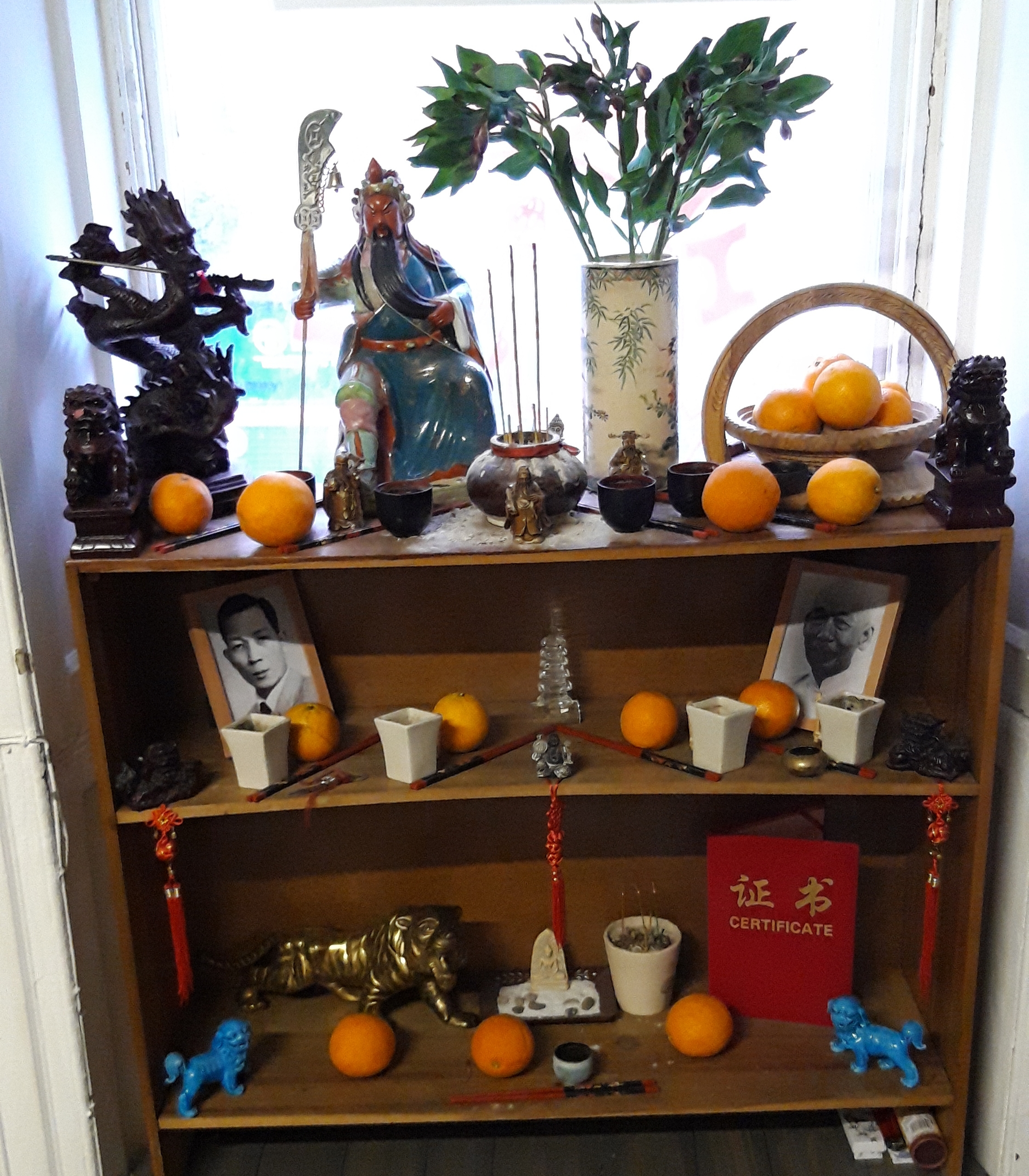
The Sun-Toi (ancestral altar) at Yee’s Hung Ga, Inverness

Why do we bother? What is the point? Is it religious or specific to Chinese culture or just some bizarre, esoteric kung fu ritual? In this article we’ll answer these questions and address the necessity and value of the Sun-Toi in modern Chinese martial arts schools.

The Sun-Toi serves as a place that we can connect with the previous masters of the Hung Ga lineage. It is somewhere that we can show respect to our ancestors and keep their memory alive. We are thankful for the opportunity to practice an art form which they laid the foundation to. As practitioners, students, teachers and masters, we all hope that we will do our forefathers proud as we steer the art through modern times. We all share the common aim of making Hung Ga Kuen as relevant today, and in the future, as it was in the time of the people who passed it on to us.

The unmistakable figure of General Gwan on the Sun-Toi in Inverness

The Sun-Toi is placed in a prominent position within the Mo-Kwoon, so it is visible as soon as one enters the training space. They are uniquely personal to each individual school. Even in branches of the same school, such as Yee’s, you may find many differences from school to school. Despite there being so many differences, almost every Sun-Toi has a few common items that you may find upon it, regardless of kung fu style. General Gwan (Gwan Di, Gwan Yu) is a frequent figure which you will not only see in traditional Mo-Kwoons but also in police stations, restaurants, casinos, shops and even some family homes. His figure symbolises loyalty, trust, honesty and respect. He was known for his martial arts excellence and loyalty to his sworn brother. His figure is usually placed at the top of the Sun-Toi, to show the greatest respect. The Gwan Dao (The Spring Autumn Great Knife) is a traditional weapon named after General Gwan. Whilst performing with the weapon, there are many gestures which represent General Gwan. For example you may see the practitioner galloping as if he is riding his horse or perhaps composing his long beard in preparation for battle. It is also common to see miniature weapons, such as the Gwan Dao, on a traditional Sun-Toi. You may also see other figurines such as ‘Shishi’ or ‘foo-dogs,’ which guard the physical structure of the kwoon as well as the people who are part of it.

The censer at the foot of General Gwan on top of the Sun-Toi in Inverness

Almost every Sun-Toi will also have at least one incense holder. You may see censers for every level of the Sun-Toi or in front of pictures of the ancestors. Normally the biggest censer is placed in front of the central General Gwan figure. Many of the Hung Ga ancestors are excellent roll models, especially in today’s fast paced lifestyle of excess. They lead heroic, righteous, noble lives. Wong Fei Hung is almost certainly one of the most familiar. Their example has set a very high standard for modern martial artists to follow. Smoke from the incense is meant to cleanse the air of toxins that cannot be seen. It symbolises the connection between the ancestral spirits and our lives in the modern day. By lighting the incense we invite the essence of their positive character to motivate us in the proceedings of the present day. The smoke carries the thoughts, prayers and aspirations of the practitioner to the ancestors, or whomever they may be thinking of. As such, lighting incense can be an art form in itself. Martial artists treat the incense very respectfully and carefully, as if it were the ancestors themselves. The number of incense sticks can vary depending upon the proceedings but a common number is three, or a multiple of three, such as nine. The incense is carefully lit and fanned gently with the hand, rather than blowing or waving the sticks in the air. Two hands are always used to handle the incense and to place it in the censer. It is held above the height of the head as the practitioner bows, as if to elevate it above oneself. All these things are perceived as demonstrating awareness of the present moment, respect for tradition and appreciation of the ancestors endeavours.

Oranges, chopsticks and cups of water in front of photos of our ancestors

Fruit, such as oranges, are often placed on the Sun-Toi along with cups filled with water and also chopsticks. These are seen as symbolic gestures or offerings to pay reverence to the ancestors. The fruit represents the results of the hard work of the school. When you work hard, you gain the fruit of your labour. This is the basic principle of kung fu, to train hard and become good at what you practice, through the practice itself. Symbolically, water represents the cleansing of any wrongs. Many cultures apply the same meaning to water, to wash away sin. Water also benefits the whole world, we could not survive without it. The heart should be like the water, clear and clean. The traditional martial artist aims to be the same in their thoughts and actions. Similar to water, you may also see candles or oil lights. The light drives away the darkness and any pesky evil spirits. It represents the good in everyone. The righteous path that all traditional martial artists attempt to traverse.

Flowers signify the hard work needed to achieve a goal.

During special occasions, such as Chinese New Year; flowers, vegetables, dishes of rice, fish, chicken etc can also be placed on the Sun-Toi as a way to mark the occasion and celebrate the achievements of the Mo-Kwoon. Similar to fruit, flowers on the altar represent the hard work that accomplishes a goal or task. When you work hard your flowers will bloom. They symbolise the hard work itself, rather than the results, which the fruit represents. Wine can also replace water in the cups to signify the happy, cheerful mood of the proceedings. You may also see two chairs on either side of a traditional Sun-Toi. The right hand chair is reserved for the Si-Gung or visiting Sifus of the school. The left hand chair is for the Sifu, or Dai Si-Hing/Jai should the Sifu be away.

The Sun-Toi is not meant to be for religious purposes. As mentioned, they vary quite considerably from school to school. You may find that some schools have religious figures on their Sun-Toi if they have religious roots. For example a Shaolin school may have a figure of the Buddha because Shaolin kung fu originated in a Buddhist temple. There are many components to the Sun-Toi which can still be seen as worthwhile, without being seen as worshipping another faith. The fundamental purpose of the Sun-Toi is to pay respect to the origins and founders of the complete martial art system that we enjoy practicing daily in modern times.

If you enjoyed this post, please give it a like and share on your social media. If you wish to be notified of future articles, like our forthcoming Autumn qigong article, as well as other notices, discounts and events, pop your email address in the box below and we’ll give you a shout when new posts are added. You can also follow our journey on social media. Like and share on Instagram, twitter & Facebook

Processing…
Success! You're on the list.