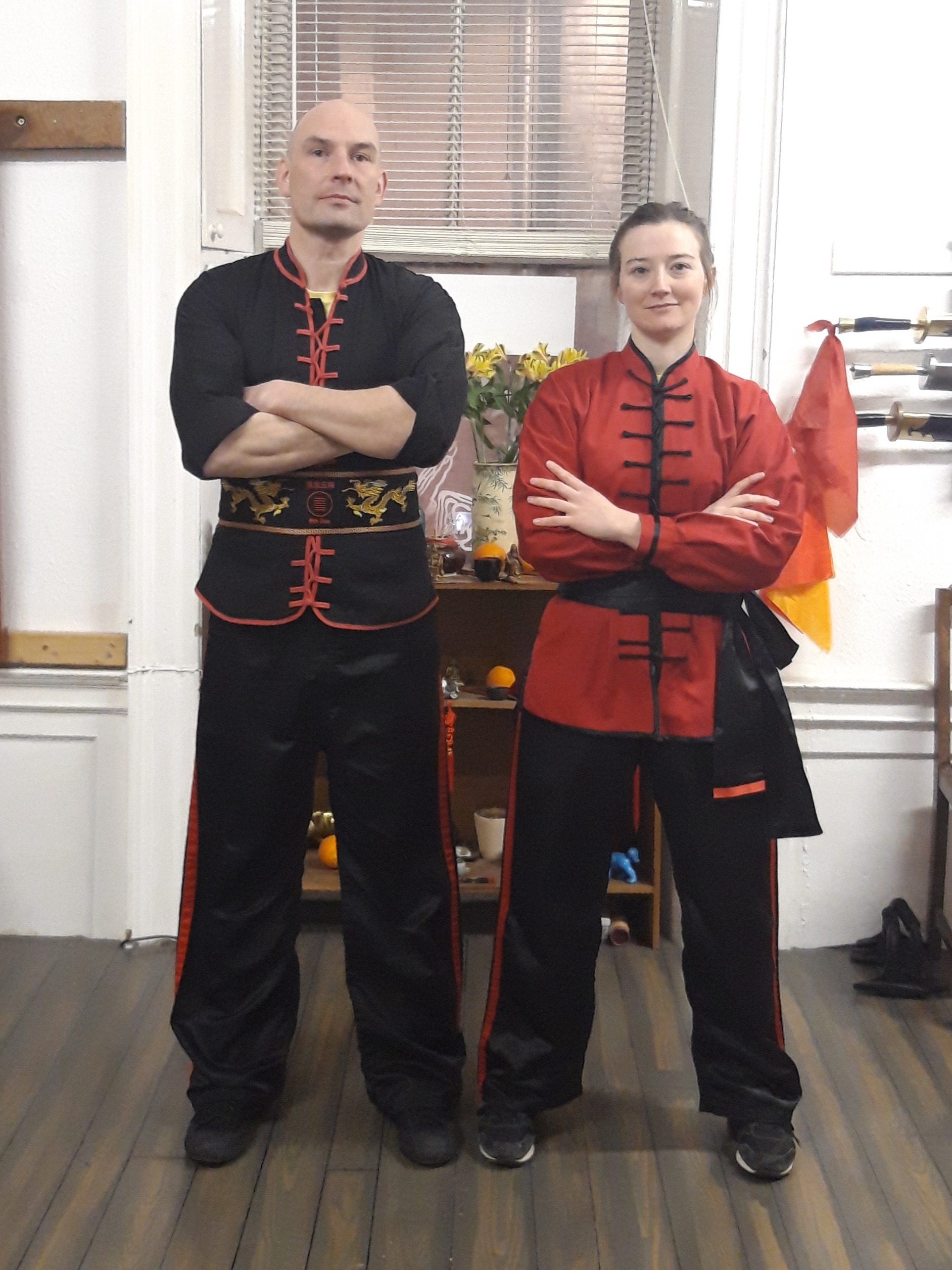
In our Student Spotlight series, our students have the opportunity to tell you about their training in their own words. Emma Archer has been training since 2015, participating in demonstrations and lion dance displays. Due to working life, Emma’s progress has been more gradual than some other students, however she enjoys committing her leisure time to training and gaining a deep appreciation for the style. Emma is currently learning the famous Fu Hok Seung Ying Kuen (Tiger & Crane Double Fist) form for her Yee Cup Junior level (1st test of 2nd level). Here Emma tells you about her experience of training at Yee’s Hung Ga Kung Fu Academy in Inverness.
Sifu Hepple and Emma Archer
What made you want to train in martial arts? Originally, I was inspired by my father who practiced Lau Gar Kung Fu in his teens. He taught me some stances and techniques. These share similarities with Hung Ga. Of course, films starring famous practitioners were also an influence.
How did you hear about the school? There was no Kung Fu school in my hometown, so growing-up I practiced Shotokan Karate off and on for several years. While I did enjoy the training and think it is a great style, something about Kung Fu always appealed to me more. In my 3rd year of University, I desperately needed an alternative focus to my dissertation, and decided that it was time to look into Kung Fu again. Miraculously, there was a school across from my flat (Yee’s Hung Ga Aberdeen at the time); guess it was just meant to be! When I moved to Inverness for work, I knew of the school here and began training under the instruction of Sifu Simon Hepple.
What was your first class like? Just as nerve wracking as my first class in Aberdeen. However, I had met Sifu Simon and some of the Inverness students before at tests and events, and they were very welcoming. Did it live up to your expectations? Exceeded them.
How did you feel after your first class? Pumped with motivation to train again and after a few more classes, felt right at home.
What do you think of your training so far? Is there anything you’d change? Enjoy every minute of it. If I could train all day every day, I would.
What are your hopes for your future in martial arts? Apart from maintaining my own fitness and well-being, eventually I would like to help others on their Hung Ga journey.
Anything else that you wish to add? I have trained at a few branches, and each has a positive and friendly atmosphere. While it is not common for a student to change schools, branch instructors have been very accommodating of my working situation. I feel accepted and enjoy training with everyone. Sifu as well as my Hung Ga brothers and sisters are always encouraging and help to improve my skills. It is also nice when we join other schools for seminars and events. Not to mention our predecessors are very skillful, knowledgeable and approachable. Always an honour to learn from them. Kung Fu truly improves your fitness and self-confidence, which has helped me in other areas of life. Come try Hung Ga and join our awesome family.
Chinese lion dance is a tradition which is at least 1000 years old. It is a fun, colourful way to bring a party atmosphere to any happy occasion. Weddings, festivals, parties, blessings, shop openings and, of course, Chinese New Year. Lion dance is huge in Asia and in many other parts of the world. As with most Chinese traditions, there are many myths, legends, symbology and folklore attached to these practices. We’ll take a look at the significance of the different lions and explore some of the hidden meanings behind them.
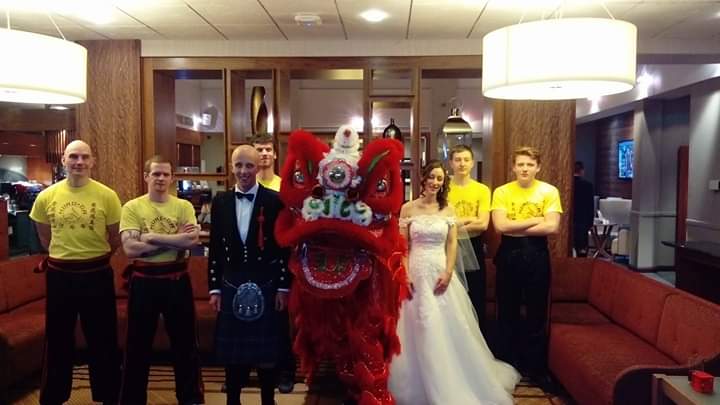
Yee’s North Scotland Lion Dance Team blessing a young couple’s wedding.
Chinese lion dances can be split into two main groups or styles, Northern and Southern. The Northern style is sometimes called Beijing style. It can be very acrobatic. They usually appear in pairs and have long, ruffled, shaggy orange and yellow hair. Dependant on whether the lion is male or female, it will have a red or green bow on the head. Male lions have a red bow and the female has a green one.
Northern lion dance tv spot. Note the coloured bows on the head.
The movements of Northern lions resemble those of a Pekingese or Fu Dog. Stunts and acrobatics such as lifts, jumps, walking on rattan poles, or balancing on giant balls are common. They sometimes appear as a family, with two large “adult” lions and a pair of small “young lions.”
A statue of a ‘fu dog’ guarding a temple, similar to a Northern lion.
Southern lion dance is usually performed as a ceremony or blessing. The ceremonies are performed to bring luck and good fortune. The Southern lions are decorated in many different colours and they have a very uniquely shaped head. There is a mirror on the forehead and a horn above it in the center. The performers animate the lion by flashing the large eyes and flapping the ears. The mouth also opens and closes.
A colourful green lion. Note the mirror on the top.
Southern lion dance is also known as Cantonese style. There are two main groups within the Cantonese style. Fat San (Buddha Mountain) and Hok San (Crane Mountain). There are other groups too, such as Fat-Hok (a fusion of Fat San and Hok San), and the Green Lion (Qingl Shil – popular with the Fukien/Hokkien and Taiwanese).
A selection of southern style lion heads at Yee’s Hung Ga, Inverness
Fat San is common amongst many Kung Fu schools. The movements are very powerful and require considerable strength. The lion represents each individual school and demonstrates a lot of the stances and footwork involved. It also shows how strong the students are. When performing, the most senior students are therefore chosen to represent their school with the lion. It is a great honour for students to be given this privilege.
A famous lion dance scene with a complicated choi chang using Fat San Lions from the film Dreadnaught.
The Hok San style combines a Southern lion head with Northern lion movements. Hok San focuses on life-like, realistic movements, and acrobatic stunts. The tail is shorter on this type of lion. Many lion dance troupes that perform pole (jong) jumping, use this type of lion. You will often see Hok San lion dances using three different coloured lions. A black, a yellow and white lion. The black lion is the youngest of the three. The movements of this lion are performed fast, like a young child with lots of energy. The yellow lion is the middle child, it’s movements are energetic and lively. The white lion is the oldest. You may see many other colours too. A red lion is common at weddings because the colour is considered to be lucky. The red lion also symbolises courage and strength. The green lion, however, represents friendship.
The three coloured Hok San lions. Black, Yellow & White. Performing in front of the Yee’s Hung Ga, Inverness Kung Fu school.
There are also three lions which represent three brothers in arms from the classic, “Romance of the Three Kingdoms.” The characters are Liu Bei, Guan Gong and Zhang Fei. Together they swore a blood oath to restore the Han dynasty. You can read more about Guan Gong and this classical Chinese novel in our article, “Who’s the guy with the big sword thingy!”
Statues of the three sworn brothers who founded Shu Han in the Three Kingdoms Period of China
The Liu Bei lion is the eldest of the three brothers. Yellow is the main colour of his face with a white beard and fur. The imperial yellow colour is significant because it shows that he became the first emperor of the Shu-Han Kingdom. The white beard and fur shows that he was very wise. He has a multicolored tail with a white underside, representing the five elements. He also has three coins on his collar, to show that he is the eldest. The Liu Bei lion is used by kung fu schools or organisations to show that they are well established. He is also known as Rui Shi or ‘Auspicious Lion’.
A Liu Bei lion. Note the yellow colour, white beard & fur and multicoloured tail.
The Guan Gong lion has red as the main colour of his face and a long black beard. His tail is red and black coloured with a white underside and white trim. He has two coins in his collar and is referred to as the second brother. He is also known as Xing Shi meaning ‘Awakened Lion’.
Guan Gong lion with red face, long black beard and red and black tail.
The Zhang Feilion has a black coloured face with a short black beard. His tail is black and white, also with a white underside and white trim. He has bells attached to his body too. He has a single coin on his collar, showing that he is the youngest brother. This Lion is known as Dou Shi or ‘Fighting Lion’. This is because Zhang Fei had a short temper and liked fighting. Kung fu schools that are just starting out or those wanting to make a challenge might use Zhang Fei.
A Zhang Fei lion with a black & white tail, black face and black beard
Choi chang
Choi chang is a Chinese New Year tradition. Shopkeepers, restaurants and business owners attach a red envelope filled with money to a lettuce and hang it above the doorway of their premises. Kung fu schools visit the premises with their lions and perform the choi chang. The lions approach the lettuce inquisitively, with cat-like movements. They will jump up and eat the lettuce, keeping the money, and spitting out the chewed up lettuce leaves around the doorway. This brings good luck to the store during the forthcoming year. “Choi chang,” literally means picking the greens. It is seen as especially auspicious for the lettuce leaves to land on you. Sweeping the lettuce leaves up however, rather than picking them up, is seen as sweeping away the good luck and therefore unlucky.
‘picking the green’
Sometimes the lettuce is hung quite high, 15 to 20 feet. The prize in the envelopes of these lettuces can be quite considerable. Only the most skilled martial artists are able to obtain these lettuces, whilst dancing with a heavy lion head and in front of a watchful crowd. The higher the lettuce, the bigger the challenge and the greater the reward, in the red envelopes and from the crowd. Kung fu schools gain notoriety through this practice and therefore more students too.
Our lion performing the choi chang in Jimmy Chungs restaurant during a Chinese New Year celebration.
Many kung fu schools would take part in the choi chang. Occasionally more than one school might approach the same lettuce. If this is the case, the lions must fight a duel to decide a winner. The battle that takes place is not a street fighting brawl but one that uses the lion’s movements to impress the crowd. The greater the style and finesse from the performers, the greater the audience’s praise. The lions with the highest praise and cheers wins the right to complete the choi chang. The reputation of the schools are at stake during these duels so the performers must act with the highest respect and decorum.
Some famous faces in this clip demonstrate some lion dance etiquette & a battle between rival schools. From the film Martial Club
There are other types of challenges that a lion dance troupe may be confronted with instead of lettuces. Pineapples, bananas, oranges, pots, benches etc have all been used as barriers for the lion to overcome.
A lion dance performances using many obstacles for the lions to overcome. From the film The Young Master
Our own new year celebrations in Inverness will begin on Saturday the 25th of January 2020. We start out at Jimmy Chungs restaurant at 1pm, then on to the Eastgate Centre for about 2pm. We then proceed to the Victorian Market for 4.30pm and finally back to Jimmy Chungs for about 5.30pm for a final dance and some food. We would love for you to come and enjoy our celebration so that we may continue to honour this wonderful festive experience year after year. As always, we value your feedback so don’t forget to tag us in your photos #yhginverness#invernesscny20. You can also email us and let us know what you thought.
All kung fu schools are very much family oriented. They are set up like a family and try to instil family values to their members. Family names are used to show respect to instructors and other students. At Yee’s Hung Ga we have many branches so it can be difficult to keep track of who is who and what the proper name should be. The following are the family names and meanings that you will commonly hear at a Yee’s Hung Ga school.
English
Cantonese
Male
Female
Door Man or Founder
Jeurng Mun Yahn
Jeurng Mun Yahn
Lineage Holder
Si-Jo
Si-Jo
Great Grandmaster
Si-Tai Gung
Si-Tai-Poa
Grandmaster
Si-Gung
Si-Poa
Senior Kung Fu Uncle
Si-Bahk
Senior Kung Fu Aunt
Si-Guma
Junior Kung Fu Uncle
Si-Sook
Junior Kung Fu Aunt
Si-Guje
Teacher/Instructor
Si-Fu
Si-Fu
Teacher’s Husband/Wife
Si-Jeong
Si-Mo
Most Senior Brother/Sister
Di-Si-Hing
Di-Si-Jeh
Senior Brother/Sister
Si-Hing
Si-Jeh
Junior Brother/Sister
Si-Dai
Si-Mui
Student
Toh-Dai
Toh-Dai
If you are a student at Yee’s Hung Ga in Inverness, anyone who has been training longer than you at the school, depending on their gender, you would call Si-Hing or Si-Jeh. Anyone who begins at the school after you would be your Si-Dai or Si-Mui, depending on their gender. They would call you Si-Hing or Si-Jeh. Sifu Hepple would be your Sifu and his wife would be called Si-Mo. Sifu Bruce Clark would be your Si-Gung. Sifu Pedro Cepero Yee and Grandmaster Yee Chee Wai would be known as Si-Tai Gung.
If visiting another local Yee’s school, the students of that school would be your cousins. You would address them just as if they were training brothers or sisters at Inverness, Si-Hing, Si-Jeh if more senior and Si-Dai or Si-Mui if junior. The Sifu of that school would be your uncle. You would call them Si-Bahk or Si-Guma if they were Sifu Hepple’s Si-Hing or Si-Jeh. If they were Sifu Hepple’s Si-Dai or Si-Mui, you would call them Si-Sook or Si-Guje.
Confused?!
This might seem rather complex and difficult to learn but it is important to maintain the traditions of the kung fu school so that we can pass on our heritage for future generations. The important ones to remember are your Sifu and Si-Mo/Si-Jeong. Showing further respect to their teacher, Si-Gung/Si-Poa, and their teacher, Si-Tai Gung/Si-Tai Poa is also expected. Everything else can be worked out and nobody else is likely to take great offence if you call them the wrong name. If you are unsure, it is always best to ask, just like anything else that you may be uncertain of.
It is also worth noting that a senior uncle/aunt/brother or sister are senior only by the length of time practicing and not necessarily of a higher rank. Your Si-Hing is, and always will be, your Si-Hing. Just as an older brother can never be demoted to a younger brother, no matter how much you may wish for it to happen.
Other important terms that you may hear is the Kwoon or Kung Fu School itself. We shall look at the etiquette within and around the Kwoon in a future post. Suffice to say though, that it is important to remain respectful and uphold composure whilst in and around the Kwoon. Inside the Kwoon is the Sun-Toi or ancestral altar. We will also discuss this in a future post too. To show respect to the ancestors, who have passed down our art from generation to generation, we bow to the Sun-Toi. We use the traditional ‘sun and moon fist’ to bow to the ancestors, whilst entering and leaving the main training area. You may also hear your Sifu or instructor counting punches or kicks etc in Cantonese. The following table will help you to learn numbers 1 to 10:
English
Cantonese
One
Yat
Two
Yee
Three
Saam
Four
Sai
Five
Ng
Six
Luk
Seven
Chat
Eight
Baat
Nine
Gau
Ten
Sahp
Perhaps you have heard a term that you are unsure of that is not listed here. Please feel free to let us know and we can discuss. If you enjoy our posts and wish to be notified of further posts, notices, discounts and events, pop your email address in the box below and we’ll give you a shout when new posts are added. You can also like and share on Instagram & Facebook
Processing…
Success! You're on the list.
Whoops! There was an error and we couldn't process your subscription. Please reload the page and try again.
In our Student Spotlight series, our students have the opportunity to tell you about their training in their own words. Allan Poko has been training for a little under 10 months, (6/5/19) he has participated in lion dance displays for our Chinese New Year Celebrations and is a committed student, trying to take part in as many classes as he can make it along to. He is currently training for his Yat Cup Junior level (1st test of 1st level) Here Allan tells you about his experience training at Yee’s Hung Kung Fu Academy in Inverness.
What made you want to train in martial arts?
I was lucky enough to see the shoalin monks perform at Eden Court with my daughter. Since then I’ve been very inspired to learn more about Chinese martial arts and culture.
How did you hear about the school?
I was walking past the school one day and I picked up a flyer at the door.
What was your first class like?
I remember going up the stairs feeling very nervous but at the same time I felt the calmness of the school which made me very excited to learn and find out more about the school.
Did it live up to your expectations?
Yes very much so.
How did you feel after your first class?
I won’t forget how calm and relaxed I was after my first class. It was like an energy boost. Also, for me, all I wanted to do from that point on was to train and learn more.
What do you think of your training so far? Is there anything you’d change?
My training so far has been excellent! I try to go to all of the classes now as I enjoy the training so much. What I like the most is I can train and learn at my own pace. Personally I don’t think there is any need for anything to be changed.
What are your hopes for your future in martial arts?
My hopes for the future is to learn as much Kung fu as possible. For my health and fitness, for my own personal safety and protection and to learn and understand the Chinese philosophy and culture of Kung fu.
Anything else that you wish to add?
I would like to say, prior to me joining our school, my life was at a very low point. Yee’s Hung Ga Inverness saved me. I was struggling mentally and physically. Since joining the school it has given me focus and done wonders for my confidence and self asteem. Joining Yee’s Hung Ga Inverness is one of the best things I have ever done in my life so far. I feel very humbled to be part of the Inverness branch community, so big respect to my sifu and all of the other students whom train along with me.
If you enjoy our posts and wish to be notified of further posts, notices, discounts and events, pop your email address in the box below and we’ll give you a shout when new posts are added. You can also like and share on Instagram, twitter & Facebook
Processing…
Success! You're on the list.
Whoops! There was an error and we couldn't process your subscription. Please reload the page and try again.