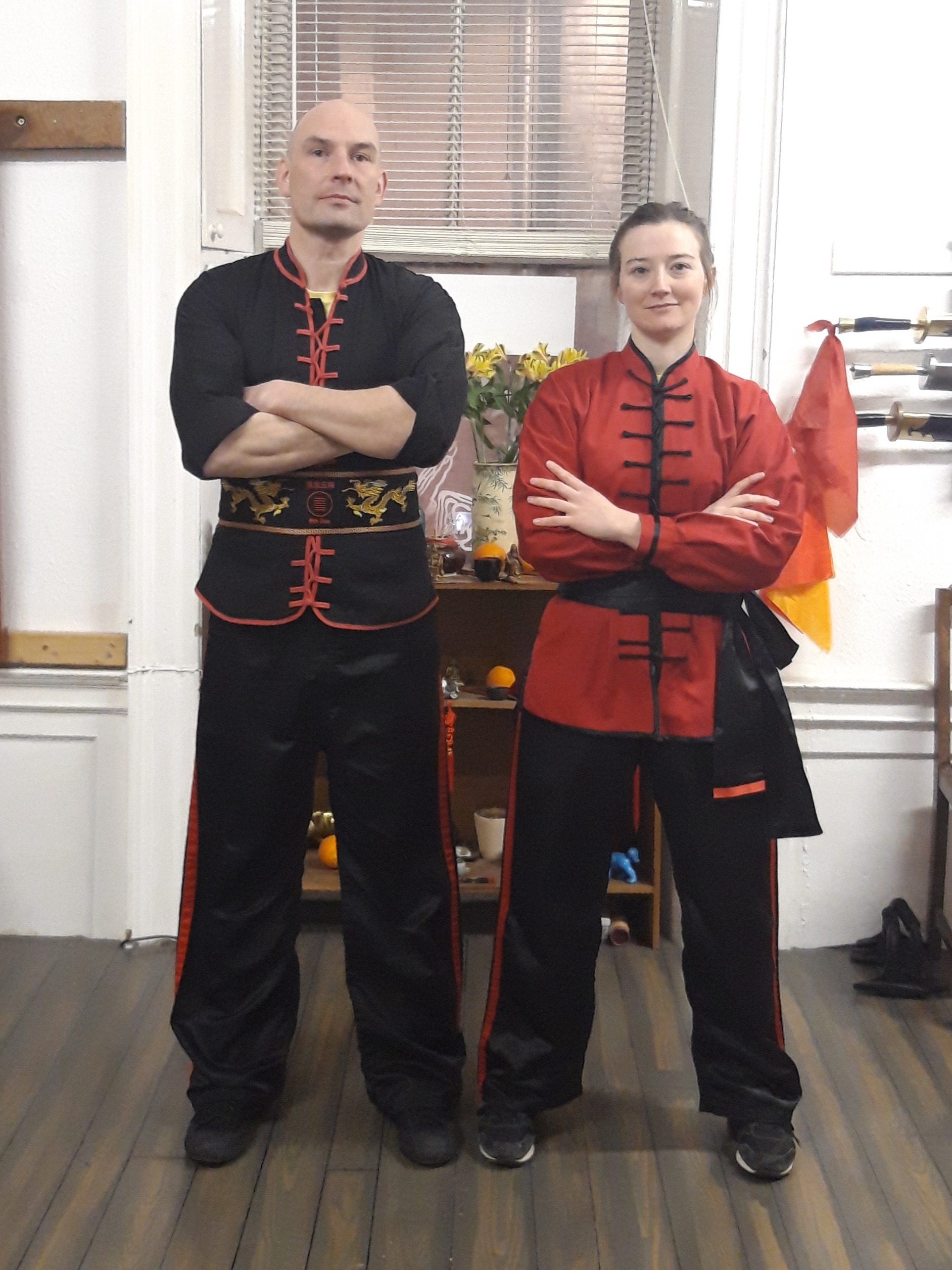
In our Student Spotlight series, our students give you an insight into their experiences training at Yee’s Hung Ga in Inverness. Here, James Doyle describes how he found our school and what it’s like learning online, from a distance. This presents some unique challenges. James tells you, in his own words, how he has managed to overcome these issues and progress to Yat cup senior level.
What made you want to train in martial arts? From an early age I was surrounded by martial arts. Both of my parents trained in karate and Shaolin White Crane kung fu, so it was always part of my world. I grew up going to demonstrations with them and watching plenty of Bruce Lee and Angela Mao films at home. That inspiration led me to join an Eagle Claw kung fu school in London with my dad. Unfortunately, the long travel made it difficult to continue regularly, but the spark for kung fu never went away.
How did you hear about the school? After the COVID-19 pandemic, I started looking for a kung fu school nearby, but most local sifus had stopped teaching. I tried searching online through the BCCMA (British Council for Chinese Martial Arts) and other websites, but many “online courses” just sent out pre-recorded videos with little personal connection. They felt more like programmes to work through alone rather than a real school with a teacher who could give real-time feedback. That’s when I discovered Yee’s Hung Ga Inverness. The website offered live online classes at a reasonable price, with interactive feedback from Sifu Hepple. That personal element was exactly what I was looking for, so I decided to give it a try.
What was your first class like? It was challenging but in the best way! After years away from martial arts, dropping into horse stance again really tested my legs. Training online felt different to what I’d experienced in person before, but I enjoyed the interaction and immediately felt the excitement of returning to kung fu.
Did it live up to your expectations? Absolutely. Sifu Hepple has a great teaching style – encouraging, clear, and always ready with a light joke – but at the same time, he keeps us focused and working hard. It struck the right balance for me.
How did you feel after your first class? Exhilarated! There was a real sense of achievement, almost like a “runner’s high”. It felt great to challenge myself again and use muscles I hadn’t worked in years.
What do you think of your training so far? Is there anything you’d change? I really enjoy the weekly routine. The stancework is tough but such an important foundation. I appreciate how Sifu Hepple explains each movement, its purpose, and variations for different situations. The Thursday applications classes build beautifully on what we learn and having them recorded is invaluable for revisiting and reinforcing lessons. I would love to have longer classes as sometimes it feels as though the classes are over all too quickly.
What are your hopes for your future in martial arts? My hope is to grow physically, mentally, and spiritually through Hung Ga. I’d like to learn the full system and, in time, perhaps share what I’ve learnt by teaching, so that others can discover and enjoy Chinese martial arts as much as I do.
Anything else you’d like to add? Training online does have its challenges, but it also teaches useful skills. At first, it can be tricky to follow movements from the front view instead of standing behind your sifu like in class, so lefts and rights sometimes need extra focus. That gets easier with practice. Another difference is that online corrections rely on observation and self-adjustment, since Sifu can’t physically move you into position. But over time, this develops your ability to self-correct – which is a valuable skill in itself. And of course, even as an online student, there’s always the option to visit and train in person. Meeting your sifu and kung fu brothers and sisters face to face, even just for a short while, is an amazing experience. The camaraderie and atmosphere in the school are something special, and I’d recommend it to anyone.
After 3 years Grandmaster Frank Yee has finally been able to return to the UK to conduct tests, seminars, Bai Si ceremonies and presentations. He spent a weekend in Peterhead from September the 10th-12th and then travelled to Edinburgh to repeat the same timetable of events the following weekend.
GM Frank Yee last visited the UK in 2019. He was due to return a year later in 2020 but Coronavirus put a stop to those plans. Now, 3 years later, we finally had the honour of meeting again, in person, and learning more knowledge from this exceptional man.
Despite just arriving from a New York flight, with a 13 hour delay and only 5 hours of broken sleep across 3 days, GM Yee was still his bright and characteristically energetic self. He also appeared to have not aged a single day since we last saw him. GM Yee wanted to begin proceedings by presenting all the senior students in attendance with a special calligraphy scroll that he had personally penned himself. He had the original intention of presenting the calligraphy to us all on his planned visit in 2020. Not only did he have the kindness and patience to inscribe each scroll individually for each student but he also had the foresight to preserve them for the duration of the pandemic, knowing that better days would once again unite us all together again.
Next on the agenda were junior and senior grading tests. Students train for a long time before they are eligible to take these tests, sometimes for years. As you can imagine, many students were very nervous. Not only performing in front of their Sifus but also the watchful eye of GM Yee. This round of tests saw many students achieving great success, including the first Jo Gow (black belt equivalent) for the branch in Ellon. Congratulations to all students who succeeded in passing their tests. Following the tests GM Yee gave a speech on the importance of correct practice and practicing for the excellent health benefits that Hung Ga can provide.
GM Yee giving a speech after the conclusion of tests.
After a brief lunch break GM Yee conducted two separate seminars. We have been lucky over the last few years where we have been able to further our knowledge with seminars online. Nothing can beat being there, in the room, learning the precious knowledge which GM Yee spends months preparing. His notes for each of the seminars are rolled onto huge scrolls of paper and draped over chairs so that every small detail can be articulated to all the attendees, both in person and online.
The end of the seminars concluded the first day of GM Yee’s visit to Peterhead. A banquet was held at the school for students to enjoy some celebratory time together after a long day of tests, practice and learning.
The next day began with many students taking Bai Si ceremonies. These are traditional discipleship ceremonies where the student is formally accepted as either an ‘in the gate’ or an ‘in the room’ disciple. You can read more about these ceremonies in our previous article, “Ceremonies in Edinburgh.” GM Yee explained in great detail the significance and symbology of the altar and table set up for these ceremonies. This ensures that future generations of students can benefit from the rich culture of Traditional Hung Ga Kung Fu and that these traditions are never forgotten.
Students with their discipleship certificates.
The finale of a memorable weekend was a senior seminar on advanced pole techniques. All attendees have been learning these techniques online over the past year. The chance to cover fine details and corrections in person was extremely beneficial, however, and demonstrates how important close contact learning is, especially after such a long period of time studying online.
After an eventful weekend in the North East of Scotland, GM Yee then travelled to Edinburgh, to continue his comprehensive teachings of the complete Hung Ga kung fu system. It was only a short period of time but an incredible wealth of knowledge and many treasured memories spent with GM Yee. We hope it won’t be so long before we can meet again.
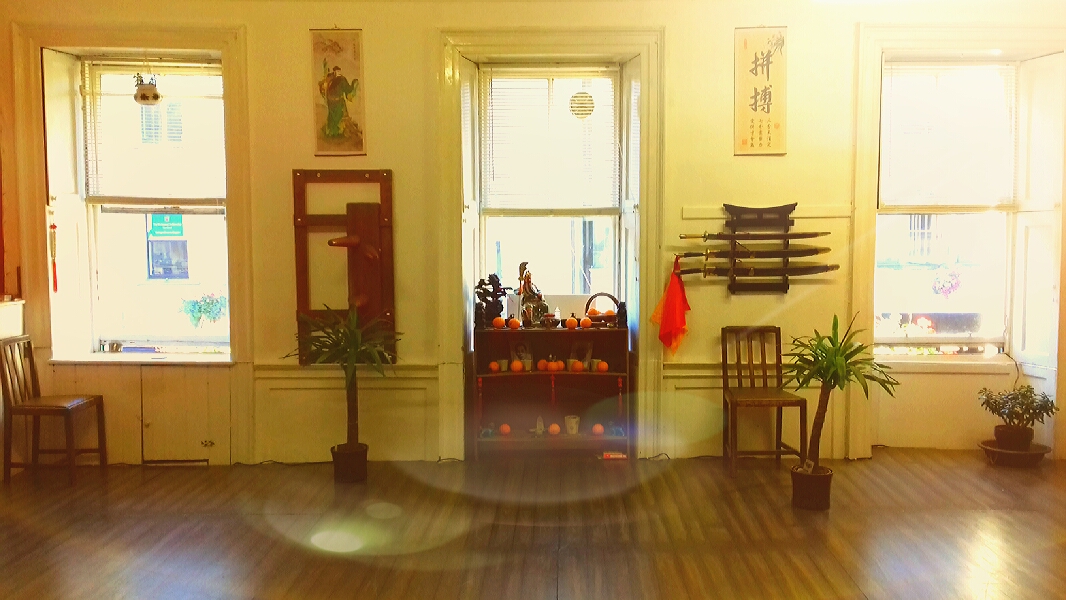
The Sun Toi, or ancestral altar, is a major feature in a traditional kung fu school. It is usually a main focal point upon entry to the training area. There are many features to the Sun Toi. You can read more about the Sun Toi in our article, “The Sun Toi – Ancestral Altar”
Sun Toi with signboards hanging above and to the sides.
Hanging above the altar and down the sides, you can find the school’s signboards. These are boards with carefully carved Chinese characters that have a special meaning that relates to the style of kung fu. The top board, above the altar, is usually the name of the style itself, such as “Hung Ga Kuen,” meaning “Hung Family Fist.” They are read from right to left, in the same way that Traditional Chinese text was written.
The vertical boards down the sides are read from top to bottom. These demonstrate a theory, philosophy, motto or poem that relates to the kung fu style. They have an equal amount of characters on either board for symmetry.
Aimee and her mum
Meet Aimee Williamson, owner of HollanDesign, and her mum, “Without her, no work would get done.” Aimee was commissioned to make the signboards for Yee’s Hung Ga Kung Fu Academy, Inverness. Aimee does everything herself. From taking the orders, to designing, buying timber, marking and preparing timber, operating the CNC machine, painting and finishing. Aimee sends her designs through her computer to her CNC machine. This carves the boards to the exact specifications of the design. The inner vertical black boards are coated with an ebony timber treatment. The top, horizontal and outer vertical boards are carved in American white oak and have been coated with Treatex UV oil. All the carvings are painted with acrylic paints.
Due to the pandemic we were unable to meet with Aimee to discuss details. All communication was through messages. We only met Aimee for the first time when we collected the signboards upon completion. The signboards have been designed to custom fit around the window architrave where our Sun Toi is situated. Aimee has made a grand job of them too.
Signboards situated above the Sun Toi.
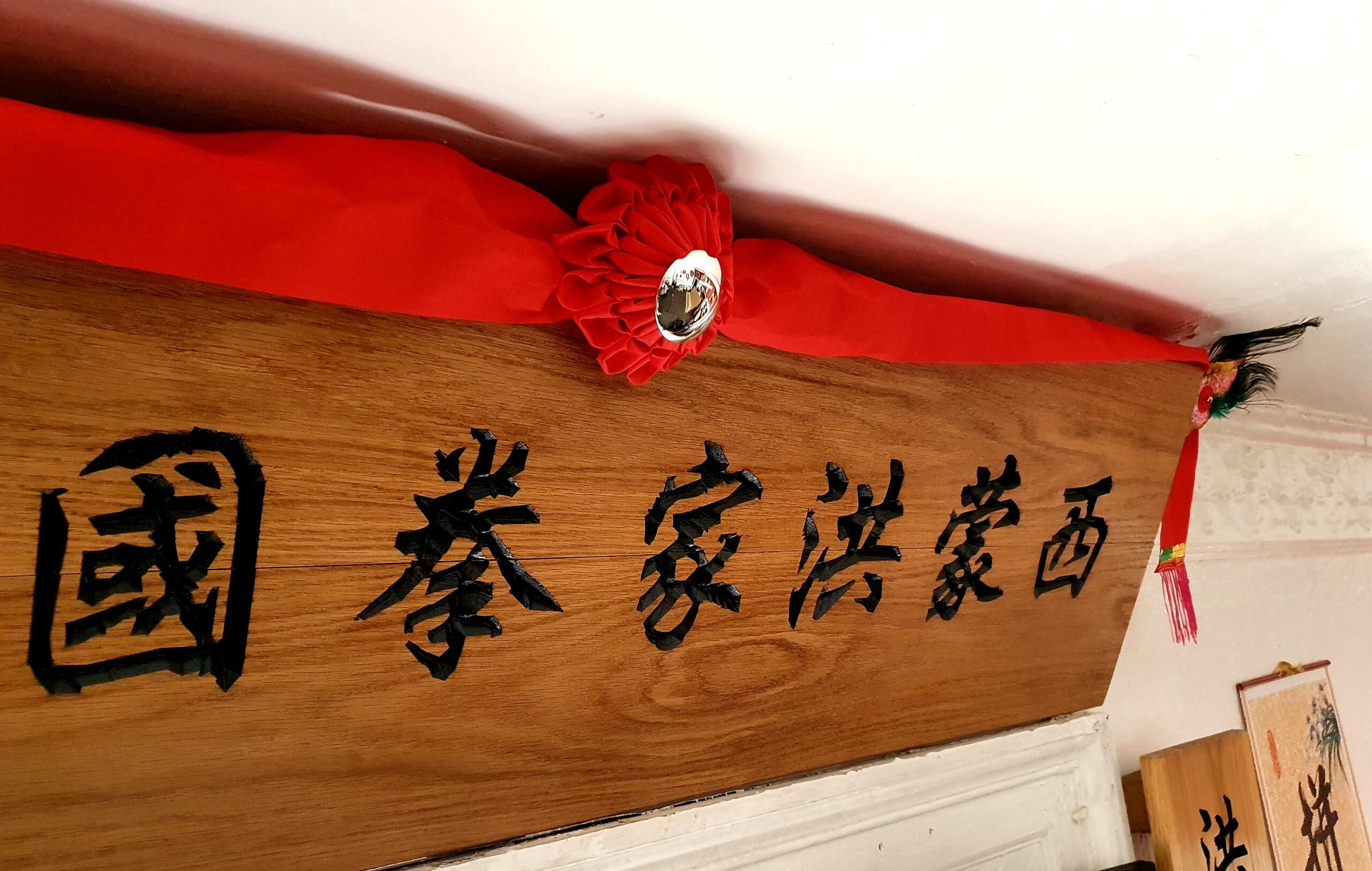
Read right to left, word-for-word, the top horizontal board reads: “Simon Hung Family Fist National Art Society.” Simon, being the first name of the chief instructor of the Inverness branch, Sifu Simon Hepple. Hung Family Fist is the style of kung fu practiced at the school. National art is translated as martial art.
The top horizontal board.
The board furthest to the right reads: “The disciples of the Hung Family are everywhere.” Meaning that Hung Ga kung fu has spread across the world.
Right hand side vertical boards.
The board furthest to the left reads: “Fist techniques astonish ancient and modern.” Basically meaning that the techniques taught from ancient times are still relevant today and for the rest of time.
The left hand side, vertical boards.
On the inside, right and left, boards, in black and gold, is a list of the twelve bridges. This is a philosophy which Hung Ga styles all over the world are renowned for. In order, from the right hand side, they read: Gong, Yau, Bik, Jik, Fun, Ding, Chuen. The inside, left board finishes the twelve bridges and adds two characters for symmetry: Tai, Lau, Wan, Jai, Deng, San, Haw. The last two characters (San & Haw) literally mean “mountain river.” The reference to “mountain” and “river” refers to very different environments for which the 12 bridges would still be applicable. Basically, it is a shorthand way of saying that the 12 bridges are applicable everywhere.
Ribbon, mirror and Jam Foh above the top signboard.
You will notice a round mirror and red ribbon that is located centrally on the top signboard. This is similar to the mirrors on traditional lion dance heads. Its purpose is to reflect good fortune into the school. You may also notice the peacock feathers or Jam Foh (triangle feather) at the sides of this board. These also bring luck and good fortune to the school. In traditional kung fu schools, the angle to which the feathers are pointed has a special significance and meaning too.
In our Student Spotlight series, our students have the opportunity to tell you about their training in their own words. Emma Archer has been training since 2015, participating in demonstrations and lion dance displays. Due to working life, Emma’s progress has been more gradual than some other students, however she enjoys committing her leisure time to training and gaining a deep appreciation for the style. Emma is currently learning the famous Fu Hok Seung Ying Kuen (Tiger & Crane Double Fist) form for her Yee Cup Junior level (1st test of 2nd level). Here Emma tells you about her experience of training at Yee’s Hung Ga Kung Fu Academy in Inverness.
Sifu Hepple and Emma Archer
What made you want to train in martial arts? Originally, I was inspired by my father who practiced Lau Gar Kung Fu in his teens. He taught me some stances and techniques. These share similarities with Hung Ga. Of course, films starring famous practitioners were also an influence.
How did you hear about the school? There was no Kung Fu school in my hometown, so growing-up I practiced Shotokan Karate off and on for several years. While I did enjoy the training and think it is a great style, something about Kung Fu always appealed to me more. In my 3rd year of University, I desperately needed an alternative focus to my dissertation, and decided that it was time to look into Kung Fu again. Miraculously, there was a school across from my flat (Yee’s Hung Ga Aberdeen at the time); guess it was just meant to be! When I moved to Inverness for work, I knew of the school here and began training under the instruction of Sifu Simon Hepple.
What was your first class like? Just as nerve wracking as my first class in Aberdeen. However, I had met Sifu Simon and some of the Inverness students before at tests and events, and they were very welcoming. Did it live up to your expectations? Exceeded them.
How did you feel after your first class? Pumped with motivation to train again and after a few more classes, felt right at home.
What do you think of your training so far? Is there anything you’d change? Enjoy every minute of it. If I could train all day every day, I would.
What are your hopes for your future in martial arts? Apart from maintaining my own fitness and well-being, eventually I would like to help others on their Hung Ga journey.
Anything else that you wish to add? I have trained at a few branches, and each has a positive and friendly atmosphere. While it is not common for a student to change schools, branch instructors have been very accommodating of my working situation. I feel accepted and enjoy training with everyone. Sifu as well as my Hung Ga brothers and sisters are always encouraging and help to improve my skills. It is also nice when we join other schools for seminars and events. Not to mention our predecessors are very skillful, knowledgeable and approachable. Always an honour to learn from them. Kung Fu truly improves your fitness and self-confidence, which has helped me in other areas of life. Come try Hung Ga and join our awesome family.
Do you wish to start your own yoga class or meditation group? Perhaps you already run a martial art class, excercise club or group and are looking into other locations?
Guided tour of our school.
We currently have space available (out with our regular timetabled classes) where you can rent out our school. We don’t boast state of the art, air conditioned facilities. In fact our premises are very modest and humble. It does have a certain charm though and is an ideal training space. It would be a great place if you are thinking of starting up and want to “test out the waters.”
We can offer:
Regular availability (outwith our own timetabled classes)
Full use of our premises
large storage area
Advertising space on our A-frame signboard, front door poster and flyer rack area, social media and website.
Discounts for students.
A fantastic, central location.
All of this for only £12 per hour.
If you would like to take on a new venture in 2020 and this sounds like an ideal location and opportunity for you. Just email us to view the property, ask any questions or enquire about availability:
Our Spring Festival/birthday celebrations for Inverness has now been and gone. The dust has, just about, settled and our students have returned to their regular practice routine. We had a real blast with our lion and dragon dance parade and, if you came to see us, we hope that you did too. We performed displays at various locations across the city centre including Jimmy Chung’s Restaurant, The Eastgate Centre, The Victorian Market, Blacks Outdoor Retailers and outside our very own premises on Inverness High Street. We are honoured to have taken part in the blessing of so many stores around Inverness. It was quite a large undertaking but, with the help of our other schools across the North East from Ellon and Peterhead, we were able to complete around 50 blessings. This is sure to clear the city of evil spirits, at least until next year when ‘Nian’ is set to return for the ‘Year of the Ox’. These blessings are traditional “Choi Chang,” blessings. You can read more about them in our article about Chinese Lion Dance. The Spring Festival lasts for about two weeks so there will still be many more celebrations besides our own. You can check out photos and videos of our parade, blessings and performances on our Facebook and Instagram pages. Please feel free to tag us in your own posts, so we can see them all, with the tags #yhginverness #yeeshungga or #invernesscny20 You can also see many other performances and demonstrations from our Lion & Dragon Dance Team throughout the year. You can even book us for your own celebration, wedding or event.
We also have a Facebook Event Page for our 2021 celebrations. Feel free to like and share this to help us spread the word for next year.
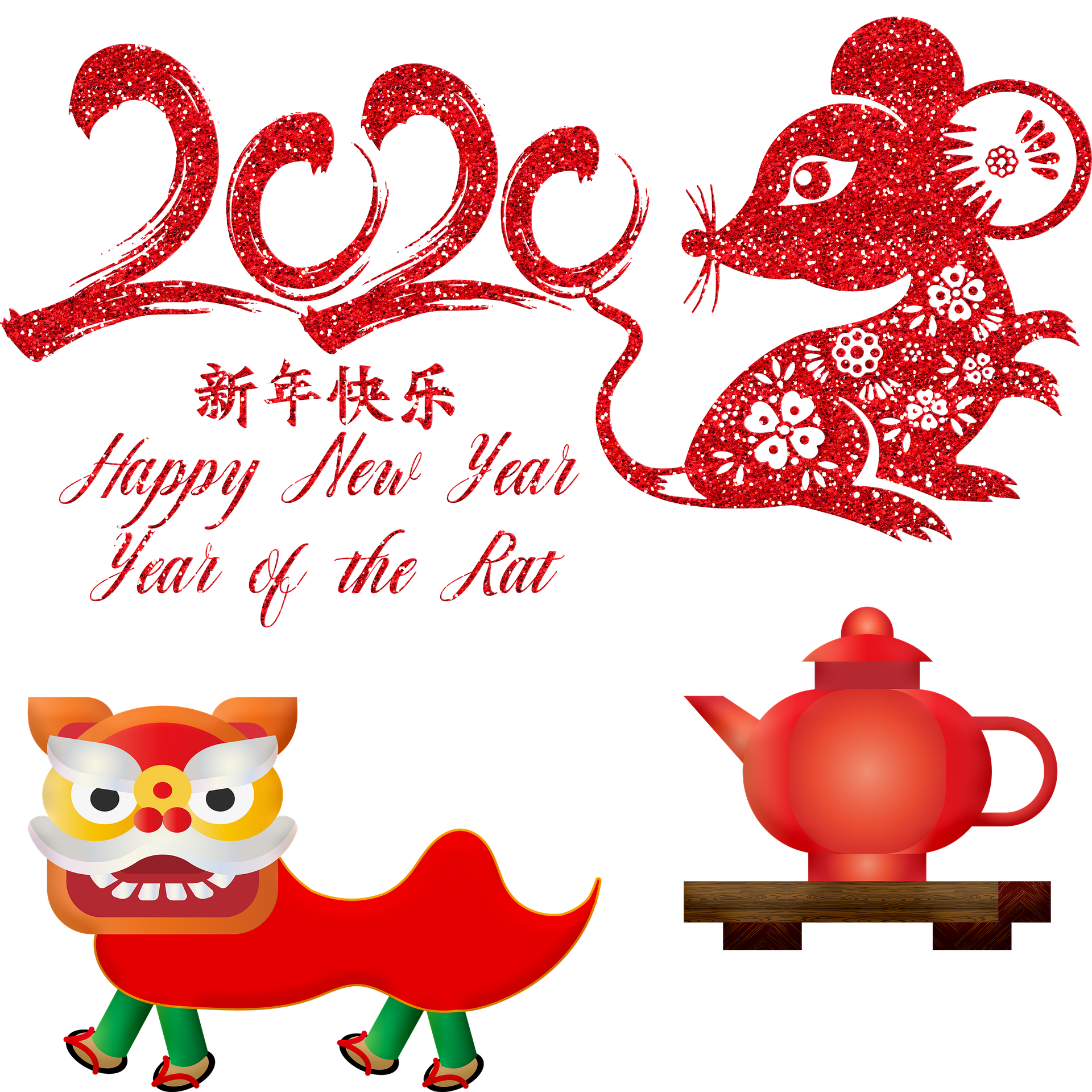
Here are a few photos from our Year of the Rat Celebrations on Saturday the 25th of January 2020. 恭喜发财 (Gung Hei Fa Choy)
Chinese New Year Celebrations for the Year of the Rat 2020
Chinese lion dance is a tradition which is at least 1000 years old. It is a fun, colourful way to bring a party atmosphere to any happy occasion. Weddings, festivals, parties, blessings, shop openings and, of course, Chinese New Year. Lion dance is huge in Asia and in many other parts of the world. As with most Chinese traditions, there are many myths, legends, symbology and folklore attached to these practices. We’ll take a look at the significance of the different lions and explore some of the hidden meanings behind them.
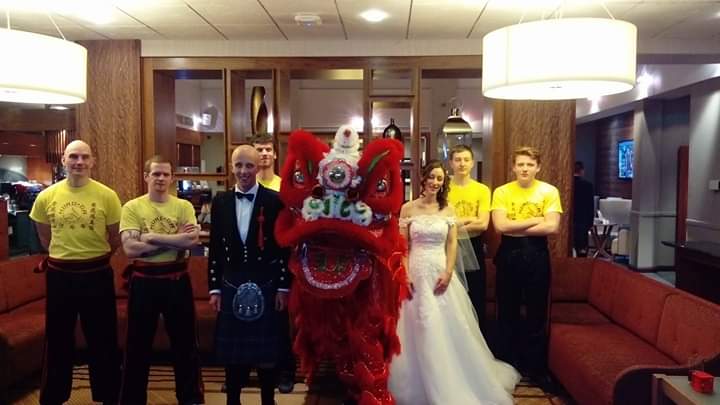
Yee’s North Scotland Lion Dance Team blessing a young couple’s wedding.
Chinese lion dances can be split into two main groups or styles, Northern and Southern. The Northern style is sometimes called Beijing style. It can be very acrobatic. They usually appear in pairs and have long, ruffled, shaggy orange and yellow hair. Dependant on whether the lion is male or female, it will have a red or green bow on the head. Male lions have a red bow and the female has a green one.
Northern lion dance tv spot. Note the coloured bows on the head.
The movements of Northern lions resemble those of a Pekingese or Fu Dog. Stunts and acrobatics such as lifts, jumps, walking on rattan poles, or balancing on giant balls are common. They sometimes appear as a family, with two large “adult” lions and a pair of small “young lions.”
A statue of a ‘fu dog’ guarding a temple, similar to a Northern lion.
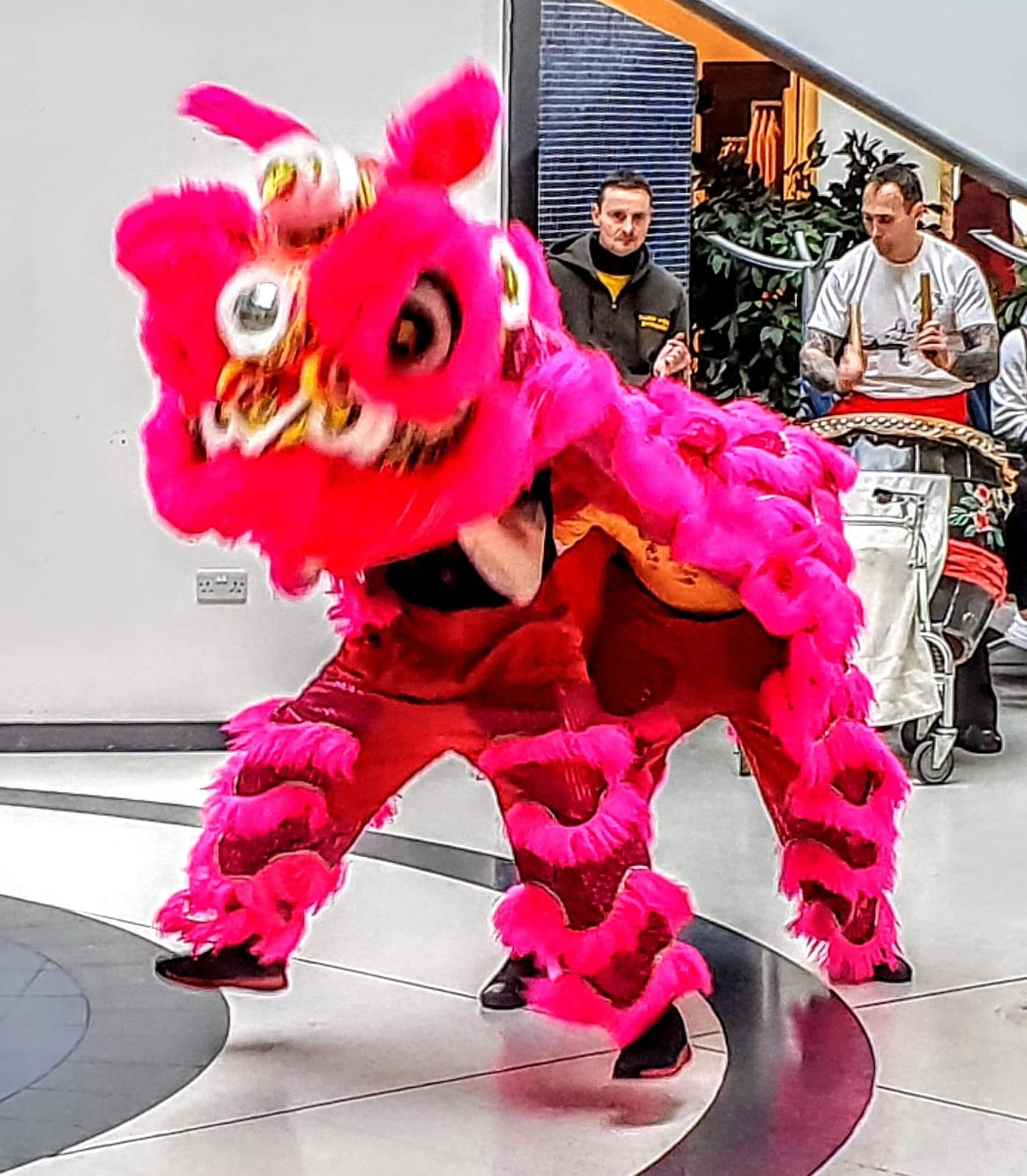
Southern lion dance is usually performed as a ceremony or blessing. The ceremonies are performed to bring luck and good fortune. The Southern lions are decorated in many different colours and they have a very uniquely shaped head. There is a mirror on the forehead and a horn above it in the center. The performers animate the lion by flashing the large eyes and flapping the ears. The mouth also opens and closes.
A colourful green lion. Note the mirror on the top.
Southern lion dance is also known as Cantonese style. There are two main groups within the Cantonese style. Fat San (Buddha Mountain) and Hok San (Crane Mountain). There are other groups too, such as Fat-Hok (a fusion of Fat San and Hok San), and the Green Lion (Qingl Shil – popular with the Fukien/Hokkien and Taiwanese).
A selection of southern style lion heads at Yee’s Hung Ga, Inverness
Fat San is common amongst many Kung Fu schools. The movements are very powerful and require considerable strength. The lion represents each individual school and demonstrates a lot of the stances and footwork involved. It also shows how strong the students are. When performing, the most senior students are therefore chosen to represent their school with the lion. It is a great honour for students to be given this privilege.
A famous lion dance scene with a complicated choi chang using Fat San Lions from the film Dreadnaught.
The Hok San style combines a Southern lion head with Northern lion movements. Hok San focuses on life-like, realistic movements, and acrobatic stunts. The tail is shorter on this type of lion. Many lion dance troupes that perform pole (jong) jumping, use this type of lion. You will often see Hok San lion dances using three different coloured lions. A black, a yellow and white lion. The black lion is the youngest of the three. The movements of this lion are performed fast, like a young child with lots of energy. The yellow lion is the middle child, it’s movements are energetic and lively. The white lion is the oldest. You may see many other colours too. A red lion is common at weddings because the colour is considered to be lucky. The red lion also symbolises courage and strength. The green lion, however, represents friendship.
The three coloured Hok San lions. Black, Yellow & White. Performing in front of the Yee’s Hung Ga, Inverness Kung Fu school.
There are also three lions which represent three brothers in arms from the classic, “Romance of the Three Kingdoms.” The characters are Liu Bei, Guan Gong and Zhang Fei. Together they swore a blood oath to restore the Han dynasty. You can read more about Guan Gong and this classical Chinese novel in our article, “Who’s the guy with the big sword thingy!”
Statues of the three sworn brothers who founded Shu Han in the Three Kingdoms Period of China
The Liu Bei lion is the eldest of the three brothers. Yellow is the main colour of his face with a white beard and fur. The imperial yellow colour is significant because it shows that he became the first emperor of the Shu-Han Kingdom. The white beard and fur shows that he was very wise. He has a multicolored tail with a white underside, representing the five elements. He also has three coins on his collar, to show that he is the eldest. The Liu Bei lion is used by kung fu schools or organisations to show that they are well established. He is also known as Rui Shi or ‘Auspicious Lion’.
A Liu Bei lion. Note the yellow colour, white beard & fur and multicoloured tail.
The Guan Gong lion has red as the main colour of his face and a long black beard. His tail is red and black coloured with a white underside and white trim. He has two coins in his collar and is referred to as the second brother. He is also known as Xing Shi meaning ‘Awakened Lion’.
Guan Gong lion with red face, long black beard and red and black tail.
The Zhang Feilion has a black coloured face with a short black beard. His tail is black and white, also with a white underside and white trim. He has bells attached to his body too. He has a single coin on his collar, showing that he is the youngest brother. This Lion is known as Dou Shi or ‘Fighting Lion’. This is because Zhang Fei had a short temper and liked fighting. Kung fu schools that are just starting out or those wanting to make a challenge might use Zhang Fei.
A Zhang Fei lion with a black & white tail, black face and black beard
Choi chang
Choi chang is a Chinese New Year tradition. Shopkeepers, restaurants and business owners attach a red envelope filled with money to a lettuce and hang it above the doorway of their premises. Kung fu schools visit the premises with their lions and perform the choi chang. The lions approach the lettuce inquisitively, with cat-like movements. They will jump up and eat the lettuce, keeping the money, and spitting out the chewed up lettuce leaves around the doorway. This brings good luck to the store during the forthcoming year. “Choi chang,” literally means picking the greens. It is seen as especially auspicious for the lettuce leaves to land on you. Sweeping the lettuce leaves up however, rather than picking them up, is seen as sweeping away the good luck and therefore unlucky.
‘picking the green’
Sometimes the lettuce is hung quite high, 15 to 20 feet. The prize in the envelopes of these lettuces can be quite considerable. Only the most skilled martial artists are able to obtain these lettuces, whilst dancing with a heavy lion head and in front of a watchful crowd. The higher the lettuce, the bigger the challenge and the greater the reward, in the red envelopes and from the crowd. Kung fu schools gain notoriety through this practice and therefore more students too.
Our lion performing the choi chang in Jimmy Chungs restaurant during a Chinese New Year celebration.
Many kung fu schools would take part in the choi chang. Occasionally more than one school might approach the same lettuce. If this is the case, the lions must fight a duel to decide a winner. The battle that takes place is not a street fighting brawl but one that uses the lion’s movements to impress the crowd. The greater the style and finesse from the performers, the greater the audience’s praise. The lions with the highest praise and cheers wins the right to complete the choi chang. The reputation of the schools are at stake during these duels so the performers must act with the highest respect and decorum.
Some famous faces in this clip demonstrate some lion dance etiquette & a battle between rival schools. From the film Martial Club
There are other types of challenges that a lion dance troupe may be confronted with instead of lettuces. Pineapples, bananas, oranges, pots, benches etc have all been used as barriers for the lion to overcome.
A lion dance performances using many obstacles for the lions to overcome. From the film The Young Master
Our own new year celebrations in Inverness will begin on Saturday the 25th of January 2020. We start out at Jimmy Chungs restaurant at 1pm, then on to the Eastgate Centre for about 2pm. We then proceed to the Victorian Market for 4.30pm and finally back to Jimmy Chungs for about 5.30pm for a final dance and some food. We would love for you to come and enjoy our celebration so that we may continue to honour this wonderful festive experience year after year. As always, we value your feedback so don’t forget to tag us in your photos #yhginverness#invernesscny20. You can also email us and let us know what you thought.
Chinese New Year is celebrated by more than 20% of the world’s population. It’s the most important holiday across China and most of Asia. There are lots of festivities from people, businesses and organisations all over the world. Yee’s Hung Ga are no exception, we have organised a free Chinese New Year Celebration for Inverness, performing lion dance displays, parades and demonstrations. You can find a link to our Facebook Event Page here:
If you would like to get involved, promote your business or would like us to perform a lion dance, please email us directly. You can keep up to date with all our displays and demonstrations on our specially created Facebook page:
The Chinese New Year of 2020 falls on January 25th (Saturday), and the festival will continue to February 8th, about 2 weeks in total. 2020 will be the Year of the Rat according to the Chinese zodiac. The Rat is the first of all the zodiac animals and represents the beginning of a new cycle. In Chinese culture, rats are seen as a sign of wealth and surplus. Because of their reproduction rate, married couples used to pray to them to bless them with children. People born in the Rat years are likable, charismatic and energetic.
The Year of the Rat
In China, you’ll hear Chinese New Year being called chunjie (春节), or the Spring Festival. It can still be very wintry, but the holiday marks the end of the cold, short days and the beginning of the days getting longer. People welcome spring and all that comes with it: planting and harvests, new beginnings and fresh starts.
Yee’s Hung Ga in New York
At Yee’s Hung Ga, we celebrate with lion and dragon dance parades. Yee’s displays in New York Chinatown are world renowned. Here, in Scotland, our displays gain ever increasing popularity and media coverage. We travel all over the North, performing at galas, highland games, weddings, festivals, special occasions and events throughout the year.
Yee’s Lions performing at Belladrum music Festival
Lion dance displays play an important role in Chinese mythology. They represent joy and happiness and symbolise power, wisdom, and superiority. The lion dance is one of the most important traditions of the Spring Festival. They are performed with the accompaniment of percussion instruments such as drums, cymbals, and gongs, synchronised to the lion dance movements and actions. People traditionally used to perform lion dances to bring luck and to get rid of evil spirits. It is performed nowadays to symbolise prosperity and good luck, for instance at a shop opening, celebration or wedding. It is also a great way to create a festive atmosphere, bringing happy times and good memories.
Yee’s Traditional Lion Dance Blessing at a young couple’s wedding.
There are many legends surrounding the customs and practices of the Spring Festival. According to one such legend, a monster called Nian (年) would appear every New Year’s Eve and terrorise the local people. Everyone would hide away in their homes from the creature. The legend tells of one boy who was brave enough to fight off Nian using firecrackers. The next day, people celebrated their survival by setting off even more firecrackers. That practice has become, forevermore, a crucial part of the Spring Festival.
Nian
In modern times we use firecrackers to make a lot of noise for celebrating and to welcome in the new year. It is customary to stay up on Chinese New Year’s Eve and set off firecrackers at midnight. In the morning, firecrackers are used again to welcome the new year and bring good luck. The most amount of fireworks are set off at this time, more than any other time of the year, anywhere in the world. Due to safety reasons and concerns for air pollution, many Chinese cities have banned fireworks. Over 500 cities also have restrictions in place too. Beijing banned fireworks for 13 years. The ban was lifted in 2006 due to public pressure. If you’re in China during this time, you’ll probably be able to hear and see the explosions for at least 3 nights (and it can go on for weeks).
Defeating Nian with firecrackers
Kung fu schools have kept the traditional lion dance alive over the years. Chinese new year is a big deal for most kung fu schools all over the world over. It is a chance to demonstrate the skills of the students and promote the school, raising awareness and interest. It is a great honour for students to be involved in these celebrations. It demonstrates a high level of commitment to the school and also that their skills are worthy of such displays. It is a great way to showcase the strong stances of the students from the school. Lion dance can be quite hard work. It requires considerable strength to carry and animate the lion heads for any length of time. At Yee’s Hung Ga, these traditions have been passed on to our students so that they may carry it on for future generations to enjoy.
Yee’s Hung Ga Inverness will be 8!
The Spring Festival also coincides, roughly, with our birthday at Yee’s, Inverness. This will be the 8th year that YHGInverness has been open on Inverness High Street. In Chinese culture, the number 8 is regarded as the luckiest number. It’s pronunced ‘Ba’ in Chinese, similar to the word ‘Fa’, which means to be prosperous. It signifies prosperity, success and high social status. We hope that this means it will be a good year for us at Yee’s. 2020 is also the year of the rat. The rat is also particularly auspicious for businesses starting new ventures.
Lions & Dragons
We celebrate our birthday and the Spring Festival together by organising the free Inverness Chinese New Year Celebrations throughout the city centre, performing lion and dragon dance displays. The lions and dragons are often confused with each other. Both dance traditions date back well over a thousand years. Although neither creature existed in ancient China, both are celebrated as mythical, powerful, and auspicious, especially during Chinese New Year and other important events. The main difference between the two is the number of performers. A lion only has two, a head and a tail performer. A dragon is very long and can have 10 performers operating it. Some of the larger dragon parades can have many many more performers. It also looks like a dragon flying in the air. It is raised up on poles and the performers move the dragon around in spirals, usually above the heads of the audience. The lion performers move around on the ground, using stances based around their style of kung fu.
Robert Burns
It should also be noted that the 25th of January is Rabbie Burns Night. Robert Burns was a famous Scottish poet who was born on this day in 1759. Burns Night, also known as a Burns Supper, is celebrated the world over. Rabbie Burns’s poems are very popular in China and have been ever since they were first published for a magazine in the 1920s.
“Gung Haggis Fat Choy”
“Gung Haggis Fat Choy” is also a thing! It is an event which began in Vancouver, Canada but has since gained popularity in other countries too. The phrase, “Gung Haggis Fat Choy,” is a fusion of Scottish and Chinese words. Haggis, being our national dish and ‘Gung Hei Fat Choy’ is a traditional Cantonese greeting used during Chinese New Year. The event, which began in 1998, is a celebration of both Burns Night and Chinese New Year which includes bagpipes and lion dances. We are certain that there will be plenty of both this year in the Highlands capital. We would love for you to come and enjoy our celebration so that we may continue to celebrate this wonderful festive experience year after year. As always, we value your feedback so don’t forget to tag us in your photos #yhginverness#invernesscny20. You can also email us and let us know what you thought.
The Horse stance, feared by some, celebrated by others! What is it, what’s the point? Let’s take a look…
Jackie Chan in Drunken Master
The horse stance (Ma Bu in Chinese), also known as the Four Point Great Stance (Sai Ping Dai Ma). It is not unique to Hung Ga, by any means, however it is of particular importance to practitioners of the Hung style. It is a basic stance for training the foundation. The foundation is the fundamental elements that support the three pillars. The fundamental elements being the strong body, including the bones, muscles ligaments, fascia and tendons. Ma Bu lowers the centre of gravity which helps the practitioner have a stable base. Practicing Ma Bu improves the structure of the body and the body’s alignment. Holding the stance can increase the stamina and determination of the practitioner, far beyond what they ever thought possible. With the correct posture, one can then focus on the breath. Having a regulated slow, deep breathing cycle has many calming benefits. It has been proven to reduce the heart rate and relax the body. With the relaxed, yet stable structure, one can then improve further with the circulation of fluids and the transportation of oxygen to the vital organs and the efficient removal of toxins, improving performance. With regular practice, the body can then heighten its performance further with the circulation of vital energy or Qi. Circulating qi around the body can have a huge benefit to physical, emotional and mental wellbeing, as well as increasing longevity, boosting energy levels and creating a barrier against diseases. This encompasses the three pillars we mentioned earlier. They are the body, the mind and the spirit. The physical body is trained by using the mind to focus and hold the static posture for a period of time. When the mind and body are synchronized in this way, over time, the spirit can elevated to higher levels.
Standing in Ma Bu takes time. It is hard. It is not the kind of practice for someone who is looking for quick results. At Yee’s, students train Ma Bu, it is a requirement for their gradings. As students advance through the system to higher levels, they must have a bigger and bigger foundation. They therefore need to train Ma Bu for longer periods of time. This is not just to pass a test but also to build the three pillars and to protect themselves from harm. This can be the downfall for many students who neglect to train Ma Bu. As students progress through he Hung Ga system, they learn more and more forms and techniques. Training Ma Bu often takes a back seat in favour of the other types of training. It can often be overlooked as it is so simple. Because it is simple, that doesn’t mean that it is easy. In fact it can be very difficult to maintain the stance for a long period of time. This is the nature of kung fu however, hard work and perseverance to achieve results. In today’s fast paced world, there are a select few people who wish to take this path. Most people try to take shortcuts or look for easier methods. For many practitioners the Ma Bu is a love/hate relationship. To succeed, you must enjoy the challenge and you must persevere through hardship.
Gordon Liu as Pai Mei in Kill Bill: Vol. 2
Are you ready to step up to the challenge? Think you can master the Ma Bu? Do you want to rise to the levels of previous kung fu masters throughout history? Good. Let your training begin….
• Stand with your feet together. Hands by your sides.
• Lift your arms up in front of you, palms up, and take a nice deep breath.
• Once you have breathed in, make fists and place them at the chamber (the groove above the hip and below the bottom rib) as you breathe out.
• Pivot on your heels and turn your toes out at an angle, creating a V shape. Pivot on the ball of the feet and turn the heels out. Pivot on the heels again to turn the toes outwards and then once more so that the toes are now pointing forward. Your feet should be fairly wide apart. Roughly the length of your lower leg.
Horse stance feet placement.
• Next, bend the knees and ‘sit’. Push your knees out so that they are above the feet. Keep your back straight and head up, with your fists in the chamber, elbows squeezed towards each other. The thighs should be almost parallel with the ground, at a slight angle. You can use a mirror to check your posture.
• Focus on your breathing. Place your tongue on the roof of your mouth and breathe through the nose. Take long, slow, deep breathes. Aim for 4-5 complete breathes in and out per minute.
• Great job. You’re now in the Ma Bu. You are practising an art which every Hung Ga master before you has also practiced, for centuries.
• Comfortable?
• Time how long you can maintain this stance for, without getting up. Every time you practice, try to beat your best time, even if it’s just a few seconds.
Sifu Hepple demonstrating the Ma Bu
How did you get on? How long did you manage before you had to get up? Let us know in the comments below. Send us an email or give us a tinkle on our social media channels.
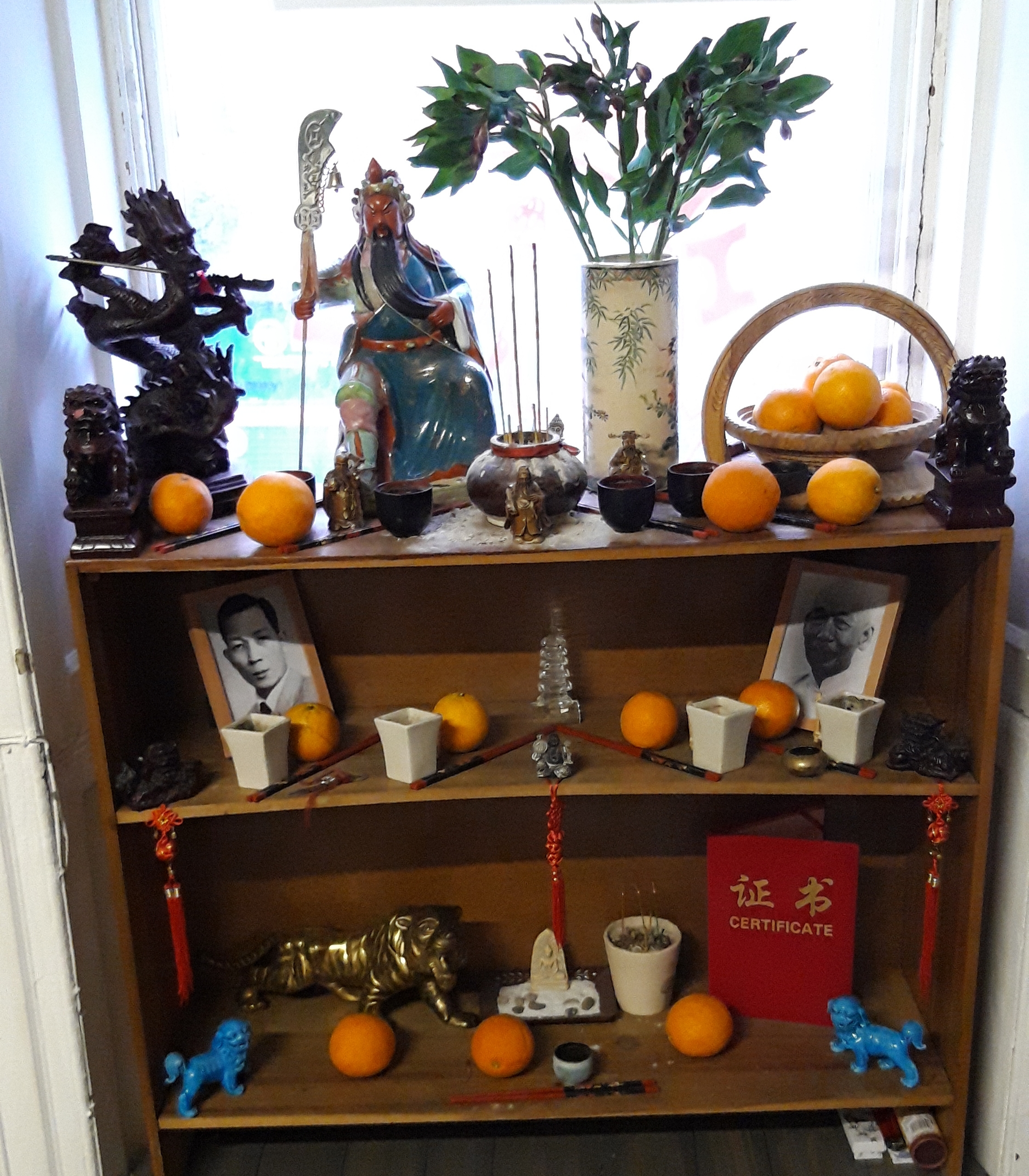
The Sun-Toi is the ancestral altar in the Mo-Kwoon (Kung Fu School). Kung fu martial artists bow to the Sun-Toi when we enter and leave the training space using the traditional ‘sun and moon fist.’ We light incense and place it in censers on the Sun-Toi. On special occasions we pour wine in the cups and put vegetables and/or meat on the Sun-Toi. It can be a small table or it could be the whole side of a wall. They can be ornately carved wooden masterpieces or a simple shelf-style structure.
The Sun-Toi (ancestral altar) at Yee’s Hung Ga, Inverness
Why do we bother? What is the point? Is it religious or specific to Chinese culture or just some bizarre, esoteric kung fu ritual? In this article we’ll answer these questions and address the necessity and value of the Sun-Toi in modern Chinese martial arts schools.
The Sun-Toi serves as a place that we can connect with the previous masters of the Hung Ga lineage. It is somewhere that we can show respect to our ancestors and keep their memory alive. We are thankful for the opportunity to practice an art form which they laid the foundation to. As practitioners, students, teachers and masters, we all hope that we will do our forefathers proud as we steer the art through modern times. We all share the common aim of making Hung Ga Kuen as relevant today, and in the future, as it was in the time of the people who passed it on to us.
The unmistakable figure of General Gwan on the Sun-Toi in Inverness
The Sun-Toi is placed in a prominent position within the Mo-Kwoon, so it is visible as soon as one enters the training space. They are uniquely personal to each individual school. Even in branches of the same school, such as Yee’s, you may find many differences from school to school. Despite there being so many differences, almost every Sun-Toi has a few common items that you may find upon it, regardless of kung fu style. General Gwan (Gwan Di, Gwan Yu) is a frequent figure which you will not only see in traditional Mo-Kwoons but also in police stations, restaurants, casinos, shops and even some family homes. His figure symbolises loyalty, trust, honesty and respect. He was known for his martial arts excellence and loyalty to his sworn brother. His figure is usually placed at the top of the Sun-Toi, to show the greatest respect. The Gwan Dao (The Spring Autumn Great Knife) is a traditional weapon named after General Gwan. Whilst performing with the weapon, there are many gestures which represent General Gwan. For example you may see the practitioner galloping as if he is riding his horse or perhaps composing his long beard in preparation for battle. It is also common to see miniature weapons, such as the Gwan Dao, on a traditional Sun-Toi. You may also see other figurines such as ‘Shishi’ or ‘foo-dogs,’ which guard the physical structure of the kwoon as well as the people who are part of it.
The censer at the foot of General Gwan on top of the Sun-Toi in Inverness
Almost every Sun-Toi will also have at least one incense holder. You may see censers for every level of the Sun-Toi or in front of pictures of the ancestors. Normally the biggest censer is placed in front of the central General Gwan figure. Many of the Hung Ga ancestors are excellent roll models, especially in today’s fast paced lifestyle of excess. They lead heroic, righteous, noble lives. Wong Fei Hung is almost certainly one of the most familiar. Their example has set a very high standard for modern martial artists to follow. Smoke from the incense is meant to cleanse the air of toxins that cannot be seen. It symbolises the connection between the ancestral spirits and our lives in the modern day. By lighting the incense we invite the essence of their positive character to motivate us in the proceedings of the present day. The smoke carries the thoughts, prayers and aspirations of the practitioner to the ancestors, or whomever they may be thinking of. As such, lighting incense can be an art form in itself. Martial artists treat the incense very respectfully and carefully, as if it were the ancestors themselves. The number of incense sticks can vary depending upon the proceedings but a common number is three, or a multiple of three, such as nine. The incense is carefully lit and fanned gently with the hand, rather than blowing or waving the sticks in the air. Two hands are always used to handle the incense and to place it in the censer. It is held above the height of the head as the practitioner bows, as if to elevate it above oneself. All these things are perceived as demonstrating awareness of the present moment, respect for tradition and appreciation of the ancestors endeavours.
Oranges, chopsticks and cups of water in front of photos of our ancestors
Fruit, such as oranges, are often placed on the Sun-Toi along with cups filled with water and also chopsticks. These are seen as symbolic gestures or offerings to pay reverence to the ancestors. The fruit represents the results of the hard work of the school. When you work hard, you gain the fruit of your labour. This is the basic principle of kung fu, to train hard and become good at what you practice, through the practice itself. Symbolically, water represents the cleansing of any wrongs. Many cultures apply the same meaning to water, to wash away sin. Water also benefits the whole world, we could not survive without it. The heart should be like the water, clear and clean. The traditional martial artist aims to be the same in their thoughts and actions. Similar to water, you may also see candles or oil lights. The light drives away the darkness and any pesky evil spirits. It represents the good in everyone. The righteous path that all traditional martial artists attempt to traverse.
Flowers signify the hard work needed to achieve a goal.
During special occasions, such as Chinese New Year; flowers, vegetables, dishes of rice, fish, chicken etc can also be placed on the Sun-Toi as a way to mark the occasion and celebrate the achievements of the Mo-Kwoon. Similar to fruit, flowers on the altar represent the hard work that accomplishes a goal or task. When you work hard your flowers will bloom. They symbolise the hard work itself, rather than the results, which the fruit represents. Wine can also replace water in the cups to signify the happy, cheerful mood of the proceedings. You may also see two chairs on either side of a traditional Sun-Toi. The right hand chair is reserved for the Si-Gung or visiting Sifus of the school. The left hand chair is for the Sifu, or Dai Si-Hing/Jai should the Sifu be away.
The Sun-Toi is not meant to be for religious purposes. As mentioned, they vary quite considerably from school to school. You may find that some schools have religious figures on their Sun-Toi if they have religious roots. For example a Shaolin school may have a figure of the Buddha because Shaolin kung fu originated in a Buddhist temple. There are many components to the Sun-Toi which can still be seen as worthwhile, without being seen as worshipping another faith. The fundamental purpose of the Sun-Toi is to pay respect to the origins and founders of the complete martial art system that we enjoy practicing daily in modern times.
If you enjoyed this post, please give it a like and share on your social media. If you wish to be notified of future articles, like our forthcoming Autumn qigong article, as well as other notices, discounts and events, pop your email address in the box below and we’ll give you a shout when new posts are added. You can also follow our journey on social media. Like and share on Instagram, twitter & Facebook
Processing…
Success! You're on the list.
Whoops! There was an error and we couldn't process your subscription. Please reload the page and try again.
All kung fu schools are very much family oriented. They are set up like a family and try to instil family values to their members. Family names are used to show respect to instructors and other students. At Yee’s Hung Ga we have many branches so it can be difficult to keep track of who is who and what the proper name should be. The following are the family names and meanings that you will commonly hear at a Yee’s Hung Ga school.
English
Cantonese
Male
Female
Door Man or Founder
Jeurng Mun Yahn
Jeurng Mun Yahn
Lineage Holder
Si-Jo
Si-Jo
Great Grandmaster
Si-Tai Gung
Si-Tai-Poa
Grandmaster
Si-Gung
Si-Poa
Senior Kung Fu Uncle
Si-Bahk
Senior Kung Fu Aunt
Si-Guma
Junior Kung Fu Uncle
Si-Sook
Junior Kung Fu Aunt
Si-Guje
Teacher/Instructor
Si-Fu
Si-Fu
Teacher’s Husband/Wife
Si-Jeong
Si-Mo
Most Senior Brother/Sister
Di-Si-Hing
Di-Si-Jeh
Senior Brother/Sister
Si-Hing
Si-Jeh
Junior Brother/Sister
Si-Dai
Si-Mui
Student
Toh-Dai
Toh-Dai
If you are a student at Yee’s Hung Ga in Inverness, anyone who has been training longer than you at the school, depending on their gender, you would call Si-Hing or Si-Jeh. Anyone who begins at the school after you would be your Si-Dai or Si-Mui, depending on their gender. They would call you Si-Hing or Si-Jeh. Sifu Hepple would be your Sifu and his wife would be called Si-Mo. Sifu Bruce Clark would be your Si-Gung. Sifu Pedro Cepero Yee and Grandmaster Yee Chee Wai would be known as Si-Tai Gung.
If visiting another local Yee’s school, the students of that school would be your cousins. You would address them just as if they were training brothers or sisters at Inverness, Si-Hing, Si-Jeh if more senior and Si-Dai or Si-Mui if junior. The Sifu of that school would be your uncle. You would call them Si-Bahk or Si-Guma if they were Sifu Hepple’s Si-Hing or Si-Jeh. If they were Sifu Hepple’s Si-Dai or Si-Mui, you would call them Si-Sook or Si-Guje.
Confused?!
This might seem rather complex and difficult to learn but it is important to maintain the traditions of the kung fu school so that we can pass on our heritage for future generations. The important ones to remember are your Sifu and Si-Mo/Si-Jeong. Showing further respect to their teacher, Si-Gung/Si-Poa, and their teacher, Si-Tai Gung/Si-Tai Poa is also expected. Everything else can be worked out and nobody else is likely to take great offence if you call them the wrong name. If you are unsure, it is always best to ask, just like anything else that you may be uncertain of.
It is also worth noting that a senior uncle/aunt/brother or sister are senior only by the length of time practicing and not necessarily of a higher rank. Your Si-Hing is, and always will be, your Si-Hing. Just as an older brother can never be demoted to a younger brother, no matter how much you may wish for it to happen.
Other important terms that you may hear is the Kwoon or Kung Fu School itself. We shall look at the etiquette within and around the Kwoon in a future post. Suffice to say though, that it is important to remain respectful and uphold composure whilst in and around the Kwoon. Inside the Kwoon is the Sun-Toi or ancestral altar. We will also discuss this in a future post too. To show respect to the ancestors, who have passed down our art from generation to generation, we bow to the Sun-Toi. We use the traditional ‘sun and moon fist’ to bow to the ancestors, whilst entering and leaving the main training area. You may also hear your Sifu or instructor counting punches or kicks etc in Cantonese. The following table will help you to learn numbers 1 to 10:
English
Cantonese
One
Yat
Two
Yee
Three
Saam
Four
Sai
Five
Ng
Six
Luk
Seven
Chat
Eight
Baat
Nine
Gau
Ten
Sahp
Perhaps you have heard a term that you are unsure of that is not listed here. Please feel free to let us know and we can discuss. If you enjoy our posts and wish to be notified of further posts, notices, discounts and events, pop your email address in the box below and we’ll give you a shout when new posts are added. You can also like and share on Instagram & Facebook
Processing…
Success! You're on the list.
Whoops! There was an error and we couldn't process your subscription. Please reload the page and try again.
The Shaolin Monastery, or Shaolin Temple, is a Buddhist temple in Dengfeng County, Henan Province, China. The name ‘Shaolin’ refers to the location of the temple. It is situated in the forests of Shaoshi mountain, one of the seven peaks of the Song mountains. It literally means “Temple of Shao[shi Mountain] Forest”.
Ariel views of the Shaolin Temple.
The Shaolin Temple is known, not only as the birthplace of Chan, or “Zen,” Buddhism, in China, but also where kung fu martial arts originated. The temple is steeped in myths and legends. (More about these in future posts) Shaolin became a renowned centre for extremely powerful martial arts. As the teachings of Shaolin grew, other Shaolin monasteries appeared across China. From a Southern monastery came the lineage of the Abbot Gee Sim Sim See. He is recognised as the first person to bring Shaolin martial arts out of the temple and to the people of Southern China.
Gee Sim taught five founding fathers of “Southern Shaolin.” The five families of martial arts from the Gee Sim lineage became Hung Ga, Choy Ga, Mok Ga, Lau Ga and Li Ga. The “Ga,” or sometimes “Gar,” means family, in this case the Hung family. The founding father of the Hung family was Hung Hei Guen and therefore it is named after him.
Donnie Yen plays Hung Hei Guen in the 1994 TV series, “The Kung Fu Master”
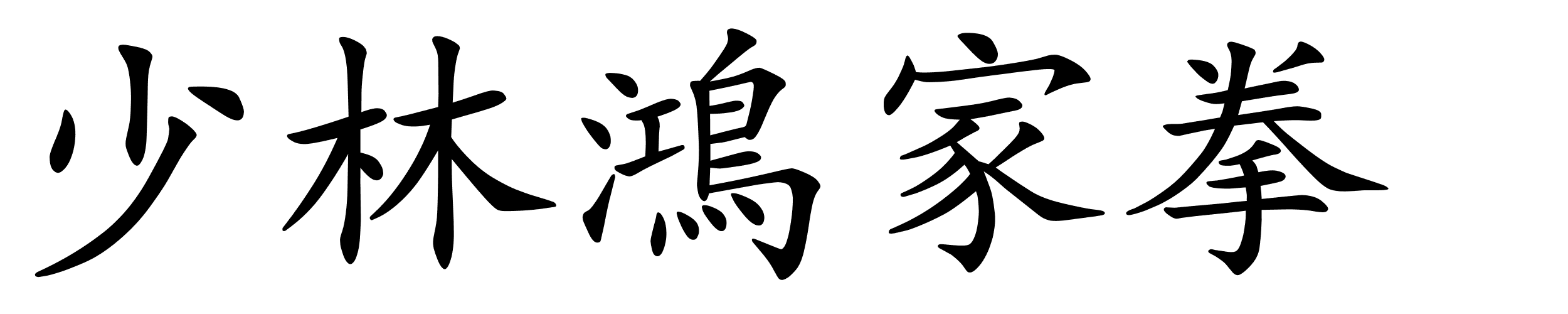
“Kuen” means fist, but in this case “fist” refers to the art or system of fighting, not just the hand shape. Therefore “Shaolin Hung Ga Kuen,” means, “The fighting art of the Hung family from the temple in the forest of Shaoshi Mountain.”
In general terms, the Hung Ga art is renowned for very strong, rooted stances and extremely powerful arm movements. Training concentrates heavily on stance work, body and arm conditioning, qigong, and practicing the forms or set routines. Yee’s Hung Ga run classes for you to specifically train each of these key areas. The forms are a way of practicing fighting techniques as well as a tool for developing a strong mind and body. One of the most famous forms in the world is the Tiger Crane Double Fist (Fu Hok Seung Ying Kuen). This form is at the core of the entire Hung Ga art.
A montage of Hung Ga Kuen, as portrayed in the movies.
If you have a question that you would like to ask us, why not send us an email or get in touch via our social media? Just search for YHGInverness.
If you like our blog posts, you can also sign up for notifications of further posts, notices, discounts and events, pop your email address in the box below and we’ll give you a shout when new posts are added. You can also like and share on Instagram, twitter & Facebook
Processing…
Success! You're on the list.
Whoops! There was an error and we couldn't process your subscription. Please reload the page and try again.
On Sunday 9th June 2019, the World Headquarters of Yee’s Hung Ga International Kung Fu Association appointed new governing positions to the UK & European Headquarters. These new positions will help in overseeing the numerous branches that have descended from the expansion of our disciples in the UK and across Europe. They are charged with maintaining the quality, philosophy and direction of our Association. In a ceremony in Edinburgh, UK, Grandmaster Frank Yee (Yee Chee Wai) presented certificates, the appointees took oaths of office for their positions in the organization.
Grandmaster Frank Yee is seated in the middle, on his left is Sifu Ian Rose, President, and on his right is Sifu Conrad Barrett-Freeman, Chairman.From Sifu Ian Rose’s left to the end: Sifu Michael Rose (Vice-President), Sifu Simon Hepple (2nd Vice-President), Sifu Paul Leslie (3rd Vice-President). From Sifu Conrad Barrett-Freeman’s right to the end: Sifu Philip Horey (Vice-Chairman), Sifu Hannah Dawson (2nd Vice-Chairman), absent from photo is Sifu Simon Finlayson (3rd Vice-Chairman).
Grandmaster Yee, lighting incense to pay respects to the ancestors and invite them to witness proceedings.
Grandmaster Yee handing out incese and giving instruction on the traditional Shaolin bow so we can pay respects to the ancestors and forefathers of Hung Ga.
Another important ceremony which took place on Sunday the 9th June was the Bai Si. The Bai Si ceremony is often referred to as the “discipleship ceremony” or “tea ceremony.” It is not often seen in many western martial arts schools. At Yee’s Hung Ga, we feel that it is important to preserve our art in all its forms, this includes official ceremonies such as these, so that we can pass on the complete art to future generations. It is perhaps the most important ceremony a martial artist, in kung fu, could ever be invited to participate in.
In China, many of the kung fu systems were passed down through the generations to family members only. The higher levels were considered private and secret. Traditionally a Sifu would agree to teach students out-with the family, but with caution. General classes, available to everyone, were often held in public areas, parks or inside the courtyard of the Sifu’s own home. When a student first began their training, and were not well known to the Sifu, they weren’t trusted enough to actually be taught inside the Sifu’s house. These were known as, “outside students.” Once the student earned the trust of their Sifu, a Bai Si ceremony took place. This made the student an “indoor student.” It meant that the student had gained the complete trust of their Sifu and would be taught the whole martial arts system. The Bai Si ceremony also confirmed the relationship between a Sifu and the student. If you completed a Bai Si ceremony the student was given a name in the Sifu’s family and they were treated like a son or daughter.
After almost 19 years of diligent practice and loyal conduct, the great honour of performing this ceremony was bestowed upon Sifu Hepple by his Sifu, Bruce Clark. Other highly trusted martial artists were also given the privilege at the same time. It was witnessed by Sifu Ian Rose, in front of a small group of people. After the ceremony, speeches were given. It was a great chance to celebrate together by sharing some food and drinking a toast after the proceedings.
Sifi Hepple receiving his discipleship certificate from Grandmaster Yee.
If you enjoy our posts and wish to be notified of further posts, notices, discounts and events, pop your email address in the box below and we’ll give you a shout when new posts are added. You can also like and share on Instagram, twitter & Facebook
Processing…
Success! You're on the list.
Whoops! There was an error and we couldn't process your subscription. Please reload the page and try again.
In our Student Spotlight series, our students have the opportunity to tell you about their training in their own words. Allan Poko has been training for a little under 10 months, (6/5/19) he has participated in lion dance displays for our Chinese New Year Celebrations and is a committed student, trying to take part in as many classes as he can make it along to. He is currently training for his Yat Cup Junior level (1st test of 1st level) Here Allan tells you about his experience training at Yee’s Hung Kung Fu Academy in Inverness.
What made you want to train in martial arts?
I was lucky enough to see the shoalin monks perform at Eden Court with my daughter. Since then I’ve been very inspired to learn more about Chinese martial arts and culture.
How did you hear about the school?
I was walking past the school one day and I picked up a flyer at the door.
What was your first class like?
I remember going up the stairs feeling very nervous but at the same time I felt the calmness of the school which made me very excited to learn and find out more about the school.
Did it live up to your expectations?
Yes very much so.
How did you feel after your first class?
I won’t forget how calm and relaxed I was after my first class. It was like an energy boost. Also, for me, all I wanted to do from that point on was to train and learn more.
What do you think of your training so far? Is there anything you’d change?
My training so far has been excellent! I try to go to all of the classes now as I enjoy the training so much. What I like the most is I can train and learn at my own pace. Personally I don’t think there is any need for anything to be changed.
What are your hopes for your future in martial arts?
My hopes for the future is to learn as much Kung fu as possible. For my health and fitness, for my own personal safety and protection and to learn and understand the Chinese philosophy and culture of Kung fu.
Anything else that you wish to add?
I would like to say, prior to me joining our school, my life was at a very low point. Yee’s Hung Ga Inverness saved me. I was struggling mentally and physically. Since joining the school it has given me focus and done wonders for my confidence and self asteem. Joining Yee’s Hung Ga Inverness is one of the best things I have ever done in my life so far. I feel very humbled to be part of the Inverness branch community, so big respect to my sifu and all of the other students whom train along with me.
If you enjoy our posts and wish to be notified of further posts, notices, discounts and events, pop your email address in the box below and we’ll give you a shout when new posts are added. You can also like and share on Instagram, twitter & Facebook
Processing…
Success! You're on the list.
Whoops! There was an error and we couldn't process your subscription. Please reload the page and try again.
A common question asked about Yee’s Hung Ga is, “Do you have a grading system or belts, like in other martial arts?”
Coloured martial arts belts
There are many martial arts which have a grading system. As the student passes through the different grades and attains a higher level of skill, they also obtain a different coloured belt to show the practitioner’s rank within the system. Normally a white belt is given to a novice and a black belt is given to a proficient or skilled practitioner. It is said that originally all novices started off with a white belt and over the years of training the white colour turned to a dark grey/black, which is where the coveted black belt stems from. All the colours in between have been added in recent years, varying in degrees of brightness, from white to black (i.e. yellow, orange, red, purple, brown etc) to portray the idea that the student has trained hard enough for the belt to change colour. There are many other martial art systems that don’t have coloured belts but still have gradings. There is also a lot of tradition and etiquette surrounding the different belts of each martial art, for instance how they are tied, which side of the body the knot is tied on, how they are stored and looked after etc. These traditions are usually specific to the individual martial art system.
At Yee’s Hung Ga we have a grading system where student’s skills are tested regularly. The student begins with a black sash and as they pass through the different skill levels, a red stripe is added to the end of the sash to display the student’s rank.There are 3 main levels. Each level has 2 tests, a junior and senior.
1st level (yat cup) sash displays a single stripe to show 1st the rank.2nd level (yee cup) sash, displays 2 stripes.3rd level (Saam cup) sash displays 3 stripes.
When the student completes all 3 levels, they may then begin their ‘Jo Gow’ (black belt) training. Once the Jo Gow has been attained, a red stripe is attached all around the black sash.
A Jo Gow (black belt) Sash
Attaining this level is cause for a big celebration. It demonstrates that the student has mastered the basic skills of the Hung Ga system, which is a notoriously difficult level to reach. At the Jo Gow level, a student is considered an Assistant Instructor. To become a full-fledged Instructor (Sifu), 2 years of additional intensive training is required. Training does not end with becoming a Sifu. Sifus must continue their training and testing to progress through the 10 Dan (Levels) if they wish to understand the full depth of the Yee’s Hung Ga art – a feat that requires great dedication, loyalty and passion for the art.
Through these rigid training and testing protocols, Yee’s Hung Ga is able to preserve the highest levels of quality and integrity of the Hung Ga style passed down through its lineage, while simultaneously and uniformly advancing the art itself. Very few martial arts systems go to such lengths to maintain quality instruction.
If you enjoy our posts and wish to be notified of further posts, notices, discounts and events, pop your email address in the box below and we’ll give you a shout when new posts are added. You can also like and share on Instagram, twitter & Facebook
Processing…
Success! You're on the list.
Whoops! There was an error and we couldn't process your subscription. Please reload the page and try again.
You’ve worked hard all day and you’re tired. Despite this you’ve dragged yourself off the couch, on a chilly winter evening, to make it to class. You’re psyching yourself up in the changing room whilst getting ready. You suddenly remember that you forgot to go to the bank on the way.
How are you going to pay for the class? You could get changed again and nip out to the cash machine? Maybe just run out in your uniform? Class is about to start though and you daren’t turn up late! Perhaps one of your training brothers or sisters could lend you….. Nobody has any spare cash on them either though!
Don’t stress it, we can now accept contactless and card payments from all major credit and debit cards.
Phew, that’s a relief! One less thing to worry about.
You can also use all major credit and debit cards to pay for items on the Fu-kit section of our website via PayPal. Even if you don’t have a PayPal account.
If you enjoy our posts and wish to be notified of further posts, notices, discounts and events, pop your email address in the box below and we’ll give you a shout when new posts are added. You can also like and share on Instagram, twitter & Facebook
Processing…
Success! You're on the list.
Whoops! There was an error and we couldn't process your subscription. Please reload the page and try again.
In honour of the World Tai Chi & Qigong Day, Yee’s Hung Ga Kung Fu Academy, Inverness will be hosting a FREE workshop on The Silk Reeling Exercise, beginning at 10am on Saturday the 29th of April. This will be the fourth time that YHGInverness has hosted a free event for WTCQD. The Silk Reeling exercise is a set of repetitive spiralling movements with the arms and hands. The gradual opening and closing movements create inner energy circulation. The silk reeling exercise not only improves one’s spinal alignment but it can increase one’s flexibility, joint movement, and balance. It is also an exercise for internal power training. The Silk Reeling exercise is easy to learn and suitable for beginners as well as people of all ages and skill levels. The exercise will be taught in easy to learn steps by Sifu Simon Hepple, chief instructor and owner of Yee’s Hung Ga Kung Fu Academy in Inverness. After the workshop The Silk Reeling exercise will be added to the comprehensive qigong curriculum at Yee’s Hung Ga, Inverness, so don’t miss this fantastic opportunity to learn this set absolutely FREE! For updates on the event you can check out our Facebook Event or you can contact Sifu Hepple with the following form:
If you enjoy our posts and wish to be notified of further posts, notices, discounts and events, pop your email address in the box below and we’ll give you a shout when new posts are added. You can also like and share on Instagram, twitter & Facebook
Processing…
Success! You're on the list.
Whoops! There was an error and we couldn't process your subscription. Please reload the page and try again.
This is a picture of Sifu Hepple and John Weaver. John has been practicing for 3-4 years now and is currently training towards his Yee Cup Jr (1st test of the 2nd level) Grading. Here John tells, in his own words, of his experience training at Yee’s Hung Ga Academy in Inverness.
What made you want to train in martial arts?
I previously trained in Jujitsu when I was about eight years old. When I reached twenty four, I became very interested in practising meditation, healing arts and focusing (balancing) my mental/physical energies. I read books, became Reiki attuned and watched videos to increase my knowledge on the subject. This led me to learn versions of qi gong, from some new age teachers and other kung fu personalities. I think I was the ripe old age of thirty one before I attempted to do kung fu work out drills; I was completely exhausted and realised I knew nothing of the hard work and discipline that was required to achieve what I wanted. It was then I started looking for a teacher.
How did you hear about this school and why did you want to train there? What were your expectations before you started?
Kung Fu was the obvious choice for me based on my interests. I did a little research on the different styles, and thought about what may suit my body type. I knew already I would prefer something that would be powerful and balanced, but more hand based rather than the flippy-flappy leg kicks. I saw some videos of the Hung style online after finding out that a new had school opened up in Inverness. I contacted Sifu to see if he would accept me as a student, and the rest is history. My expectations were realistic; having tried to keep up with drills on dvds and failed, I was open to whatever lessons Sifu had for me in order to progress.
What was your first class like?
I was slightly nervous and wondered what the other students would be like. At that very first class, I mentioned some of the things I had been doing and Sifu responded “this may be a little different to what you’re used to!” He proceeded to show us Tiger techniques, specifically how to break an opponents arm. After that class, I was aching all over. My legs felt like jelly, and I thought it would be very hard to build up my fitness to an acceptable level to continue. However, I stuck with it and after a further four or five lessons I got used to doing the warm up exercises! It is quite invigorating once you have built up the stamina and I am glad I have continued with my training. My life has changed considerably in the last two years and I now have a young family and a home to maintain. I haven’t had as much time as I would have liked to train recently but as my understanding of Hung Ga grows, so does my desire to push myself further.
What do you think of your training so far? Is there anything that you would change?
So far I have learnt the full Gung Gi Fuk Fu form and am now learning Fu Hok. I have also learnt about the theory of Hung Ga and some of the additional exercises that can be done to unlock potential skills; fighting and some softer skills like balance, conditioning and strengthening. I have attended seminars in Aberdeen with Grandmaster Yee Chee Wai and our Sifu’s teacher, Si Gung Bruce Clark – both are very well respected Martial Artists. It is hard to start with, but if you try and push through it is very much worth your while. Our Kwoon (school) is very friendly, and Sifu obviously loves Hung Ga; showing us how it becomes a solid foundation in life. I would change nothing about the training given but if I could give advice to other beginners it would be to put three times as much effort in to practising at home, as you do in class. Basic drills, form and practising stances – but also looking at the ways in which Qi Gong and breath exercises can improve your general well-being.
What are your hopes for your future in martial arts?
My hopes for the future are to continue training, and to push myself further. My aim at the moment is to improve my stances, transitions between movements and get more sparring practice to apply what I have learned. I enjoy the traditional Lion Dance practice and would like to do more of that for the school in the coming years.
Anything else that you wish to add?
While studying for the Fuk Fu test, I wrote this down. ‘Kung Fu is something that cannot be bought or stolen; you cannot cheat or make it easier as it is what it is. You get out what you put into it via training – body and mind with a strong spirit.’ I am beginning to understand more on the concept of ‘martial virtue’ and can say that with Kung Fu, actions speak louder than words – so come join us.
If you enjoy our posts and wish to be notified of further posts, notices, discounts and events, pop your email address in the box below and we’ll give you a shout when new posts are added. You can also like and share on Instagram & Facebook
Processing…
Success! You're on the list.
Whoops! There was an error and we couldn't process your subscription. Please reload the page and try again.
Whether you’re just starting out or you’re a seasoned warrior, it can sometimes feel difficult to keep yourself motivated, especially with the cold weather, dark nights, the hectic partying over the festive period taking its toll on the body. It can be a bit of a slog getting yourself back into a routine and keeping that routine going. If one of your New Years Resolutions is to get fit and healthy, like many other people, you might be thinking about attending one of our classes. If you are serious about taking it past the thinking stage and really want to attend, (obviously we would highly recommend that you do and you would be most welcome.) what steps can you take to ensure that your first class isn’t also your last? What if even your best intentions aren’t good enough and you run out of steam before you even get up and running? Well we’re not going to lie to you, there’s no magic wand. You still have to actually make it to class (on time!) and you still have to do the work but here’s our top 10 hints & tips on keeping yourself keeping going.
#1. Patience
It takes time, don’t be put off if you don’t see results straight away. Looks can be deceiving. You may not see results for a while, especially if you are just starting out. It takes time to learn and to build muscle memory. You may hear claims that you can be a master in a short time, “Learn Kung Fu in 3 Months,” “Become a master in only 2 weeks.” There are some things that you can learn and use straight away but to be a master you first need to learn and that can take time, patience and lots of practice.
Just because you’re not seeing results it doesn’t mean that you are not getting any. You are better today than you were yesterday, try to remember that. Your brain will get better at sending messages to your body and your body will get better at receiving and understanding them. You will actually be able to activate a higher percentage of your muscle fibers, commonly referred to as neuromuscular efficiency. Your coordination will improve, reflexes start to become faster, your breathing and focus will increase. It is a slow process because you are bound by your body’s limitations, just be patient. Don’t look in the mirror after two weeks and wonder why you’re not looking like Bruce Lee or why you’re not managing to quite get the results that you are looking for. Be patient and put in the work, the results will come.
#2. Enjoy the journey.
Try not to think of your goals as the soul purpose for training, that’s just a destination. Enjoy the process and get excited about what you are learning. If you enjoy what you are doing you are more likely to keep it up. Get excited. You have to want to do it. If you force yourself, it could have negative results. Instead of looking negatively at things that you are not so good at or find difficult, try and turn your thinking around. Be positive about it and see if you can work at those things, bit by bit, to get better at them. Chip away a little bit every day and they will soon become less of a problem.
#3. Don’t rush!
Arrive early, give yourself time. If you leave things to the last minute it gives your mind one more excuse to back out of it. If you have plenty time and are well prepared then you are less likely to change your mind at the last minute. Make sure you have your kit ready the day before. Write a list of all the things that you need to take with you and make sure you check your list every time you get yourself ready. Plan your trip, where you’re going to park the car, how long will it take you to get there? Allow extra time in case of slow traffic or for events beyond your control. If you think ahead and plan in advance you will put yourself in the right frame of mind and it will give you less excuses to not go through with it.
#4. Are you keeping track?
Keeping records can help you to remember what you have learned. What did you get out of class today? Did you just go through the motions or did you pick something up? Were there any “light-bulb moments?” Keeping a training diary can help you to remember information and focus on learning. It can also help you to look back and see how far you have come in your training. You can also see what went wrong, should you get injured, and learn from any mistakes.
If you can only make it to the occasional class, it is down to you to make the effort to practice between those classes. Your Sifu will give you advice on what and how to practice. If you just practice bits of what you remember, it may be that you are not paying attention to the right things or worse, practicing them the wrong way. You should know it inside out and back to front.
#5. Stick to a plan
Remove the randomness from your training. This is the best way to improve your speed, strength, focus, body weight…. any of your goals in fact. For a beginner it can be tempting to try out all the different classes that are available to you at Yee’s but it is better to pick one or two which you can definitely, regularly make, every week. Stick to them and make them part of your routine. When you feel more confident in what you have learned and you have time available to try out the other classes, then give them a go. Too much, too soon is a recipe for failure.
#6. Do it for yourself.
Do it for yourself, not because of anyone else. Come with friends but don’t stay at home just because they decided that they couldn’t be bothered. Their excuses will turn into your excuses. You must do it because you want to do it for yourself. Similarly, try not to compare yourself to others. Everyone has strengths and weaknesses so whilst you might not be as good as the one you are comparing yourself to, they might not be as good as you at other things. They may also be further ahead in their training or have practiced more or many other reasons. If you practice, you will become better. If you practice a lot, you will become a lot better. Sometimes it takes longer for some people so just relax and enjoy the ride.
#7. Prevention is better than cure.
Be sensible about how you train. An injury can set you back months, perhaps even years. It may stop you training altogether. It is important in the beginning to take things slowly until your body gets used to it. If you push too hard, you can injure yourself. Ensure that your body is warmed up gently and muscles are stretched before you do your main practice. You will have to do this every time and you will have to factor the time it takes into your practice. Similarly, a cool down routine can help to bring your body back to normal. Again gentle stretching can be useful. After your training your muscle fibers will be warmed up and loose. The sudden shock from the cold outside, especially in the North of Scotland, can cause them to constrict. Problems may result from over tension such as muscular cramps and pain, twisting and knotting of the muscle fibers. Be sensible and have an extra layer of clothing to put on before you head out into the cold. Our training hoodies are perfect for this purpose.
#8. If you don’t make time, you’ll never have time.
You need to factor time into your daily routine or weekly schedule. If you don’t have one, make one! Fit it into your lifestyle. It is difficult juggling everything in your life but the bottom line is that if you don’t do it, then you won’t do it. Spare time can seem to be a rarity in modern life and if you really want to do something, you will have to make the effort to make it happen. With kung fu this means making time to practice. In the same way though, if you do nothing but practice then you will not have time for anything or anyone else so you need to find a balance. Make it happen!!
#9. Rise to the challenge!
Treat it like a test. Everything that you find hard is an obstacle to you becoming better and achieving your goals. If you clear the obstacle then you are one step closer. If you don’t quite make it then it’s no big deal, just try again. It may take you many attempts. Many, many, many attempts in fact. This is the challenge that you face. Give up, find an easier way or just keep chipping away until you get it. The nature of kung fu means that you kind of do all 3. You try until you get it, you understand the movement. You then find an economy in the movement, simplify it, make it easy. Then, when you get it, you leave it. It’s there now until you need it. You just need to maintain it. Great skill obtained through hard practice.
#10. Don’t beat yourself up
You’ve all seen the motivational memes on social media, “Failure is not an option!” “Winners never quit!” ” You haven’t failed until you quit trying!”
Jeezzz….. Give yourself a break, we are only human. Circumstances might mean that you have to put things aside for a while. You might have to give yourself some time to focus on other areas of your life. Family, work, friends, commitments. You know what that is? That’s life! (That’s what people say, You’re riding high in April, Shot down in May) It doesn’t mean that you’ve failed. If you falter or can’t remember or didn’t practice or took the day off, it doesn’t matter. Everyone needs a break. In fact it is advisable to take a break every once in a while. “All work and no play makes Jack a very dull boy!” Have you never seen ‘The Shining’ before?!? It only becomes a problem if you let it. You gave it a shot, you turned up for class and you trained really hard. That’s more than a lot of people ever do. A lot of people never get further than giving it a whimsical thought. “Wouldn’t it be amazing to be able to move like that?” “I wish I was as strong or graceful as that?” But you actually made the effort. That is amazing in itself. (a round of applause please!) If you need a breather, that’s not failing, that’s being realistic. Just don’t let it get to you. Get back in the saddle again and own it!! Take your training to the next level and achieve what you set out to do.
See you in class…
If you enjoy our posts and wish to be notified of further posts, notices, discounts and events, pop your email address in the box below and we’ll give you a shout when new posts are added. You can also like and share on Instagram, twitter & Facebook
Processing…
Success! You're on the list.
Whoops! There was an error and we couldn't process your subscription. Please reload the page and try again.
The guy with the big sword thingy goes by a few names, Guan Yu, Guan Gong, Guan Di, General Gwan, amongst many others. In the ancient times of the East, there was a great war between Three Kingdoms. Guan Yu, and his friends, Liu Bei and Zheng Fei, swore an oath of brotherhood in the mystical Peach Garden, vowing to create a new, righteous world. Together they fought countless battles against the warlords Cao Cao and Sun Quan. Guan Yu grew famous for his combat prowess and unwavering honor.
Cao Cao captured Guan Yu and at the time, Liu Bei’s fate was uncertain. He agreed to fight for Cao Cao under specific terms, chiefly that he would abandon Cao Cao if ever he learned the whereabouts of his sworn brother. Despite Cao Cao’s gifts and promises of wealth, when Liu Bei resurfaced, Guan Yu immediately went to his side. Years later, Guan Yu again faced Cao Cao on the battlefield as the warlord fled from his defeat at Red Cliffs. Guan Yu cut off Cao Cao’s retreat and obliterated his forces. He spared Cao Cao, however, and released him, as an act of honor.
Guan Yu is one of the best known historical figures in ancient history. Part of the reason for this is that he appears in popular comics and movies, even modern video games. He is also a major character in The Romance of the Three Kingdoms, a semi-historical novel said to be written by Luo Guan Zhong at the end of the Yuan Dynasty period (1279-1368). This novel is one of China’s four greatest classic novels. Partly because of fictional portrayals in The Romance of the Three Kingdoms, his reputation has only increased over the years. A famous tale about Guan Yu is that he was once injured in the left arm by a stray arrow, which pierced through his arm. Although the wound had healed, he would experience pain in the bone whenever there was a heavy downpour. A physician told him, “The arrowhead had poison on it and the poison had seeped into the bone. The only way to get rid of this problem is to cut open your arm and scrape away the poison in your bone.” Guan Yu then stretched out his arm and asked the physician to heal him. He then invited his subordinates to dine with him while the surgery was being performed. Blood flowed from his arm into a container below. Throughout the operation, Guan Yu feasted and drank wine and chatted with his men as though nothing had happened. In some accounts of the tale he sits calmly and plays a game of weiqi (Chinese chess)
Guan Yu being operated on. Guan Yu Comic BookThe Romance of the Three Kingdoms book
In the Western world, Guan Yu is sometimes called the God of War, probably because he is one of the most well-known military generals revered by the Chinese people. This is a misconception of his role, as, unlike the Greco-Roman deity Mars or the Norse god Týr, Guan Yu, as a god, does not necessarily bless those who go to battle, but rather people who observe the code of brotherhood and righteousness.
Giant Guan Yu Statue, 190ft tall
The big sword thingy that he can be seen with is the Spring/Autumn Great Knife. It is often named after him, some legends say that he invented it. The Guan dao, or kwan dao, is a large halberd which was used by the general during combat on horse-back. It is a heavy weapon with a sharp edge on one side for cutting and slicing. On the other side is a jagged edge with a hooked point which is used to maim and stab as well as for catching the opponent’s weapon to disarm them. The weapon is balanced with a pointed counterweight at the other end of the central shaft. Guan Yu’s “guan dao” was called “Green Dragon Crescent Blade” which weighed 82 Chinese jin (estimated 18.263kg or around 40lbs, there are tales of it being over 300lbs) and that he was extremely proficient with it on the battlefield.
Green dragon Guan Dao
If you enjoy our posts and wish to be notified of further posts, notices, discounts and events, pop your email address in the box below and we’ll give you a shout when new posts are added. You can also like and share on Instagram, twitter & Facebook
Processing…
Success! You're on the list.
Whoops! There was an error and we couldn't process your subscription. Please reload the page and try again.
Almost 2 years ago, we did some major work in the school. A partition wall was taken down and new flooring added to make the training space bigger and level out the floors.
Original layout with partition wall on right
After wall had been taken down and new suspended flooring laid down.
From the above photos you can see the changes that we made.
We recently gave the flooring another facelift, just to spruce it up a bit. you can see from the following photos how they have been transformed.
We are very proud of the finished result. It makes the training space look a lot more spacious and better to train on too. 🙂
After a lot of hard work, our school garden/training space is slowly taking shape. All the organic waste from the school (paper, card, tea bags, banana skins, weeds old oranges from the altar etc) gets turned into compost. At this time of year we collect all the leaves from the sycamore tree in the garden too, and turn those into leaf mold.
The compost and leaf bins at YHGInverness
We use the compost and leaf mold to grow specific plants. One of them is Jing Jie, sometimes called Japanese Catnip or Schizonepeta Tenuifolia. This medicinal herb has many uses including the treatment of the common cold, sore throats, nettle rash and skin disorders like eczema. We grow the plant because it relieves body aches and it has hemostatic, antibiotic and anti-inflammatory properties. All of which mean that it is excellent for treating bruises. It is one of the plants used in our famous Dit Da Jow recipe.
Keep an eye out for future updates about our garden/training space and our Dit Da Jow medicine.
A common question from new students is, “What’s with all the oranges on the altar?”
Oranges are a common sight on Chinese shrines and altars. You may also see flowers or cups of tea as well as other types of food with incense burning nearby and statues or figures of deities. During Chinese New Year tangerines and oranges are given as a symbol of good fortune and riches because of the golden colour and their round shape which are both seen as auspicious. Tangerines represent wealth where oranges are a popular symbol of good luck. The associations come from a similarity between the Chinese words for tangerine and gold, as well as a resemblance between the words orange and good luck.
Hung Ga Kuen is also a style of kung fu derived from the Shaolin Temple. Shaolin is a Buddhist temple and in Buddhist culture, fruit symbolizes enlightenment, the ultimate goal of all humans. Offerings are not made to please Buddha, since he is seen to already possess universal love and compassion. Instead, the altars and offerings promote positive energy for the ancestors of the family or tradition.
The last Saturday in April every year plays host to World Tai Chi & Qigong Day. It is part of a global effort to promote the healing aspects of Tai Chi and Qigong within our society. For the second year running YHGInverness participated in this global celebration by hosting a free Qigong seminar/workshop. Sifu Hepple, Chief Instructor at YHGInverness, conducted the seminar on the Yi Jin Jing, (Muscle/Tendon Changing Classic) which is a Qigong set or ‘form’ thought to have been developed by the Indian Buddhist Monk Bodhidharma, the legendary monk who began the physical training of the monks at the Shaolin Temple and thus credited as the originator of Shaolin Kung Fu.
The set was taught step by step until complete. Once the whole set had been learned, the key points of each exercise and how they work with the meridian channel system of the body was discussed. During Qigong exercises Qi, or internal energy, within the body is manipulated for specific health purposes. This can be achieved by moving your body in a certain way to stimulate specific organs of the body or using your mind’s eye, will or intention to lead Qi around your body or through certain meridians of the body. Using your mind and body together with coordinated breathing increases the function of many systems of the body. It also reduces stress and fatigue, calms the mind, improves circulation and many other documented health benefits. Qigong can be practiced by anyone and although it originated in China over 2000 years ago, it is still practiced today by people all over the world, from all walks of life.
The seminar ran over the scheduled time by quite a bit, so thank you to everyone who attended and managed to focus for the whole seminar. Also thank you to everyone who helped make this a successful event, including anyone who shared our Facebook posts and helped to spread the word. Hopefully YHGInverness will continue to make this a regular event every year and continue to preserve the art for future generations. Special thanks to the organisers of World Tai Chi & Qigong Day who help to promote this art worldwide. Without their efforts we would never have all come together at the same time for their common vision of health and healing on a global scale.
If you are interested in finding out more about Qigong or would like to attend one of our Qigong classes, please visit our Qigong page: https://www.yhginverness.com/qi-gong-classes/
Participants of World Tai Chi & Qigong Day (25.4.15)
In honour of the World Tai Chi & Qigong Day, Yee’s Hung Ga Kung Fu Academy, Inverness will be hosting a FREE seminar on the Yi Jin Jing or Muscle-Tendon Strengthening Qigong. Beginning at 10am on Saturday the 25th of April.
The Yi Jing Jing is a qigong set, thought to have been developed by the Indian Buddhist Monk Bodhidharma, the legendary monk who began the physical training of the monks at the Shaolin Temple and thus credited as the originator of Shaolin Kung Fu.
The exercises in the Yi Jin Jing set feature soft even movements which will invigorate the limbs and organs of the body. Practice of the set will improve your flexibility and balance, muscle tone and strength. It is particularly beneficial to your breathing and has many documented health benefits.
The Yi Jin Jing set is easy to learn and suitable for beginners as well as people of all ages and skill levels. The set will be taught step by step by Sifu Simon Hepple, the chief instructor at Yee’s Hung Ga Kung Fu Academy. Once the complete set has been learned, we will discuss the key points of each exercise and how they work with the meridian channel system of the body.
After the seminar, The Yi Jin Jing will be added to the comprehensive qigong curriculum at Yee’s Hung Ga, Inverness, so don’t miss this fantastic opportunity to learn this set absolutely FREE!
This seminar is open to all members of the public, you do not have to be a member of the school to join in. If you would like to attend, you only need to turn up on the day. The seminar begins at 10am so please arrive in good time for the beginning. Participation is mandatory so please do not turn up expecting to be able to sit and watch. If you would like to make your attendance known then here is a link to the Facebook Event page:
You should wear loose comfortable clothing and flat shoes or trainers. Bring a drink with you. If you wish to make notes, bring a notepad and pen with you too. There is no strict age limit to the event however please exercise common sense if you are thinking of bringing very young children. You can always contact Sifu Hepple beforehand, via the Contact Us page of this website, if you are at all in any doubt.
Here is a pretty cool video, from our relatives across the ‘wee pond.’ It embodies the essential elements of Yee’s Hung Ga which, I’m certain, are pretty much the same wherever you go. Yee’s Hung Ga is synonymous with Hard Work, Practice and Family. If you are looking for a way to live your life…. Watch the video already!!!
This is a recent photo of Sifu Hepple with Jenny Thomas, one of the senior students of YHGInverness. Jenny has been training for almost 3 years now and is currently at Yee Cup Senior Level. Jenny occasionally helps teach some of the classes at the school and will also teach some Qigong classes in the new year. (Find out more details here: NEW CLASSES)
Here Jenny describes, in her own words, how she found out about the school and her training so far:
About 8 years ago, maybe more, I watched a documentary about a disillusioned priest… On his journey through life he had lost his vision,lost his passion for life, lost his reason to be alive, even lost his faith and finally lost his family. He had given up his secure, safe, well paid yet now meaningless job in the clergy and was seeking. Seeking a refuge, seeking to fill the endless void, seeking a new life, seeking to end that dull painful ache inside, seeking a reason, seeking to find the answers to the questions he didn’t even know… And all this he found in Martial Arts. He travelled extensively, visiting monastery’s, retreats, Martial establishments, government Martial groups and displays in the far east. He spent time in mist enshrouded mountains and beautiful lands…yet it was one day when he was sweeping a dirty floor that it suddenly clicked into place and his peace flowed from within. I can’t tell you how he found this peace, he didn’t know himself….but he found it inside himself through lengthy practice and meditation. A true story and exactly what brought me to Yee’s Hung Ga! I felt exactly the same as that priest and I wanted exactly what he had found. And if he could do it so could I! And so my journey began…I had done a bit of karate in my younger years but had moved away and never took it up again. I tried a few different styles which worked for a while but then I grew restless again. The self defence was good but the fitness was lacking…or the style was good but the egos were too big…or the fighting was great but the spirit was dead….I finally feel I have “come home”…in Hung Ga I am continually learning; it is a constant in my life amongst the ups and downs of every day life; I am strong, physically, mentally and spiritually ;I have met wonderful people and have lovely training brothers and sisters…the list goes on. I can truly say that walking up those stairs to meet my Sifu for the first time was the best thing I’ve done! Speaking of those stairs…after my first lesson I could hardly get down them! My legs were shaking so much from using muscles I had never used before. But I knew straight away I had found what I was looking for …Lazy legs however soon learn the stances and you’d be surprised how soon your muscles get stronger and you can do things you never thought possible. Practice, perseverance and patience is what you need. And if you don’t have them you can learn them too! Anything is possible if you go for it. We train our minds with horse stance…you’ll just have to come to a class to find out how! We do patterns, techniques, applications and drills, sparring,body conditioning….and just when you think you’ve sussed it, then you develop on what you’ve already learned and it suddenly makes sense as to why you had to twist that hand in that direction in the first place! And Qi gong, Hung Ga’ s gentle twin…or rather the yin of the two: the internal, the subtle, the gentle, the dark …Compared to yang: the external, the extrovert, the vivacious, the fire…..Hung Ga is a hard and soft style, without one you cannot balance the other and both should be trained. Qi gong trains the use of the internal energy, the bodies Qi. It also nourishes the spirit , trains the breathing, balances the bodies organs and helps the body remain in a healthful state. Regular practice can help increase your spiritual awareness, develop perception; you learn to use and lengthen that gap between stimulus and response, to act but not react…. It is slow, gentle and relaxing yet still powerful. (Qi Gong is trained during Hung Ga classes and as its own class. It is suitable for all ages, we currently have age 10 to age 75!) Of course we also learn to fight, to defend ourselves and our families if the need arose, and to spar amongst ourselves and also in competitions. But if you only know how to fight then you are a fighter, not a Martial artist. Our Grandmaster Yee Chee Wai says: “To be a martial artist you must learn Martial virtue, Martial knowledge, Chinese medicine and Chinese philosophy. And that you shall! All of this and more at Yee’s Hung Ga …like the priest, I too have found my peace, I don’t really know how either. It just happens! Come and find out for yourselves! Enrich your life!
Whilst YHGInverness was closed for the festivities, we were also busy doing some work inside the changing room. With the help of Graham, Kenny, Davis and Seamus, Sifu constructed three new changing cubicles for students to have a little more privacy whilst they are getting changed and psyching themselves up for their classes throughout the coming year ahead. Any new or interested students who would like to come along and see what Hung Ga is like should have a look at THIS PAGE
Here are a few photos taken during the process.
The side panels for the cubicles
Checking the alignment of the first panel
Strengthening the whole construction with a cross beam.
Here you can see that the cubicles are pretty spacious for getting changed in.
In the original design, three doors were going to be re-used, one for each cubicle.
The original idea of re-using doors was shelved, for the time being, and curtains were put up instead for simplicity.
We would like to wish everyone a happy new year. 2013 was amazing for YhgInverness and we are hoping that 2014 will be even more memorable.
To kick off the new year we have re-introduced the Qi-gong and Tai Chi classes at a more user friendly day and time. They will begin on Saturday the 4th January at 3.30-4.30pm. As always, the first class is free. You can find out more information HERE. Qi-gong is great for your mind, body and spirit and these classes are suitable for most people of all ages and abilities.
Gift certificates will still be available throughout the year, so if you know someone who wants to train but lacking in motivation, this would be the perfect gift for them. You can find out more info HERE.
If your new year’s resolution is to get fit, have fun, lose weight, make new friends, learn something new, or just to be able to defend yourself, Yee’s Hung Ga has everything for you. To begin your new journey, it’s a lot easier than you might think. You can find out what to do HERE.
The hours of daylight are getting shorter and the weather is getting colder but at Yee’s in Inverness we can now make good use of the light that we do get with the new windows that Sifu has renovated in the stairwell.
From this…..
The old boarded up Stairwell window
To this….
The renovated windows viewed from the alley.
It’s just like ‘Changing Rooms’ 🙂
Special thanks to Seamus for your help installing them.
Do you know someone who wants to train but haven’t managed to get themselves off the sofa yet? Here is a great way to get them motivated and a perfect gift for any budding Hung Ga enthusiast.
yhginverness gift certificates
Certificates are available for:
Monthly class subscriptions
Private one-one tuition
Or even a mix of the two, classes and private one-one sessions.
A fantastic way to get fit, healthy and motivated in learning authentic Chinese martial arts.
Students of Yee’s Hung Ga Kung Fu Academy in Inverness have been invited to attend a very special test and training day in Aberdeen on the 19th May 2013.
Sifu Pedro Yee was the first non-Asian ever on the cover of New Martial Hero Magazine
and to pass his extensive knowledge and skills on to further generations with a series of seminars.
Sifu Pedro Cepero Yee is a 7th Dan Sifu. He has demonstrated all over the world and is a well published author on Hung Ga Kung Fu. He is also an accomplished therapist, experienced in Tuina-Chinese Bodywork Therapy and Swedish massage therapy as well as Traditional Dit Da (Traumatology Medicine). He is the eighth Senior Yup Sut (In the Room) Disciple of Master Frank Yee (Yee Chi Wai), as well as one of the first Americans to be accepted into the Yee’s Family Lineage at the New York Chinatown’s Yee Fong Toy Association and their world headquarters.
The forthcoming tests and seminars will further enhance students skills and hopefully inspire them to continue to train hard in their chosen art. Keep an eye out for updates on their progress.
Yee’s Hung Ga Inverness has been busy over the Lunar New Year period. A traditional Lion dance parade, arranged by SHIMCA, passed right outside the front doors of our school, on Inverness High Street.
There was also a seminar on the legendary Chinese folk hero, Wong Fei Hung. This seminar focused on Wong Fei Hung and what made him famous. Snake techniques were used to demonstrate the martial skill which made him renowned throughout China and the rest of the World. Here are a few photos from the seminar:
Yee’s Hung Ga Inverness students were invited to attend an insightful day of seminars and introductions to other martial arts, last weekend, by the Scottish Fighting Arts Society.
The event was organised by Alan Mitchell from the Smithton Kempo School and seminars were hosted by instructors from Hapkido, Kempo, Ju-Jitsu and also from Yee’s Hung Ga Kung Fu Academy.
The seminars were very insightful, giving students and instructors a glimpse into the world of other styles and systems which they may not have been introduced to before. There were many similarities between the various arts which demonstrates the common bond that we share. It was refreshing to see the differences in similar techniques and the thought processes behind them. “We all have similar goals but go about it in different ways.” Sifu Hepple, from Yee’s Hung Ga, stated during his seminar. “We are all part of the same family, yet have different paths.”
Here are a few photos from the day:
Sifu Hepple has also been invited to host a free seminar and kung fu demonstration in his home-town of Forres, for the coming Chinese New Year celebrations.
This scroll was bought for me by my students as a gift. It is made of silk and, as you can see, it depicts two cranes.
Crane Scroll.
It is believed that the White Crane can live for a very long time because it knows how to conserve and protect its essence (jing). The Crane trains you to recognise proper timing and patience. It teaches perfect control and balance. When it is necessary to be slow (stillness), then be slow, have patience. When it is necessary to be fast, act fast, do not waste time or the opportunity will pass you by and you may never get it again.
In Chinese 5 Elements Philosophy, the element associated to the crane is wood. It is also paired with the liver and the gall bladder organs in the body. The gall bladder and the heart are responsible for making decisions, which will help you know when you need to have patience and when to act fast. The liver is also associated with the mind. Strengthening these organs will give you confidence to act on the decisions that you make.
Hung Ga Kung Fu is centred around the attack and defence patterns of the tiger and the crane. They balance each other and compliment each other. The combination of the two produce extreme, hard and soft power. At Yee’s Hung Ga Kung Fu Academy in Inverness you can learn about these two animals and the philosophies associated with them. In the Qi-Gong classes you can learn how to regulate and balance the associated organs within the body in correspondence with these philosophies, helping you to live a fulfilling and healthy life. New students are always welcome and if you have any further questions or would like to attend a class please email Sifu Hepple yhginverness@gmail.com
Yee’s in Inverness have now opened the school for 2013 classes. We have successfully upgraded the training area over the holidays. Special thanks to Charlie, Jenn and Graham for all your hard work and effort. We now have plenty of space to train in and to take on new students too.
If you are a beginner thinking of coming along to Yee’s to learn Hung Ga Kung Fu, the best days to begin with would be Tuesday evenings at 5.30pm or Friday evenings at 6.30pm. If either of them are unsuitable then Saturday evening at 6.30pm would also be a good time.
There have also been a few changes to the timetable and prices with regards to Qi-gong practice. This should hopefully engage students more in their practice and give them a better idea of how Qi-gong works and the benefits of practising it.
The new year should hold some exciting opportunities, including seminars and Chinese New Year celebrations. Look out for future blog updates on those.
In the meantime, here are a few photos of the new training area taking shape and we hope to see you all soon at your new Yee’s Hung Ga Kung Fu Academy in Inverness.
Congratulations to the 3 students from Yee’s Hung Ga, Inverness who passed their grading tests in November at the Aberdeen branch.
Jenny Thomas, one of the students from Inverness said, “It was such a fantastic experience to visit The Granite City, train in such a renowned school and learn from such a well respected Master, Sifu Bruce Clark. Even if I had failed the tests I would do it all again, just for the experience.”
Davis Anston, another ecstatic student from Inverness said, “I’ve never trained so hard or wanted anything so badly in my whole life. I was incredibly nervous and now that it is all over, I feel a huge relief.”
Sifu Simon Hepple, the Chief Instructor at the Inverness school, said, “I am incredibly proud of my students. They have trained very hard for a long time to get to this level and they all did very well on the day. This is just the first step of many though, they will have to keep up the good work to keep the standards high.”
The Inverness kung fu school, located on the High Street, opened earlier this year and has already managed to grade its first students. “It has grown from strength to strength,” said Sifu Hepple, “Since we started accepting students, earlier this year, we have expanded the premises and built the school up a bit at a time. We plan to do further work to the property next year which will include a courtyard where the students can practice outside. 2013 should be an exciting year for us in Inverness. We also have plans to host some free seminars for anyone to come along to, so that they can see for themselves what we do and what our martial art is about. This would be an ideal opportunity for anyone thinking about taking up a martial art or getting fit and healthy in the New Year to try it out and get involved.”
The Foo Dogs inside Yee’s Hung Ga Kung Fu Academy, Inverness.
On a recent trip to Glasgow, I bought these wee guys in a Chinese supermarket. They are called Shishi, which means Stone Lion. Sometimes they are called Imperial Guardian Lions, Chinese Guardian Lions or Foo Dogs in the West. It is common to see them in front of important buildings such as temples, Imperial Palaces, Government buildings etc. They are also classed as a kind of status symbol because they are traditionally carved from marble or granite or sometimes even cast in bronze or iron. The rich and famous often place them outside their homes as a symbol of their social status or wealth. Mine are of slightly more modest design and are made from resin. It is common to see Foo Dogs like this in Chinese restaurants, supermarkets and in normal family homes.
There is always a pair of Foo Dogs, a male and a female. The female representing yin and the male yang. The female’s paw restrains a cub whilst the male’s paw sits on top of an embroidered ball. This is to symbolize the female lion protecting the people inside the structure, that the lions protect, and the male protecting the structure itself. Looking in the same direction as the lions, the male should be placed on the left and the female on the right.
These Foo Dogs are placed upon the top of the alter at Yee’s Hung Ga Kung Fu Academy in Inverness. Although we are not a religious organisation, we bow towards the alter at the start and end of every class to show respect for all the masters who have passed on the Hung Ga knowledge through our lineage.
Yee’s are always happy to take on new students, so if you are thinking about getting fit and healthy for the New Year, Hung Ga could be perfect for you. It is great for strengthening the mind as well as the body. Your first class is free so you have nothing to lose. Email or phone to arrange your first class: email: enquiries@yhginverness.com
Here is something that you don’t see every day, a woman levitating in the middle of the street!
Levitating Woman outside Yee’s Hung Ga Kung Fu Academy, Inverness
This photo was taken right outside Yee’s Hung Ga Kung Fu Academy on Inverness High Street, Sunday 19th of August 2012.
It is, of course, a clever trick. I was asked by one of my students when they will be shown how to do this. I laughed at the time but it made me think of clever techniques that we use in Hung Ga, like the shadowless kick, which uses distraction to hide a kick. Other techniques that might seem remarkable, to people outside of kung fu circles, might include the power of the mind over the body, the ability to block out pain which,amongst other training methods, is taught through long periods of diligent Horse Stance practice. The explosion of force in a small area is another technique which can seem to be an almost impossible feat, however this is taught through inch power training. An example of this, made famous by Bruce Lee, is the one inch punch. Many people comment on the unnatural gripping strength that many Hung Ga practitioners have yet this is developed through practice and hard work, conditioning the muscles and tendons of the arms, hands and fingers through Fu Jow Qi-gong.
This scroll was given to me when I first opened my school.
Chinese Scroll
It says that ‘to overcome a challenge requires 30% talent and 70% hard work. You need to love a challenge to be able to win.’
My Sifu instilled this ethos into all of his students. Hung Ga is not about illusions or weird phenomena, it is about hard work and practice. That is the only way to gain the skill required to perform such powerful techniques.
Practice hard and you will win, whatever your challenge.
The qi-gong classes at the Inverness branch of Yee’s Hung Ga Kung Fu Academy are proving to be very popular. New classes have been added to give students more flexability. There are now classes on Sunday 2-3pm, Tuesday mornings 10.30-11.30am and also Tuesdays & Thursdays 6.30-7.30pm.
Qi-Gong (pronounced Chee Gung) are gentle relaxing exercises, designed to bring energy into the body and calm the mind. Typically a qi-gong class involves rhythmic breathing, coordinated with slow movements or static postures and a calm mindful state. Qi-gong is a great form of gentle exercise and can be practised by everyone, young and old. It is great for improving health as well as concentration levels and focus.
In this class you will also learn the Ba Duan Jin (8 Pieces Of Brocade) Qi-Gong set. This set has been handed down for centuries. It has been attributed to legendary Chinese General Yue Fei who taught the exercise to his men to help keep their bodies strong and well-prepared for battle. The set consists of 8 sections. Each section contains a specific qi-gong exercise which can be practiced repeatedly for certain health benefits, or as part of the qi-gong set.
To find out more or to enquire about classes, email or phone Sifu Hepple.
Here is another fine display of traditional Scottish entertainment, filmed on the doorstep of Yee’s Hung Ga Kung Fu Academy tonight. (12/7/12)
www.yhginverness.com
Here’s a wee update on the changing rooms of the Inverness branch of Yee’s. The flooring has now been laid and the lockers will soon be added. Ideally cubicles will be added for students to change in. It does still need some work and a bit of a paint but you can see from this photo that progress has been made. Students will soon have access to their new changing rooms. 🙂
This is a regular sight outside the Inverness branch of Yee’s Hung Ga Kung Fu Academy. You can often hear pipers play whilst training. Many buskers play on the High Street during the day but this pipe band practise every Tuesday night.
Here’s a photo of some military webbing which I recently purchased. Its pretty tough stuff, used to hold cargo onto lorries etc. I wasn’t particularly interested in the webbing itself, more the rings on it. These rings can be used around the forearms to add extra weight for training and help condition the muscles, bones, skin and tendons. They help strengthen the whole arm and fist.
cargo webbing
This is a link to the intro for The 36th Chamber of Shaolin, arguably one of the greatest kung fu films ever made, certainly up there amongst them anyway. It was made by the Shaw Brothers in 1978. In the opening credits you can see Gordon Liu practicing hand and weapon forms from Hung Ga, using iron rings.
It was smiles all round this weekend (26th-27th May 2012) as 30 students from the Aberdeen branch, the European headquarters of Yee’s Hung Ga Kung Fu Association, passed their gruelling tests in front of the watchful eye of 10th Dan Great Grand Master Frank Yee (Yee Chee Wai.) Master Frank Yee filmed some of the occasion specifically to broadcast on Chinese television. He has previously filmed a four part documentary which reached critical acclaim in China. He hopes to repeat this success with his new documentary featuring the many branches of Yee’s Hung Ga Kung Fu Association Worldwide. Grandmaster Frank Yee said, “We have many branches, the headquarters being in Guangdong Province, China but also throughout America and we are also branching out into Europe. Our European headquarters are in Aberdeen but we also have schools in Peterhead, Edinburgh and a new one has just opened up in Inverness, as well as new ones planned for Berlin, Prague and possibly even London too. This demonstrates a trend in martial arts students favouring more traditional styles all over the world.” A large portion of the tests were completed at an advanced level. Chief instructor of the newly opened Inverness branch, Sifu Simon Hepple, passed his 3rd Dan black belt and was also a judge on many of the tests. “The level of skill and determination over the weekend was fantastic to witness. There was a lot of nerves and tensions were high but the passion illustrated by all the students was very obvious. They all worked extremely hard to achieve their goals and all deserved to achieve them.” On receiving his certificate another student said, “I’ve never trained so hard or wanted anything so badly in my whole life. I was incredibly nervous and now that it is all over, I feel a tremendous relief. The hard work never stops though and my black belt is only just the beginning.”
The training area for Yee’s Hung Ga Inverness is now mostly complete. You can view a couple of photos in the Gallery. The changing rooms and courtyard are still undergoing some works but the school is now open to students. See the Classes page for times and costs.
Here is a video of Grandmaser Yee which aired on Chinese television a few years ago. It shows many sections from some of the Hung Ga forms, some drills and some fighting applications. It also stars Master Pedro Cepero Yee.