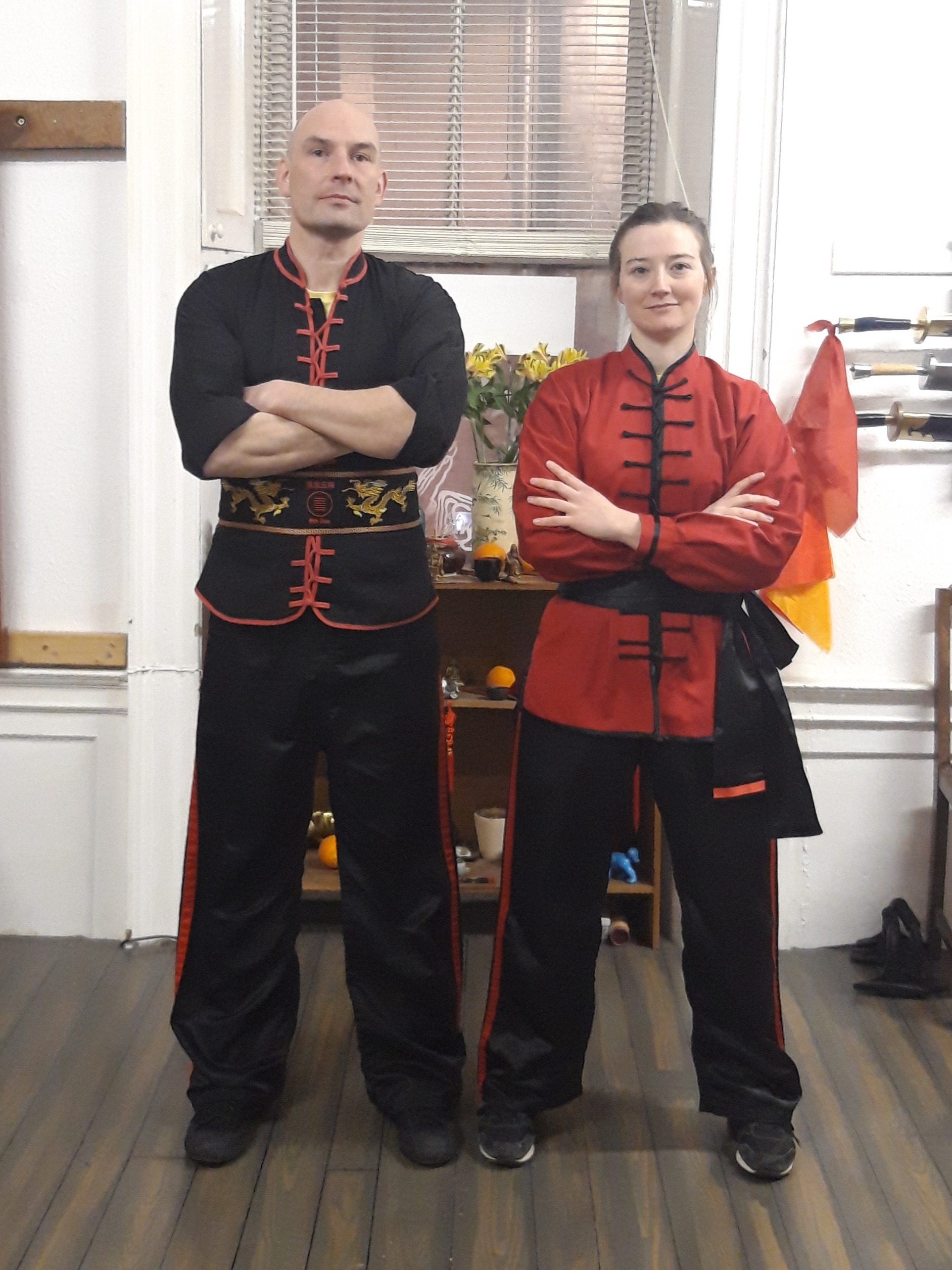
In our Student Spotlight series, our students have the opportunity to tell you about their training in their own words. Emma Archer has been training since 2015, participating in demonstrations and lion dance displays. Due to working life, Emma’s progress has been more gradual than some other students, however she enjoys committing her leisure time to training and gaining a deep appreciation for the style. Emma is currently learning the famous Fu Hok Seung Ying Kuen (Tiger & Crane Double Fist) form for her Yee Cup Junior level (1st test of 2nd level). Here Emma tells you about her experience of training at Yee’s Hung Ga Kung Fu Academy in Inverness.
Sifu Hepple and Emma Archer
What made you want to train in martial arts? Originally, I was inspired by my father who practiced Lau Gar Kung Fu in his teens. He taught me some stances and techniques. These share similarities with Hung Ga. Of course, films starring famous practitioners were also an influence.
How did you hear about the school? There was no Kung Fu school in my hometown, so growing-up I practiced Shotokan Karate off and on for several years. While I did enjoy the training and think it is a great style, something about Kung Fu always appealed to me more. In my 3rd year of University, I desperately needed an alternative focus to my dissertation, and decided that it was time to look into Kung Fu again. Miraculously, there was a school across from my flat (Yee’s Hung Ga Aberdeen at the time); guess it was just meant to be! When I moved to Inverness for work, I knew of the school here and began training under the instruction of Sifu Simon Hepple.
What was your first class like? Just as nerve wracking as my first class in Aberdeen. However, I had met Sifu Simon and some of the Inverness students before at tests and events, and they were very welcoming. Did it live up to your expectations? Exceeded them.
How did you feel after your first class? Pumped with motivation to train again and after a few more classes, felt right at home.
What do you think of your training so far? Is there anything you’d change? Enjoy every minute of it. If I could train all day every day, I would.
What are your hopes for your future in martial arts? Apart from maintaining my own fitness and well-being, eventually I would like to help others on their Hung Ga journey.
Anything else that you wish to add? I have trained at a few branches, and each has a positive and friendly atmosphere. While it is not common for a student to change schools, branch instructors have been very accommodating of my working situation. I feel accepted and enjoy training with everyone. Sifu as well as my Hung Ga brothers and sisters are always encouraging and help to improve my skills. It is also nice when we join other schools for seminars and events. Not to mention our predecessors are very skillful, knowledgeable and approachable. Always an honour to learn from them. Kung Fu truly improves your fitness and self-confidence, which has helped me in other areas of life. Come try Hung Ga and join our awesome family.
Chinese lion dance is a tradition which is at least 1000 years old. It is a fun, colourful way to bring a party atmosphere to any happy occasion. Weddings, festivals, parties, blessings, shop openings and, of course, Chinese New Year. Lion dance is huge in Asia and in many other parts of the world. As with most Chinese traditions, there are many myths, legends, symbology and folklore attached to these practices. We’ll take a look at the significance of the different lions and explore some of the hidden meanings behind them.
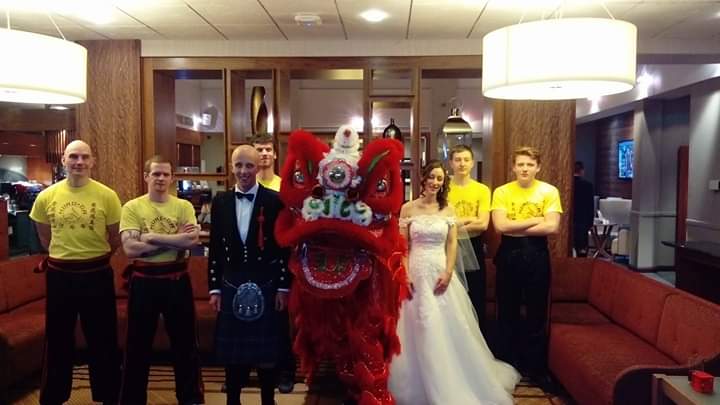
Yee’s North Scotland Lion Dance Team blessing a young couple’s wedding.
Chinese lion dances can be split into two main groups or styles, Northern and Southern. The Northern style is sometimes called Beijing style. It can be very acrobatic. They usually appear in pairs and have long, ruffled, shaggy orange and yellow hair. Dependant on whether the lion is male or female, it will have a red or green bow on the head. Male lions have a red bow and the female has a green one.
Northern lion dance tv spot. Note the coloured bows on the head.
The movements of Northern lions resemble those of a Pekingese or Fu Dog. Stunts and acrobatics such as lifts, jumps, walking on rattan poles, or balancing on giant balls are common. They sometimes appear as a family, with two large “adult” lions and a pair of small “young lions.”
A statue of a ‘fu dog’ guarding a temple, similar to a Northern lion.
Southern lion dance is usually performed as a ceremony or blessing. The ceremonies are performed to bring luck and good fortune. The Southern lions are decorated in many different colours and they have a very uniquely shaped head. There is a mirror on the forehead and a horn above it in the center. The performers animate the lion by flashing the large eyes and flapping the ears. The mouth also opens and closes.
A colourful green lion. Note the mirror on the top.
Southern lion dance is also known as Cantonese style. There are two main groups within the Cantonese style. Fat San (Buddha Mountain) and Hok San (Crane Mountain). There are other groups too, such as Fat-Hok (a fusion of Fat San and Hok San), and the Green Lion (Qingl Shil – popular with the Fukien/Hokkien and Taiwanese).
A selection of southern style lion heads at Yee’s Hung Ga, Inverness
Fat San is common amongst many Kung Fu schools. The movements are very powerful and require considerable strength. The lion represents each individual school and demonstrates a lot of the stances and footwork involved. It also shows how strong the students are. When performing, the most senior students are therefore chosen to represent their school with the lion. It is a great honour for students to be given this privilege.
A famous lion dance scene with a complicated choi chang using Fat San Lions from the film Dreadnaught.
The Hok San style combines a Southern lion head with Northern lion movements. Hok San focuses on life-like, realistic movements, and acrobatic stunts. The tail is shorter on this type of lion. Many lion dance troupes that perform pole (jong) jumping, use this type of lion. You will often see Hok San lion dances using three different coloured lions. A black, a yellow and white lion. The black lion is the youngest of the three. The movements of this lion are performed fast, like a young child with lots of energy. The yellow lion is the middle child, it’s movements are energetic and lively. The white lion is the oldest. You may see many other colours too. A red lion is common at weddings because the colour is considered to be lucky. The red lion also symbolises courage and strength. The green lion, however, represents friendship.
The three coloured Hok San lions. Black, Yellow & White. Performing in front of the Yee’s Hung Ga, Inverness Kung Fu school.
There are also three lions which represent three brothers in arms from the classic, “Romance of the Three Kingdoms.” The characters are Liu Bei, Guan Gong and Zhang Fei. Together they swore a blood oath to restore the Han dynasty. You can read more about Guan Gong and this classical Chinese novel in our article, “Who’s the guy with the big sword thingy!”
Statues of the three sworn brothers who founded Shu Han in the Three Kingdoms Period of China
The Liu Bei lion is the eldest of the three brothers. Yellow is the main colour of his face with a white beard and fur. The imperial yellow colour is significant because it shows that he became the first emperor of the Shu-Han Kingdom. The white beard and fur shows that he was very wise. He has a multicolored tail with a white underside, representing the five elements. He also has three coins on his collar, to show that he is the eldest. The Liu Bei lion is used by kung fu schools or organisations to show that they are well established. He is also known as Rui Shi or ‘Auspicious Lion’.
A Liu Bei lion. Note the yellow colour, white beard & fur and multicoloured tail.
The Guan Gong lion has red as the main colour of his face and a long black beard. His tail is red and black coloured with a white underside and white trim. He has two coins in his collar and is referred to as the second brother. He is also known as Xing Shi meaning ‘Awakened Lion’.
Guan Gong lion with red face, long black beard and red and black tail.
The Zhang Feilion has a black coloured face with a short black beard. His tail is black and white, also with a white underside and white trim. He has bells attached to his body too. He has a single coin on his collar, showing that he is the youngest brother. This Lion is known as Dou Shi or ‘Fighting Lion’. This is because Zhang Fei had a short temper and liked fighting. Kung fu schools that are just starting out or those wanting to make a challenge might use Zhang Fei.
A Zhang Fei lion with a black & white tail, black face and black beard
Choi chang
Choi chang is a Chinese New Year tradition. Shopkeepers, restaurants and business owners attach a red envelope filled with money to a lettuce and hang it above the doorway of their premises. Kung fu schools visit the premises with their lions and perform the choi chang. The lions approach the lettuce inquisitively, with cat-like movements. They will jump up and eat the lettuce, keeping the money, and spitting out the chewed up lettuce leaves around the doorway. This brings good luck to the store during the forthcoming year. “Choi chang,” literally means picking the greens. It is seen as especially auspicious for the lettuce leaves to land on you. Sweeping the lettuce leaves up however, rather than picking them up, is seen as sweeping away the good luck and therefore unlucky.
‘picking the green’
Sometimes the lettuce is hung quite high, 15 to 20 feet. The prize in the envelopes of these lettuces can be quite considerable. Only the most skilled martial artists are able to obtain these lettuces, whilst dancing with a heavy lion head and in front of a watchful crowd. The higher the lettuce, the bigger the challenge and the greater the reward, in the red envelopes and from the crowd. Kung fu schools gain notoriety through this practice and therefore more students too.
Our lion performing the choi chang in Jimmy Chungs restaurant during a Chinese New Year celebration.
Many kung fu schools would take part in the choi chang. Occasionally more than one school might approach the same lettuce. If this is the case, the lions must fight a duel to decide a winner. The battle that takes place is not a street fighting brawl but one that uses the lion’s movements to impress the crowd. The greater the style and finesse from the performers, the greater the audience’s praise. The lions with the highest praise and cheers wins the right to complete the choi chang. The reputation of the schools are at stake during these duels so the performers must act with the highest respect and decorum.
Some famous faces in this clip demonstrate some lion dance etiquette & a battle between rival schools. From the film Martial Club
There are other types of challenges that a lion dance troupe may be confronted with instead of lettuces. Pineapples, bananas, oranges, pots, benches etc have all been used as barriers for the lion to overcome.
A lion dance performances using many obstacles for the lions to overcome. From the film The Young Master
Our own new year celebrations in Inverness will begin on Saturday the 25th of January 2020. We start out at Jimmy Chungs restaurant at 1pm, then on to the Eastgate Centre for about 2pm. We then proceed to the Victorian Market for 4.30pm and finally back to Jimmy Chungs for about 5.30pm for a final dance and some food. We would love for you to come and enjoy our celebration so that we may continue to honour this wonderful festive experience year after year. As always, we value your feedback so don’t forget to tag us in your photos #yhginverness#invernesscny20. You can also email us and let us know what you thought.
The Horse stance, feared by some, celebrated by others! What is it, what’s the point? Let’s take a look…
Jackie Chan in Drunken Master
The horse stance (Ma Bu in Chinese), also known as the Four Point Great Stance (Sai Ping Dai Ma). It is not unique to Hung Ga, by any means, however it is of particular importance to practitioners of the Hung style. It is a basic stance for training the foundation. The foundation is the fundamental elements that support the three pillars. The fundamental elements being the strong body, including the bones, muscles ligaments, fascia and tendons. Ma Bu lowers the centre of gravity which helps the practitioner have a stable base. Practicing Ma Bu improves the structure of the body and the body’s alignment. Holding the stance can increase the stamina and determination of the practitioner, far beyond what they ever thought possible. With the correct posture, one can then focus on the breath. Having a regulated slow, deep breathing cycle has many calming benefits. It has been proven to reduce the heart rate and relax the body. With the relaxed, yet stable structure, one can then improve further with the circulation of fluids and the transportation of oxygen to the vital organs and the efficient removal of toxins, improving performance. With regular practice, the body can then heighten its performance further with the circulation of vital energy or Qi. Circulating qi around the body can have a huge benefit to physical, emotional and mental wellbeing, as well as increasing longevity, boosting energy levels and creating a barrier against diseases. This encompasses the three pillars we mentioned earlier. They are the body, the mind and the spirit. The physical body is trained by using the mind to focus and hold the static posture for a period of time. When the mind and body are synchronized in this way, over time, the spirit can elevated to higher levels.
Standing in Ma Bu takes time. It is hard. It is not the kind of practice for someone who is looking for quick results. At Yee’s, students train Ma Bu, it is a requirement for their gradings. As students advance through the system to higher levels, they must have a bigger and bigger foundation. They therefore need to train Ma Bu for longer periods of time. This is not just to pass a test but also to build the three pillars and to protect themselves from harm. This can be the downfall for many students who neglect to train Ma Bu. As students progress through he Hung Ga system, they learn more and more forms and techniques. Training Ma Bu often takes a back seat in favour of the other types of training. It can often be overlooked as it is so simple. Because it is simple, that doesn’t mean that it is easy. In fact it can be very difficult to maintain the stance for a long period of time. This is the nature of kung fu however, hard work and perseverance to achieve results. In today’s fast paced world, there are a select few people who wish to take this path. Most people try to take shortcuts or look for easier methods. For many practitioners the Ma Bu is a love/hate relationship. To succeed, you must enjoy the challenge and you must persevere through hardship.
Gordon Liu as Pai Mei in Kill Bill: Vol. 2
Are you ready to step up to the challenge? Think you can master the Ma Bu? Do you want to rise to the levels of previous kung fu masters throughout history? Good. Let your training begin….
• Stand with your feet together. Hands by your sides.
• Lift your arms up in front of you, palms up, and take a nice deep breath.
• Once you have breathed in, make fists and place them at the chamber (the groove above the hip and below the bottom rib) as you breathe out.
• Pivot on your heels and turn your toes out at an angle, creating a V shape. Pivot on the ball of the feet and turn the heels out. Pivot on the heels again to turn the toes outwards and then once more so that the toes are now pointing forward. Your feet should be fairly wide apart. Roughly the length of your lower leg.
Horse stance feet placement.
• Next, bend the knees and ‘sit’. Push your knees out so that they are above the feet. Keep your back straight and head up, with your fists in the chamber, elbows squeezed towards each other. The thighs should be almost parallel with the ground, at a slight angle. You can use a mirror to check your posture.
• Focus on your breathing. Place your tongue on the roof of your mouth and breathe through the nose. Take long, slow, deep breathes. Aim for 4-5 complete breathes in and out per minute.
• Great job. You’re now in the Ma Bu. You are practising an art which every Hung Ga master before you has also practiced, for centuries.
• Comfortable?
• Time how long you can maintain this stance for, without getting up. Every time you practice, try to beat your best time, even if it’s just a few seconds.
Sifu Hepple demonstrating the Ma Bu
How did you get on? How long did you manage before you had to get up? Let us know in the comments below. Send us an email or give us a tinkle on our social media channels.
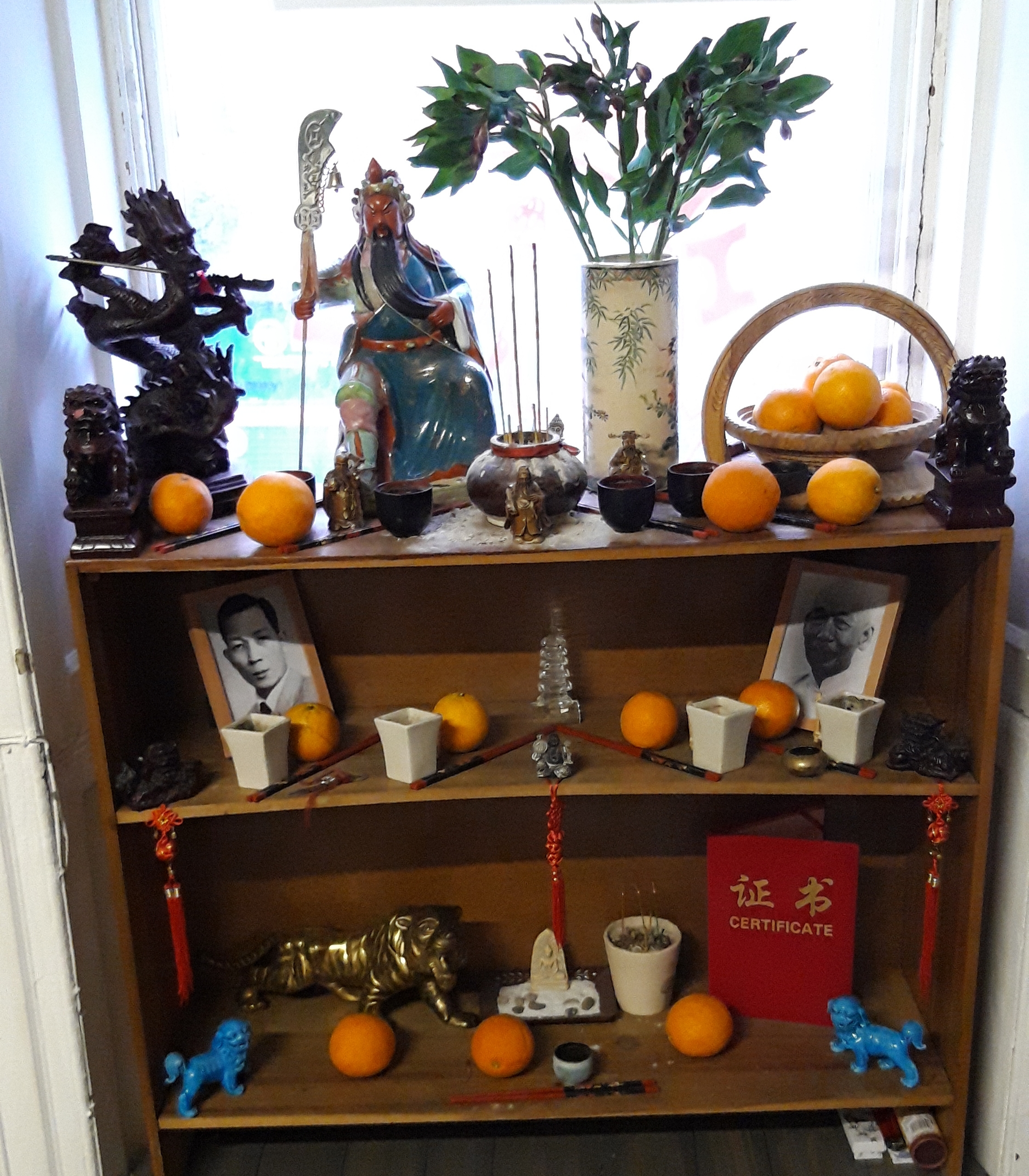
The Sun-Toi is the ancestral altar in the Mo-Kwoon (Kung Fu School). Kung fu martial artists bow to the Sun-Toi when we enter and leave the training space using the traditional ‘sun and moon fist.’ We light incense and place it in censers on the Sun-Toi. On special occasions we pour wine in the cups and put vegetables and/or meat on the Sun-Toi. It can be a small table or it could be the whole side of a wall. They can be ornately carved wooden masterpieces or a simple shelf-style structure.
The Sun-Toi (ancestral altar) at Yee’s Hung Ga, Inverness
Why do we bother? What is the point? Is it religious or specific to Chinese culture or just some bizarre, esoteric kung fu ritual? In this article we’ll answer these questions and address the necessity and value of the Sun-Toi in modern Chinese martial arts schools.
The Sun-Toi serves as a place that we can connect with the previous masters of the Hung Ga lineage. It is somewhere that we can show respect to our ancestors and keep their memory alive. We are thankful for the opportunity to practice an art form which they laid the foundation to. As practitioners, students, teachers and masters, we all hope that we will do our forefathers proud as we steer the art through modern times. We all share the common aim of making Hung Ga Kuen as relevant today, and in the future, as it was in the time of the people who passed it on to us.
The unmistakable figure of General Gwan on the Sun-Toi in Inverness
The Sun-Toi is placed in a prominent position within the Mo-Kwoon, so it is visible as soon as one enters the training space. They are uniquely personal to each individual school. Even in branches of the same school, such as Yee’s, you may find many differences from school to school. Despite there being so many differences, almost every Sun-Toi has a few common items that you may find upon it, regardless of kung fu style. General Gwan (Gwan Di, Gwan Yu) is a frequent figure which you will not only see in traditional Mo-Kwoons but also in police stations, restaurants, casinos, shops and even some family homes. His figure symbolises loyalty, trust, honesty and respect. He was known for his martial arts excellence and loyalty to his sworn brother. His figure is usually placed at the top of the Sun-Toi, to show the greatest respect. The Gwan Dao (The Spring Autumn Great Knife) is a traditional weapon named after General Gwan. Whilst performing with the weapon, there are many gestures which represent General Gwan. For example you may see the practitioner galloping as if he is riding his horse or perhaps composing his long beard in preparation for battle. It is also common to see miniature weapons, such as the Gwan Dao, on a traditional Sun-Toi. You may also see other figurines such as ‘Shishi’ or ‘foo-dogs,’ which guard the physical structure of the kwoon as well as the people who are part of it.
The censer at the foot of General Gwan on top of the Sun-Toi in Inverness
Almost every Sun-Toi will also have at least one incense holder. You may see censers for every level of the Sun-Toi or in front of pictures of the ancestors. Normally the biggest censer is placed in front of the central General Gwan figure. Many of the Hung Ga ancestors are excellent roll models, especially in today’s fast paced lifestyle of excess. They lead heroic, righteous, noble lives. Wong Fei Hung is almost certainly one of the most familiar. Their example has set a very high standard for modern martial artists to follow. Smoke from the incense is meant to cleanse the air of toxins that cannot be seen. It symbolises the connection between the ancestral spirits and our lives in the modern day. By lighting the incense we invite the essence of their positive character to motivate us in the proceedings of the present day. The smoke carries the thoughts, prayers and aspirations of the practitioner to the ancestors, or whomever they may be thinking of. As such, lighting incense can be an art form in itself. Martial artists treat the incense very respectfully and carefully, as if it were the ancestors themselves. The number of incense sticks can vary depending upon the proceedings but a common number is three, or a multiple of three, such as nine. The incense is carefully lit and fanned gently with the hand, rather than blowing or waving the sticks in the air. Two hands are always used to handle the incense and to place it in the censer. It is held above the height of the head as the practitioner bows, as if to elevate it above oneself. All these things are perceived as demonstrating awareness of the present moment, respect for tradition and appreciation of the ancestors endeavours.
Oranges, chopsticks and cups of water in front of photos of our ancestors
Fruit, such as oranges, are often placed on the Sun-Toi along with cups filled with water and also chopsticks. These are seen as symbolic gestures or offerings to pay reverence to the ancestors. The fruit represents the results of the hard work of the school. When you work hard, you gain the fruit of your labour. This is the basic principle of kung fu, to train hard and become good at what you practice, through the practice itself. Symbolically, water represents the cleansing of any wrongs. Many cultures apply the same meaning to water, to wash away sin. Water also benefits the whole world, we could not survive without it. The heart should be like the water, clear and clean. The traditional martial artist aims to be the same in their thoughts and actions. Similar to water, you may also see candles or oil lights. The light drives away the darkness and any pesky evil spirits. It represents the good in everyone. The righteous path that all traditional martial artists attempt to traverse.
Flowers signify the hard work needed to achieve a goal.
During special occasions, such as Chinese New Year; flowers, vegetables, dishes of rice, fish, chicken etc can also be placed on the Sun-Toi as a way to mark the occasion and celebrate the achievements of the Mo-Kwoon. Similar to fruit, flowers on the altar represent the hard work that accomplishes a goal or task. When you work hard your flowers will bloom. They symbolise the hard work itself, rather than the results, which the fruit represents. Wine can also replace water in the cups to signify the happy, cheerful mood of the proceedings. You may also see two chairs on either side of a traditional Sun-Toi. The right hand chair is reserved for the Si-Gung or visiting Sifus of the school. The left hand chair is for the Sifu, or Dai Si-Hing/Jai should the Sifu be away.
The Sun-Toi is not meant to be for religious purposes. As mentioned, they vary quite considerably from school to school. You may find that some schools have religious figures on their Sun-Toi if they have religious roots. For example a Shaolin school may have a figure of the Buddha because Shaolin kung fu originated in a Buddhist temple. There are many components to the Sun-Toi which can still be seen as worthwhile, without being seen as worshipping another faith. The fundamental purpose of the Sun-Toi is to pay respect to the origins and founders of the complete martial art system that we enjoy practicing daily in modern times.
If you enjoyed this post, please give it a like and share on your social media. If you wish to be notified of future articles, like our forthcoming Autumn qigong article, as well as other notices, discounts and events, pop your email address in the box below and we’ll give you a shout when new posts are added. You can also follow our journey on social media. Like and share on Instagram, twitter & Facebook
Processing…
Success! You're on the list.
Whoops! There was an error and we couldn't process your subscription. Please reload the page and try again.
A common question asked about Yee’s Hung Ga is, “Do you have a grading system or belts, like in other martial arts?”
Coloured martial arts belts
There are many martial arts which have a grading system. As the student passes through the different grades and attains a higher level of skill, they also obtain a different coloured belt to show the practitioner’s rank within the system. Normally a white belt is given to a novice and a black belt is given to a proficient or skilled practitioner. It is said that originally all novices started off with a white belt and over the years of training the white colour turned to a dark grey/black, which is where the coveted black belt stems from. All the colours in between have been added in recent years, varying in degrees of brightness, from white to black (i.e. yellow, orange, red, purple, brown etc) to portray the idea that the student has trained hard enough for the belt to change colour. There are many other martial art systems that don’t have coloured belts but still have gradings. There is also a lot of tradition and etiquette surrounding the different belts of each martial art, for instance how they are tied, which side of the body the knot is tied on, how they are stored and looked after etc. These traditions are usually specific to the individual martial art system.
At Yee’s Hung Ga we have a grading system where student’s skills are tested regularly. The student begins with a black sash and as they pass through the different skill levels, a red stripe is added to the end of the sash to display the student’s rank.There are 3 main levels. Each level has 2 tests, a junior and senior.
1st level (yat cup) sash displays a single stripe to show 1st the rank.2nd level (yee cup) sash, displays 2 stripes.3rd level (Saam cup) sash displays 3 stripes.
When the student completes all 3 levels, they may then begin their ‘Jo Gow’ (black belt) training. Once the Jo Gow has been attained, a red stripe is attached all around the black sash.
A Jo Gow (black belt) Sash
Attaining this level is cause for a big celebration. It demonstrates that the student has mastered the basic skills of the Hung Ga system, which is a notoriously difficult level to reach. At the Jo Gow level, a student is considered an Assistant Instructor. To become a full-fledged Instructor (Sifu), 2 years of additional intensive training is required. Training does not end with becoming a Sifu. Sifus must continue their training and testing to progress through the 10 Dan (Levels) if they wish to understand the full depth of the Yee’s Hung Ga art – a feat that requires great dedication, loyalty and passion for the art.
Through these rigid training and testing protocols, Yee’s Hung Ga is able to preserve the highest levels of quality and integrity of the Hung Ga style passed down through its lineage, while simultaneously and uniformly advancing the art itself. Very few martial arts systems go to such lengths to maintain quality instruction.
If you enjoy our posts and wish to be notified of further posts, notices, discounts and events, pop your email address in the box below and we’ll give you a shout when new posts are added. You can also like and share on Instagram, twitter & Facebook
Processing…
Success! You're on the list.
Whoops! There was an error and we couldn't process your subscription. Please reload the page and try again.
This is a picture of Sifu Hepple and John Weaver. John has been practicing for 3-4 years now and is currently training towards his Yee Cup Jr (1st test of the 2nd level) Grading. Here John tells, in his own words, of his experience training at Yee’s Hung Ga Academy in Inverness.
What made you want to train in martial arts?
I previously trained in Jujitsu when I was about eight years old. When I reached twenty four, I became very interested in practising meditation, healing arts and focusing (balancing) my mental/physical energies. I read books, became Reiki attuned and watched videos to increase my knowledge on the subject. This led me to learn versions of qi gong, from some new age teachers and other kung fu personalities. I think I was the ripe old age of thirty one before I attempted to do kung fu work out drills; I was completely exhausted and realised I knew nothing of the hard work and discipline that was required to achieve what I wanted. It was then I started looking for a teacher.
How did you hear about this school and why did you want to train there? What were your expectations before you started?
Kung Fu was the obvious choice for me based on my interests. I did a little research on the different styles, and thought about what may suit my body type. I knew already I would prefer something that would be powerful and balanced, but more hand based rather than the flippy-flappy leg kicks. I saw some videos of the Hung style online after finding out that a new had school opened up in Inverness. I contacted Sifu to see if he would accept me as a student, and the rest is history. My expectations were realistic; having tried to keep up with drills on dvds and failed, I was open to whatever lessons Sifu had for me in order to progress.
What was your first class like?
I was slightly nervous and wondered what the other students would be like. At that very first class, I mentioned some of the things I had been doing and Sifu responded “this may be a little different to what you’re used to!” He proceeded to show us Tiger techniques, specifically how to break an opponents arm. After that class, I was aching all over. My legs felt like jelly, and I thought it would be very hard to build up my fitness to an acceptable level to continue. However, I stuck with it and after a further four or five lessons I got used to doing the warm up exercises! It is quite invigorating once you have built up the stamina and I am glad I have continued with my training. My life has changed considerably in the last two years and I now have a young family and a home to maintain. I haven’t had as much time as I would have liked to train recently but as my understanding of Hung Ga grows, so does my desire to push myself further.
What do you think of your training so far? Is there anything that you would change?
So far I have learnt the full Gung Gi Fuk Fu form and am now learning Fu Hok. I have also learnt about the theory of Hung Ga and some of the additional exercises that can be done to unlock potential skills; fighting and some softer skills like balance, conditioning and strengthening. I have attended seminars in Aberdeen with Grandmaster Yee Chee Wai and our Sifu’s teacher, Si Gung Bruce Clark – both are very well respected Martial Artists. It is hard to start with, but if you try and push through it is very much worth your while. Our Kwoon (school) is very friendly, and Sifu obviously loves Hung Ga; showing us how it becomes a solid foundation in life. I would change nothing about the training given but if I could give advice to other beginners it would be to put three times as much effort in to practising at home, as you do in class. Basic drills, form and practising stances – but also looking at the ways in which Qi Gong and breath exercises can improve your general well-being.
What are your hopes for your future in martial arts?
My hopes for the future are to continue training, and to push myself further. My aim at the moment is to improve my stances, transitions between movements and get more sparring practice to apply what I have learned. I enjoy the traditional Lion Dance practice and would like to do more of that for the school in the coming years.
Anything else that you wish to add?
While studying for the Fuk Fu test, I wrote this down. ‘Kung Fu is something that cannot be bought or stolen; you cannot cheat or make it easier as it is what it is. You get out what you put into it via training – body and mind with a strong spirit.’ I am beginning to understand more on the concept of ‘martial virtue’ and can say that with Kung Fu, actions speak louder than words – so come join us.
If you enjoy our posts and wish to be notified of further posts, notices, discounts and events, pop your email address in the box below and we’ll give you a shout when new posts are added. You can also like and share on Instagram & Facebook
Processing…
Success! You're on the list.
Whoops! There was an error and we couldn't process your subscription. Please reload the page and try again.
Whether you’re just starting out or you’re a seasoned warrior, it can sometimes feel difficult to keep yourself motivated, especially with the cold weather, dark nights, the hectic partying over the festive period taking its toll on the body. It can be a bit of a slog getting yourself back into a routine and keeping that routine going. If one of your New Years Resolutions is to get fit and healthy, like many other people, you might be thinking about attending one of our classes. If you are serious about taking it past the thinking stage and really want to attend, (obviously we would highly recommend that you do and you would be most welcome.) what steps can you take to ensure that your first class isn’t also your last? What if even your best intentions aren’t good enough and you run out of steam before you even get up and running? Well we’re not going to lie to you, there’s no magic wand. You still have to actually make it to class (on time!) and you still have to do the work but here’s our top 10 hints & tips on keeping yourself keeping going.
#1. Patience
It takes time, don’t be put off if you don’t see results straight away. Looks can be deceiving. You may not see results for a while, especially if you are just starting out. It takes time to learn and to build muscle memory. You may hear claims that you can be a master in a short time, “Learn Kung Fu in 3 Months,” “Become a master in only 2 weeks.” There are some things that you can learn and use straight away but to be a master you first need to learn and that can take time, patience and lots of practice.
Just because you’re not seeing results it doesn’t mean that you are not getting any. You are better today than you were yesterday, try to remember that. Your brain will get better at sending messages to your body and your body will get better at receiving and understanding them. You will actually be able to activate a higher percentage of your muscle fibers, commonly referred to as neuromuscular efficiency. Your coordination will improve, reflexes start to become faster, your breathing and focus will increase. It is a slow process because you are bound by your body’s limitations, just be patient. Don’t look in the mirror after two weeks and wonder why you’re not looking like Bruce Lee or why you’re not managing to quite get the results that you are looking for. Be patient and put in the work, the results will come.
#2. Enjoy the journey.
Try not to think of your goals as the soul purpose for training, that’s just a destination. Enjoy the process and get excited about what you are learning. If you enjoy what you are doing you are more likely to keep it up. Get excited. You have to want to do it. If you force yourself, it could have negative results. Instead of looking negatively at things that you are not so good at or find difficult, try and turn your thinking around. Be positive about it and see if you can work at those things, bit by bit, to get better at them. Chip away a little bit every day and they will soon become less of a problem.
#3. Don’t rush!
Arrive early, give yourself time. If you leave things to the last minute it gives your mind one more excuse to back out of it. If you have plenty time and are well prepared then you are less likely to change your mind at the last minute. Make sure you have your kit ready the day before. Write a list of all the things that you need to take with you and make sure you check your list every time you get yourself ready. Plan your trip, where you’re going to park the car, how long will it take you to get there? Allow extra time in case of slow traffic or for events beyond your control. If you think ahead and plan in advance you will put yourself in the right frame of mind and it will give you less excuses to not go through with it.
#4. Are you keeping track?
Keeping records can help you to remember what you have learned. What did you get out of class today? Did you just go through the motions or did you pick something up? Were there any “light-bulb moments?” Keeping a training diary can help you to remember information and focus on learning. It can also help you to look back and see how far you have come in your training. You can also see what went wrong, should you get injured, and learn from any mistakes.
If you can only make it to the occasional class, it is down to you to make the effort to practice between those classes. Your Sifu will give you advice on what and how to practice. If you just practice bits of what you remember, it may be that you are not paying attention to the right things or worse, practicing them the wrong way. You should know it inside out and back to front.
#5. Stick to a plan
Remove the randomness from your training. This is the best way to improve your speed, strength, focus, body weight…. any of your goals in fact. For a beginner it can be tempting to try out all the different classes that are available to you at Yee’s but it is better to pick one or two which you can definitely, regularly make, every week. Stick to them and make them part of your routine. When you feel more confident in what you have learned and you have time available to try out the other classes, then give them a go. Too much, too soon is a recipe for failure.
#6. Do it for yourself.
Do it for yourself, not because of anyone else. Come with friends but don’t stay at home just because they decided that they couldn’t be bothered. Their excuses will turn into your excuses. You must do it because you want to do it for yourself. Similarly, try not to compare yourself to others. Everyone has strengths and weaknesses so whilst you might not be as good as the one you are comparing yourself to, they might not be as good as you at other things. They may also be further ahead in their training or have practiced more or many other reasons. If you practice, you will become better. If you practice a lot, you will become a lot better. Sometimes it takes longer for some people so just relax and enjoy the ride.
#7. Prevention is better than cure.
Be sensible about how you train. An injury can set you back months, perhaps even years. It may stop you training altogether. It is important in the beginning to take things slowly until your body gets used to it. If you push too hard, you can injure yourself. Ensure that your body is warmed up gently and muscles are stretched before you do your main practice. You will have to do this every time and you will have to factor the time it takes into your practice. Similarly, a cool down routine can help to bring your body back to normal. Again gentle stretching can be useful. After your training your muscle fibers will be warmed up and loose. The sudden shock from the cold outside, especially in the North of Scotland, can cause them to constrict. Problems may result from over tension such as muscular cramps and pain, twisting and knotting of the muscle fibers. Be sensible and have an extra layer of clothing to put on before you head out into the cold. Our training hoodies are perfect for this purpose.
#8. If you don’t make time, you’ll never have time.
You need to factor time into your daily routine or weekly schedule. If you don’t have one, make one! Fit it into your lifestyle. It is difficult juggling everything in your life but the bottom line is that if you don’t do it, then you won’t do it. Spare time can seem to be a rarity in modern life and if you really want to do something, you will have to make the effort to make it happen. With kung fu this means making time to practice. In the same way though, if you do nothing but practice then you will not have time for anything or anyone else so you need to find a balance. Make it happen!!
#9. Rise to the challenge!
Treat it like a test. Everything that you find hard is an obstacle to you becoming better and achieving your goals. If you clear the obstacle then you are one step closer. If you don’t quite make it then it’s no big deal, just try again. It may take you many attempts. Many, many, many attempts in fact. This is the challenge that you face. Give up, find an easier way or just keep chipping away until you get it. The nature of kung fu means that you kind of do all 3. You try until you get it, you understand the movement. You then find an economy in the movement, simplify it, make it easy. Then, when you get it, you leave it. It’s there now until you need it. You just need to maintain it. Great skill obtained through hard practice.
#10. Don’t beat yourself up
You’ve all seen the motivational memes on social media, “Failure is not an option!” “Winners never quit!” ” You haven’t failed until you quit trying!”
Jeezzz….. Give yourself a break, we are only human. Circumstances might mean that you have to put things aside for a while. You might have to give yourself some time to focus on other areas of your life. Family, work, friends, commitments. You know what that is? That’s life! (That’s what people say, You’re riding high in April, Shot down in May) It doesn’t mean that you’ve failed. If you falter or can’t remember or didn’t practice or took the day off, it doesn’t matter. Everyone needs a break. In fact it is advisable to take a break every once in a while. “All work and no play makes Jack a very dull boy!” Have you never seen ‘The Shining’ before?!? It only becomes a problem if you let it. You gave it a shot, you turned up for class and you trained really hard. That’s more than a lot of people ever do. A lot of people never get further than giving it a whimsical thought. “Wouldn’t it be amazing to be able to move like that?” “I wish I was as strong or graceful as that?” But you actually made the effort. That is amazing in itself. (a round of applause please!) If you need a breather, that’s not failing, that’s being realistic. Just don’t let it get to you. Get back in the saddle again and own it!! Take your training to the next level and achieve what you set out to do.
See you in class…
If you enjoy our posts and wish to be notified of further posts, notices, discounts and events, pop your email address in the box below and we’ll give you a shout when new posts are added. You can also like and share on Instagram, twitter & Facebook
Processing…
Success! You're on the list.
Whoops! There was an error and we couldn't process your subscription. Please reload the page and try again.
The guy with the big sword thingy goes by a few names, Guan Yu, Guan Gong, Guan Di, General Gwan, amongst many others. In the ancient times of the East, there was a great war between Three Kingdoms. Guan Yu, and his friends, Liu Bei and Zheng Fei, swore an oath of brotherhood in the mystical Peach Garden, vowing to create a new, righteous world. Together they fought countless battles against the warlords Cao Cao and Sun Quan. Guan Yu grew famous for his combat prowess and unwavering honor.
Cao Cao captured Guan Yu and at the time, Liu Bei’s fate was uncertain. He agreed to fight for Cao Cao under specific terms, chiefly that he would abandon Cao Cao if ever he learned the whereabouts of his sworn brother. Despite Cao Cao’s gifts and promises of wealth, when Liu Bei resurfaced, Guan Yu immediately went to his side. Years later, Guan Yu again faced Cao Cao on the battlefield as the warlord fled from his defeat at Red Cliffs. Guan Yu cut off Cao Cao’s retreat and obliterated his forces. He spared Cao Cao, however, and released him, as an act of honor.
Guan Yu is one of the best known historical figures in ancient history. Part of the reason for this is that he appears in popular comics and movies, even modern video games. He is also a major character in The Romance of the Three Kingdoms, a semi-historical novel said to be written by Luo Guan Zhong at the end of the Yuan Dynasty period (1279-1368). This novel is one of China’s four greatest classic novels. Partly because of fictional portrayals in The Romance of the Three Kingdoms, his reputation has only increased over the years. A famous tale about Guan Yu is that he was once injured in the left arm by a stray arrow, which pierced through his arm. Although the wound had healed, he would experience pain in the bone whenever there was a heavy downpour. A physician told him, “The arrowhead had poison on it and the poison had seeped into the bone. The only way to get rid of this problem is to cut open your arm and scrape away the poison in your bone.” Guan Yu then stretched out his arm and asked the physician to heal him. He then invited his subordinates to dine with him while the surgery was being performed. Blood flowed from his arm into a container below. Throughout the operation, Guan Yu feasted and drank wine and chatted with his men as though nothing had happened. In some accounts of the tale he sits calmly and plays a game of weiqi (Chinese chess)
Guan Yu being operated on. Guan Yu Comic BookThe Romance of the Three Kingdoms book
In the Western world, Guan Yu is sometimes called the God of War, probably because he is one of the most well-known military generals revered by the Chinese people. This is a misconception of his role, as, unlike the Greco-Roman deity Mars or the Norse god Týr, Guan Yu, as a god, does not necessarily bless those who go to battle, but rather people who observe the code of brotherhood and righteousness.
Giant Guan Yu Statue, 190ft tall
The big sword thingy that he can be seen with is the Spring/Autumn Great Knife. It is often named after him, some legends say that he invented it. The Guan dao, or kwan dao, is a large halberd which was used by the general during combat on horse-back. It is a heavy weapon with a sharp edge on one side for cutting and slicing. On the other side is a jagged edge with a hooked point which is used to maim and stab as well as for catching the opponent’s weapon to disarm them. The weapon is balanced with a pointed counterweight at the other end of the central shaft. Guan Yu’s “guan dao” was called “Green Dragon Crescent Blade” which weighed 82 Chinese jin (estimated 18.263kg or around 40lbs, there are tales of it being over 300lbs) and that he was extremely proficient with it on the battlefield.
Green dragon Guan Dao
If you enjoy our posts and wish to be notified of further posts, notices, discounts and events, pop your email address in the box below and we’ll give you a shout when new posts are added. You can also like and share on Instagram, twitter & Facebook
Processing…
Success! You're on the list.
Whoops! There was an error and we couldn't process your subscription. Please reload the page and try again.
This is a recent photo of Sifu Hepple with Jenny Thomas, one of the senior students of YHGInverness. Jenny has been training for almost 3 years now and is currently at Yee Cup Senior Level. Jenny occasionally helps teach some of the classes at the school and will also teach some Qigong classes in the new year. (Find out more details here: NEW CLASSES)
Here Jenny describes, in her own words, how she found out about the school and her training so far:
About 8 years ago, maybe more, I watched a documentary about a disillusioned priest… On his journey through life he had lost his vision,lost his passion for life, lost his reason to be alive, even lost his faith and finally lost his family. He had given up his secure, safe, well paid yet now meaningless job in the clergy and was seeking. Seeking a refuge, seeking to fill the endless void, seeking a new life, seeking to end that dull painful ache inside, seeking a reason, seeking to find the answers to the questions he didn’t even know… And all this he found in Martial Arts. He travelled extensively, visiting monastery’s, retreats, Martial establishments, government Martial groups and displays in the far east. He spent time in mist enshrouded mountains and beautiful lands…yet it was one day when he was sweeping a dirty floor that it suddenly clicked into place and his peace flowed from within. I can’t tell you how he found this peace, he didn’t know himself….but he found it inside himself through lengthy practice and meditation. A true story and exactly what brought me to Yee’s Hung Ga! I felt exactly the same as that priest and I wanted exactly what he had found. And if he could do it so could I! And so my journey began…I had done a bit of karate in my younger years but had moved away and never took it up again. I tried a few different styles which worked for a while but then I grew restless again. The self defence was good but the fitness was lacking…or the style was good but the egos were too big…or the fighting was great but the spirit was dead….I finally feel I have “come home”…in Hung Ga I am continually learning; it is a constant in my life amongst the ups and downs of every day life; I am strong, physically, mentally and spiritually ;I have met wonderful people and have lovely training brothers and sisters…the list goes on. I can truly say that walking up those stairs to meet my Sifu for the first time was the best thing I’ve done! Speaking of those stairs…after my first lesson I could hardly get down them! My legs were shaking so much from using muscles I had never used before. But I knew straight away I had found what I was looking for …Lazy legs however soon learn the stances and you’d be surprised how soon your muscles get stronger and you can do things you never thought possible. Practice, perseverance and patience is what you need. And if you don’t have them you can learn them too! Anything is possible if you go for it. We train our minds with horse stance…you’ll just have to come to a class to find out how! We do patterns, techniques, applications and drills, sparring,body conditioning….and just when you think you’ve sussed it, then you develop on what you’ve already learned and it suddenly makes sense as to why you had to twist that hand in that direction in the first place! And Qi gong, Hung Ga’ s gentle twin…or rather the yin of the two: the internal, the subtle, the gentle, the dark …Compared to yang: the external, the extrovert, the vivacious, the fire…..Hung Ga is a hard and soft style, without one you cannot balance the other and both should be trained. Qi gong trains the use of the internal energy, the bodies Qi. It also nourishes the spirit , trains the breathing, balances the bodies organs and helps the body remain in a healthful state. Regular practice can help increase your spiritual awareness, develop perception; you learn to use and lengthen that gap between stimulus and response, to act but not react…. It is slow, gentle and relaxing yet still powerful. (Qi Gong is trained during Hung Ga classes and as its own class. It is suitable for all ages, we currently have age 10 to age 75!) Of course we also learn to fight, to defend ourselves and our families if the need arose, and to spar amongst ourselves and also in competitions. But if you only know how to fight then you are a fighter, not a Martial artist. Our Grandmaster Yee Chee Wai says: “To be a martial artist you must learn Martial virtue, Martial knowledge, Chinese medicine and Chinese philosophy. And that you shall! All of this and more at Yee’s Hung Ga …like the priest, I too have found my peace, I don’t really know how either. It just happens! Come and find out for yourselves! Enrich your life!
Yee’s Hung Ga Inverness students were invited to attend an insightful day of seminars and introductions to other martial arts, last weekend, by the Scottish Fighting Arts Society.
The event was organised by Alan Mitchell from the Smithton Kempo School and seminars were hosted by instructors from Hapkido, Kempo, Ju-Jitsu and also from Yee’s Hung Ga Kung Fu Academy.
The seminars were very insightful, giving students and instructors a glimpse into the world of other styles and systems which they may not have been introduced to before. There were many similarities between the various arts which demonstrates the common bond that we share. It was refreshing to see the differences in similar techniques and the thought processes behind them. “We all have similar goals but go about it in different ways.” Sifu Hepple, from Yee’s Hung Ga, stated during his seminar. “We are all part of the same family, yet have different paths.”
Here are a few photos from the day:
Sifu Hepple has also been invited to host a free seminar and kung fu demonstration in his home-town of Forres, for the coming Chinese New Year celebrations.
This scroll was bought for me by my students as a gift. It is made of silk and, as you can see, it depicts two cranes.
Crane Scroll.
It is believed that the White Crane can live for a very long time because it knows how to conserve and protect its essence (jing). The Crane trains you to recognise proper timing and patience. It teaches perfect control and balance. When it is necessary to be slow (stillness), then be slow, have patience. When it is necessary to be fast, act fast, do not waste time or the opportunity will pass you by and you may never get it again.
In Chinese 5 Elements Philosophy, the element associated to the crane is wood. It is also paired with the liver and the gall bladder organs in the body. The gall bladder and the heart are responsible for making decisions, which will help you know when you need to have patience and when to act fast. The liver is also associated with the mind. Strengthening these organs will give you confidence to act on the decisions that you make.
Hung Ga Kung Fu is centred around the attack and defence patterns of the tiger and the crane. They balance each other and compliment each other. The combination of the two produce extreme, hard and soft power. At Yee’s Hung Ga Kung Fu Academy in Inverness you can learn about these two animals and the philosophies associated with them. In the Qi-Gong classes you can learn how to regulate and balance the associated organs within the body in correspondence with these philosophies, helping you to live a fulfilling and healthy life. New students are always welcome and if you have any further questions or would like to attend a class please email Sifu Hepple yhginverness@gmail.com