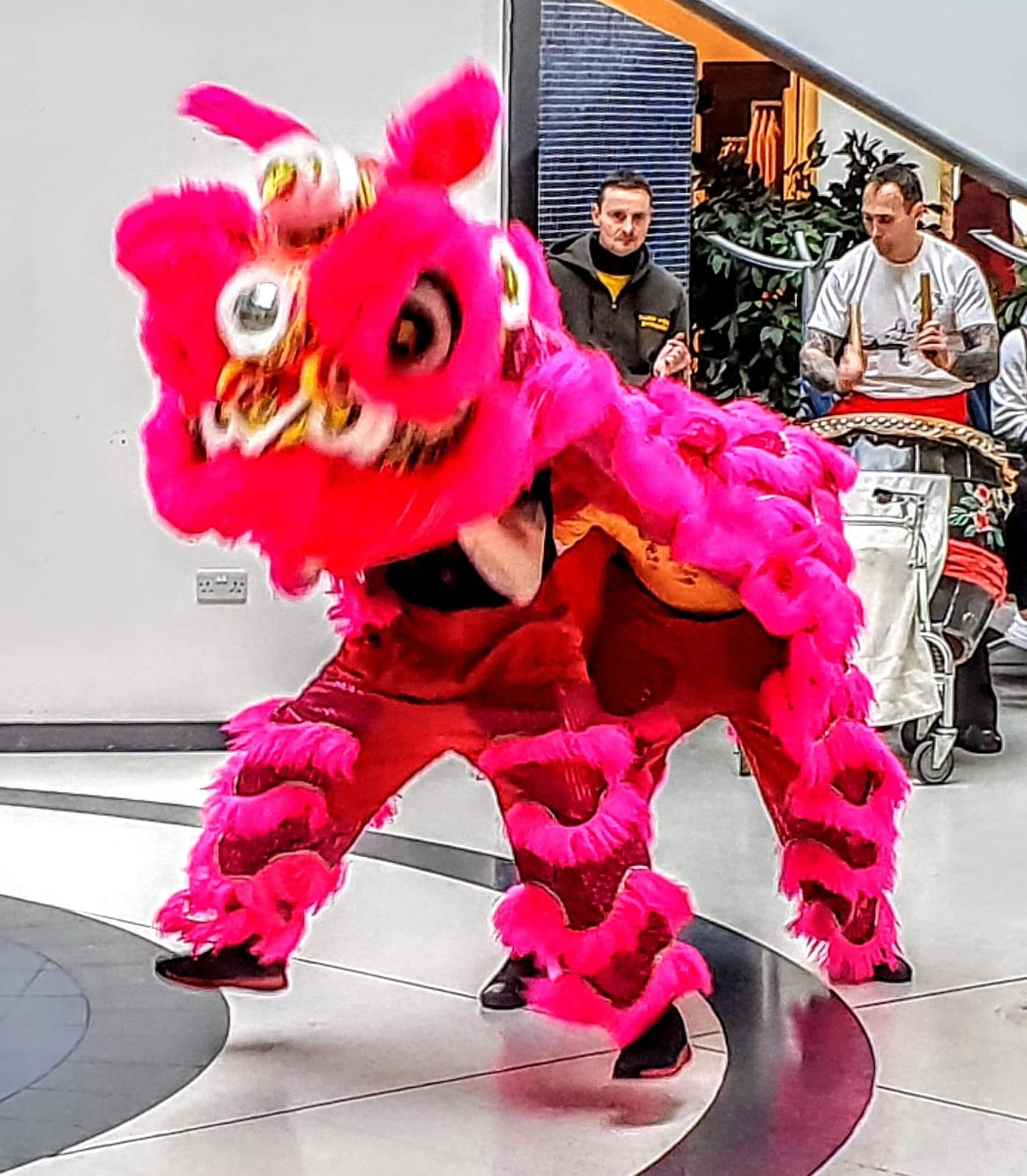
Our Spring Festival/birthday celebrations for Inverness has now been and gone. The dust has, just about, settled and our students have returned to their regular practice routine. We had a real blast with our lion and dragon dance parade and, if you came to see us, we hope that you did too. We performed displays at various locations across the city centre including Jimmy Chung’s Restaurant, The Eastgate Centre, The Victorian Market, Blacks Outdoor Retailers and outside our very own premises on Inverness High Street. We are honoured to have taken part in the blessing of so many stores around Inverness. It was quite a large undertaking but, with the help of our other schools across the North East from Ellon and Peterhead, we were able to complete around 50 blessings. This is sure to clear the city of evil spirits, at least until next year when ‘Nian’ is set to return for the ‘Year of the Ox’. These blessings are traditional “Choi Chang,” blessings. You can read more about them in our article about Chinese Lion Dance. The Spring Festival lasts for about two weeks so there will still be many more celebrations besides our own. You can check out photos and videos of our parade, blessings and performances on our Facebook and Instagram pages. Please feel free to tag us in your own posts, so we can see them all, with the tags #yhginverness #yeeshungga or #invernesscny20 You can also see many other performances and demonstrations from our Lion & Dragon Dance Team throughout the year. You can even book us for your own celebration, wedding or event.
We also have a Facebook Event Page for our 2021 celebrations. Feel free to like and share this to help us spread the word for next year.
Here are a few photos from our Year of the Rat Celebrations on Saturday the 25th of January 2020. 恭喜发财 (Gung Hei Fa Choy)
Chinese New Year Celebrations for the Year of the Rat 2020
Chinese lion dance is a tradition which is at least 1000 years old. It is a fun, colourful way to bring a party atmosphere to any happy occasion. Weddings, festivals, parties, blessings, shop openings and, of course, Chinese New Year. Lion dance is huge in Asia and in many other parts of the world. As with most Chinese traditions, there are many myths, legends, symbology and folklore attached to these practices. We’ll take a look at the significance of the different lions and explore some of the hidden meanings behind them.
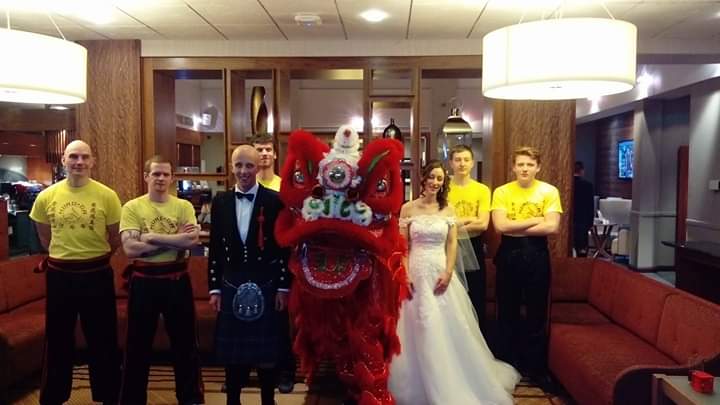
Yee’s North Scotland Lion Dance Team blessing a young couple’s wedding.
Chinese lion dances can be split into two main groups or styles, Northern and Southern. The Northern style is sometimes called Beijing style. It can be very acrobatic. They usually appear in pairs and have long, ruffled, shaggy orange and yellow hair. Dependant on whether the lion is male or female, it will have a red or green bow on the head. Male lions have a red bow and the female has a green one.
Northern lion dance tv spot. Note the coloured bows on the head.
The movements of Northern lions resemble those of a Pekingese or Fu Dog. Stunts and acrobatics such as lifts, jumps, walking on rattan poles, or balancing on giant balls are common. They sometimes appear as a family, with two large “adult” lions and a pair of small “young lions.”
A statue of a ‘fu dog’ guarding a temple, similar to a Northern lion.
Southern lion dance is usually performed as a ceremony or blessing. The ceremonies are performed to bring luck and good fortune. The Southern lions are decorated in many different colours and they have a very uniquely shaped head. There is a mirror on the forehead and a horn above it in the center. The performers animate the lion by flashing the large eyes and flapping the ears. The mouth also opens and closes.
A colourful green lion. Note the mirror on the top.
Southern lion dance is also known as Cantonese style. There are two main groups within the Cantonese style. Fat San (Buddha Mountain) and Hok San (Crane Mountain). There are other groups too, such as Fat-Hok (a fusion of Fat San and Hok San), and the Green Lion (Qingl Shil – popular with the Fukien/Hokkien and Taiwanese).
A selection of southern style lion heads at Yee’s Hung Ga, Inverness
Fat San is common amongst many Kung Fu schools. The movements are very powerful and require considerable strength. The lion represents each individual school and demonstrates a lot of the stances and footwork involved. It also shows how strong the students are. When performing, the most senior students are therefore chosen to represent their school with the lion. It is a great honour for students to be given this privilege.
A famous lion dance scene with a complicated choi chang using Fat San Lions from the film Dreadnaught.
The Hok San style combines a Southern lion head with Northern lion movements. Hok San focuses on life-like, realistic movements, and acrobatic stunts. The tail is shorter on this type of lion. Many lion dance troupes that perform pole (jong) jumping, use this type of lion. You will often see Hok San lion dances using three different coloured lions. A black, a yellow and white lion. The black lion is the youngest of the three. The movements of this lion are performed fast, like a young child with lots of energy. The yellow lion is the middle child, it’s movements are energetic and lively. The white lion is the oldest. You may see many other colours too. A red lion is common at weddings because the colour is considered to be lucky. The red lion also symbolises courage and strength. The green lion, however, represents friendship.
The three coloured Hok San lions. Black, Yellow & White. Performing in front of the Yee’s Hung Ga, Inverness Kung Fu school.
There are also three lions which represent three brothers in arms from the classic, “Romance of the Three Kingdoms.” The characters are Liu Bei, Guan Gong and Zhang Fei. Together they swore a blood oath to restore the Han dynasty. You can read more about Guan Gong and this classical Chinese novel in our article, “Who’s the guy with the big sword thingy!”
Statues of the three sworn brothers who founded Shu Han in the Three Kingdoms Period of China
The Liu Bei lion is the eldest of the three brothers. Yellow is the main colour of his face with a white beard and fur. The imperial yellow colour is significant because it shows that he became the first emperor of the Shu-Han Kingdom. The white beard and fur shows that he was very wise. He has a multicolored tail with a white underside, representing the five elements. He also has three coins on his collar, to show that he is the eldest. The Liu Bei lion is used by kung fu schools or organisations to show that they are well established. He is also known as Rui Shi or ‘Auspicious Lion’.
A Liu Bei lion. Note the yellow colour, white beard & fur and multicoloured tail.
The Guan Gong lion has red as the main colour of his face and a long black beard. His tail is red and black coloured with a white underside and white trim. He has two coins in his collar and is referred to as the second brother. He is also known as Xing Shi meaning ‘Awakened Lion’.
Guan Gong lion with red face, long black beard and red and black tail.
The Zhang Feilion has a black coloured face with a short black beard. His tail is black and white, also with a white underside and white trim. He has bells attached to his body too. He has a single coin on his collar, showing that he is the youngest brother. This Lion is known as Dou Shi or ‘Fighting Lion’. This is because Zhang Fei had a short temper and liked fighting. Kung fu schools that are just starting out or those wanting to make a challenge might use Zhang Fei.
A Zhang Fei lion with a black & white tail, black face and black beard
Choi chang
Choi chang is a Chinese New Year tradition. Shopkeepers, restaurants and business owners attach a red envelope filled with money to a lettuce and hang it above the doorway of their premises. Kung fu schools visit the premises with their lions and perform the choi chang. The lions approach the lettuce inquisitively, with cat-like movements. They will jump up and eat the lettuce, keeping the money, and spitting out the chewed up lettuce leaves around the doorway. This brings good luck to the store during the forthcoming year. “Choi chang,” literally means picking the greens. It is seen as especially auspicious for the lettuce leaves to land on you. Sweeping the lettuce leaves up however, rather than picking them up, is seen as sweeping away the good luck and therefore unlucky.
‘picking the green’
Sometimes the lettuce is hung quite high, 15 to 20 feet. The prize in the envelopes of these lettuces can be quite considerable. Only the most skilled martial artists are able to obtain these lettuces, whilst dancing with a heavy lion head and in front of a watchful crowd. The higher the lettuce, the bigger the challenge and the greater the reward, in the red envelopes and from the crowd. Kung fu schools gain notoriety through this practice and therefore more students too.
Our lion performing the choi chang in Jimmy Chungs restaurant during a Chinese New Year celebration.
Many kung fu schools would take part in the choi chang. Occasionally more than one school might approach the same lettuce. If this is the case, the lions must fight a duel to decide a winner. The battle that takes place is not a street fighting brawl but one that uses the lion’s movements to impress the crowd. The greater the style and finesse from the performers, the greater the audience’s praise. The lions with the highest praise and cheers wins the right to complete the choi chang. The reputation of the schools are at stake during these duels so the performers must act with the highest respect and decorum.
Some famous faces in this clip demonstrate some lion dance etiquette & a battle between rival schools. From the film Martial Club
There are other types of challenges that a lion dance troupe may be confronted with instead of lettuces. Pineapples, bananas, oranges, pots, benches etc have all been used as barriers for the lion to overcome.
A lion dance performances using many obstacles for the lions to overcome. From the film The Young Master
Our own new year celebrations in Inverness will begin on Saturday the 25th of January 2020. We start out at Jimmy Chungs restaurant at 1pm, then on to the Eastgate Centre for about 2pm. We then proceed to the Victorian Market for 4.30pm and finally back to Jimmy Chungs for about 5.30pm for a final dance and some food. We would love for you to come and enjoy our celebration so that we may continue to honour this wonderful festive experience year after year. As always, we value your feedback so don’t forget to tag us in your photos #yhginverness#invernesscny20. You can also email us and let us know what you thought.
The Horse stance, feared by some, celebrated by others! What is it, what’s the point? Let’s take a look…
Jackie Chan in Drunken Master
The horse stance (Ma Bu in Chinese), also known as the Four Point Great Stance (Sai Ping Dai Ma). It is not unique to Hung Ga, by any means, however it is of particular importance to practitioners of the Hung style. It is a basic stance for training the foundation. The foundation is the fundamental elements that support the three pillars. The fundamental elements being the strong body, including the bones, muscles ligaments, fascia and tendons. Ma Bu lowers the centre of gravity which helps the practitioner have a stable base. Practicing Ma Bu improves the structure of the body and the body’s alignment. Holding the stance can increase the stamina and determination of the practitioner, far beyond what they ever thought possible. With the correct posture, one can then focus on the breath. Having a regulated slow, deep breathing cycle has many calming benefits. It has been proven to reduce the heart rate and relax the body. With the relaxed, yet stable structure, one can then improve further with the circulation of fluids and the transportation of oxygen to the vital organs and the efficient removal of toxins, improving performance. With regular practice, the body can then heighten its performance further with the circulation of vital energy or Qi. Circulating qi around the body can have a huge benefit to physical, emotional and mental wellbeing, as well as increasing longevity, boosting energy levels and creating a barrier against diseases. This encompasses the three pillars we mentioned earlier. They are the body, the mind and the spirit. The physical body is trained by using the mind to focus and hold the static posture for a period of time. When the mind and body are synchronized in this way, over time, the spirit can elevated to higher levels.
Standing in Ma Bu takes time. It is hard. It is not the kind of practice for someone who is looking for quick results. At Yee’s, students train Ma Bu, it is a requirement for their gradings. As students advance through the system to higher levels, they must have a bigger and bigger foundation. They therefore need to train Ma Bu for longer periods of time. This is not just to pass a test but also to build the three pillars and to protect themselves from harm. This can be the downfall for many students who neglect to train Ma Bu. As students progress through he Hung Ga system, they learn more and more forms and techniques. Training Ma Bu often takes a back seat in favour of the other types of training. It can often be overlooked as it is so simple. Because it is simple, that doesn’t mean that it is easy. In fact it can be very difficult to maintain the stance for a long period of time. This is the nature of kung fu however, hard work and perseverance to achieve results. In today’s fast paced world, there are a select few people who wish to take this path. Most people try to take shortcuts or look for easier methods. For many practitioners the Ma Bu is a love/hate relationship. To succeed, you must enjoy the challenge and you must persevere through hardship.
Gordon Liu as Pai Mei in Kill Bill: Vol. 2
Are you ready to step up to the challenge? Think you can master the Ma Bu? Do you want to rise to the levels of previous kung fu masters throughout history? Good. Let your training begin….
• Stand with your feet together. Hands by your sides.
• Lift your arms up in front of you, palms up, and take a nice deep breath.
• Once you have breathed in, make fists and place them at the chamber (the groove above the hip and below the bottom rib) as you breathe out.
• Pivot on your heels and turn your toes out at an angle, creating a V shape. Pivot on the ball of the feet and turn the heels out. Pivot on the heels again to turn the toes outwards and then once more so that the toes are now pointing forward. Your feet should be fairly wide apart. Roughly the length of your lower leg.
Horse stance feet placement.
• Next, bend the knees and ‘sit’. Push your knees out so that they are above the feet. Keep your back straight and head up, with your fists in the chamber, elbows squeezed towards each other. The thighs should be almost parallel with the ground, at a slight angle. You can use a mirror to check your posture.
• Focus on your breathing. Place your tongue on the roof of your mouth and breathe through the nose. Take long, slow, deep breathes. Aim for 4-5 complete breathes in and out per minute.
• Great job. You’re now in the Ma Bu. You are practising an art which every Hung Ga master before you has also practiced, for centuries.
• Comfortable?
• Time how long you can maintain this stance for, without getting up. Every time you practice, try to beat your best time, even if it’s just a few seconds.
Sifu Hepple demonstrating the Ma Bu
How did you get on? How long did you manage before you had to get up? Let us know in the comments below. Send us an email or give us a tinkle on our social media channels.
The last Saturday in April every year plays host to World Tai Chi & Qigong Day. It is part of a global effort to promote the healing aspects of Tai Chi and Qigong within our society. For the second year running YHGInverness participated in this global celebration by hosting a free Qigong seminar/workshop. Sifu Hepple, Chief Instructor at YHGInverness, conducted the seminar on the Yi Jin Jing, (Muscle/Tendon Changing Classic) which is a Qigong set or ‘form’ thought to have been developed by the Indian Buddhist Monk Bodhidharma, the legendary monk who began the physical training of the monks at the Shaolin Temple and thus credited as the originator of Shaolin Kung Fu.
The set was taught step by step until complete. Once the whole set had been learned, the key points of each exercise and how they work with the meridian channel system of the body was discussed. During Qigong exercises Qi, or internal energy, within the body is manipulated for specific health purposes. This can be achieved by moving your body in a certain way to stimulate specific organs of the body or using your mind’s eye, will or intention to lead Qi around your body or through certain meridians of the body. Using your mind and body together with coordinated breathing increases the function of many systems of the body. It also reduces stress and fatigue, calms the mind, improves circulation and many other documented health benefits. Qigong can be practiced by anyone and although it originated in China over 2000 years ago, it is still practiced today by people all over the world, from all walks of life.
The seminar ran over the scheduled time by quite a bit, so thank you to everyone who attended and managed to focus for the whole seminar. Also thank you to everyone who helped make this a successful event, including anyone who shared our Facebook posts and helped to spread the word. Hopefully YHGInverness will continue to make this a regular event every year and continue to preserve the art for future generations. Special thanks to the organisers of World Tai Chi & Qigong Day who help to promote this art worldwide. Without their efforts we would never have all come together at the same time for their common vision of health and healing on a global scale.
If you are interested in finding out more about Qigong or would like to attend one of our Qigong classes, please visit our Qigong page: https://www.yhginverness.com/qi-gong-classes/
Participants of World Tai Chi & Qigong Day (25.4.15)
Yee’s Hung Ga Inverness has been busy over the Lunar New Year period. A traditional Lion dance parade, arranged by SHIMCA, passed right outside the front doors of our school, on Inverness High Street.
There was also a seminar on the legendary Chinese folk hero, Wong Fei Hung. This seminar focused on Wong Fei Hung and what made him famous. Snake techniques were used to demonstrate the martial skill which made him renowned throughout China and the rest of the World. Here are a few photos from the seminar:
Yee’s Hung Ga Inverness students were invited to attend an insightful day of seminars and introductions to other martial arts, last weekend, by the Scottish Fighting Arts Society.
The event was organised by Alan Mitchell from the Smithton Kempo School and seminars were hosted by instructors from Hapkido, Kempo, Ju-Jitsu and also from Yee’s Hung Ga Kung Fu Academy.
The seminars were very insightful, giving students and instructors a glimpse into the world of other styles and systems which they may not have been introduced to before. There were many similarities between the various arts which demonstrates the common bond that we share. It was refreshing to see the differences in similar techniques and the thought processes behind them. “We all have similar goals but go about it in different ways.” Sifu Hepple, from Yee’s Hung Ga, stated during his seminar. “We are all part of the same family, yet have different paths.”
Here are a few photos from the day:
Sifu Hepple has also been invited to host a free seminar and kung fu demonstration in his home-town of Forres, for the coming Chinese New Year celebrations.